
Aviation Updates: Sweeping Travel Chaos Grips US Airports as SkyWest, United, and Alaska Airlines Grapple with 128 Flight Cancellations and Delays
As a cascading wave of unexpected operational friction severely cripples the American aviation grid, six major US airports record 28 outright flight cancellations and over 100 severe delays.

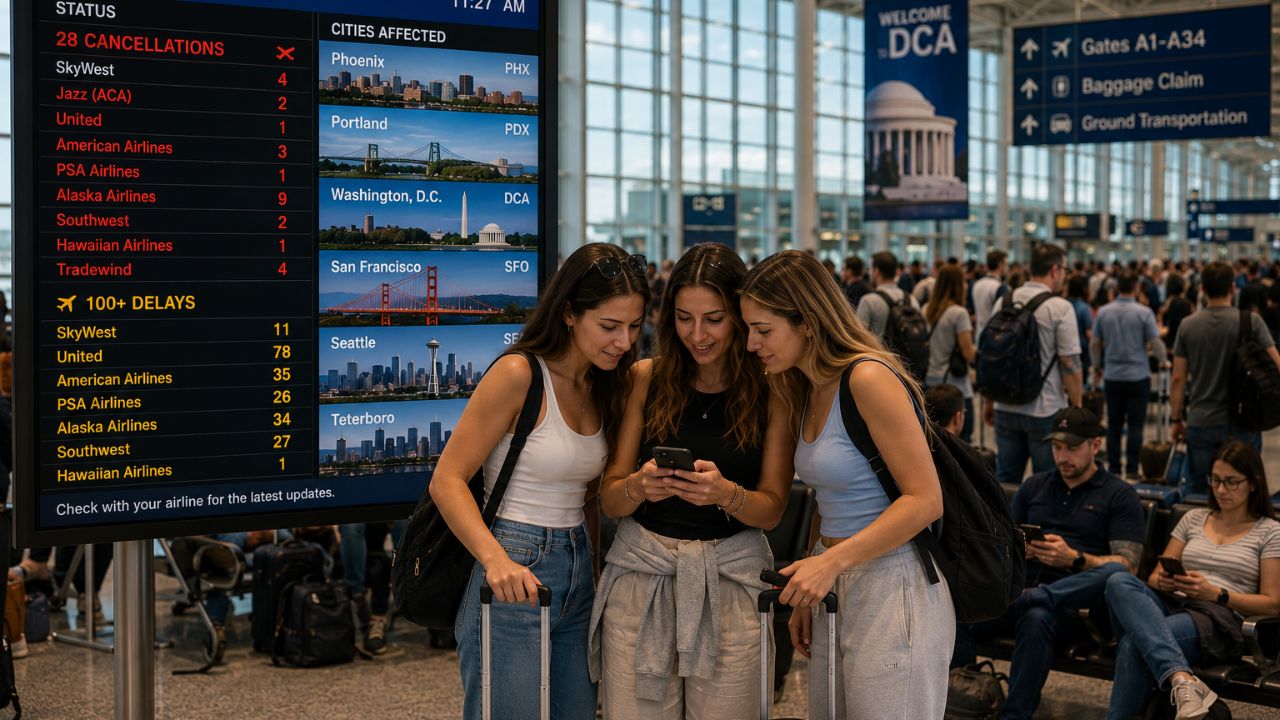
Image generated by AI
Aviation Updates: Sweeping Travel Chaos Grips US Airports as SkyWest, United, and Alaska Airlines Grapple with 128 Flight Cancellations and Delays
As systemic operational failures rapidly spread across the American aviation grid, thousands of furious passengers are currently stranded in heavily congested terminals from Seattle to Washington D.C., desperately fighting for limited rebooking options.
Image generated by AI
As high-impact airline news platforms rapidly issue continuous aviation updates regarding the intense volatility of the domestic transit network, a cascading operational collapse has just struck multiple critical US hubs. A devastating wave of severe airport disruptions is currently sweeping across the nation, resulting in 28 outright flight cancellations and over 100 massive flight delays. This highly disruptive logistical failure has instantly crippled vital routes stretching across Phoenix, Portland, Washington, D.C., San Francisco, Seattle, and Teterboro. The systemic failure has absolutely devastated operations for both major legacy carriers and regional affiliates, including SkyWest, Jazz, United, American Airlines, PSA, Alaska Airlines, and Southwest. With primary domestic corridors completely severed, thousands of business travelers and connecting tourists have been violently thrust into a sudden wave of nationwide travel chaos, exposing how quickly regional friction can completely corrupt the broader American aviation system.
Expanded Overview: The Scale of the Nationwide Gridlock
To fully comprehend the sheer logistical damage caused by these delays, aviation strategists must examine the geographical spread of the affected airports.
These massive flight disruptions are not isolated to a single, localized weather event; they are aggressively spread across six major US airports, each serving as a critical nexus for regional and transcontinental travel. On the West Coast, San Francisco International Airport and Seattle–Tacoma International Airport are currently choking on delayed passenger traffic. In the Pacific Northwest, Portland International Airport is suffering severe scheduling setbacks, while the desert hub of Phoenix Sky Harbor battles regional cancellations. Moving east, Reagan National Airport is experiencing massive delays in the capital region, and Teterboro Airport in New Jersey is seeing outright cancellations for premium business routes. Because these hubs form the absolute backbone linking major American business centers, this widespread disruption is actively destroying thousands of connecting itineraries nationwide.
Section-Wise Breakdown: The West Coast Collapse
A forensic analysis of the FlightAware telemetry reveals that the West Coast bore the absolute brunt of the outright flight cancellations.
Seattle–Tacoma International Airport recorded the highest absolute number of route failures, entirely driven by Alaska Airlines, which suffered a devastating 7 outright cancellations alongside 30 severe delays. Further south, San Francisco International Airport descended into absolute gridlock. The hub recorded six total canceled flights—two from Alaska Airlines, two from Southwest, one from United, and one from Hawaiian Airlines. However, the true damage in San Francisco was the delay volume: United Airlines alone recorded a staggering 74 delayed flights out of SFO, completely paralyzing its Pacific operations. In Oregon, Portland International Airport experienced three cancellations, with Jazz (Air Canada Express) dropping two flights and United dropping one.
Section-Wise Breakdown: Desert Friction and Capital Gridlock
While the West Coast struggled with outright route failures, airports in the Southwest and along the Eastern Seaboard battled a massive surge in delayed departures.
In the Southwest, Phoenix Sky Harbor International Airport was severely impacted by regional carrier friction, where SkyWest was forced to execute four outright cancellations and 11 delays, severely compromising feeder traffic. Meanwhile, in Arlington, Virginia, Reagan National Airport (DCA) suffered massive schedule degradation. American Airlines executed three cancellations alongside 35 massive delays, while its regional affiliate, PSA Airlines, dropped one flight and delayed 26 others, completely severing critical East Coast business routes. Finally, Teterboro Airport—a vital hub for private and business aviation near New York City—reported four canceled flights, all exclusively operated by Tradewind.
Flight Details: Verified Nationwide Route Disruption Matrix
To fully comprehend the exact volume of delayed and canceled flights originating from each specific hub during this national crisis, the verified operational telemetry has been consolidated into the mandatory matrix below.
| Airport | Airline | Cancelled | Delayed |
|---|---|---|---|
| Phoenix Sky Harbor International Airport | SkyWest | 4 | 11 |
| Portland International Airport | Jazz (ACA) | 2 | 0 |
| Portland International Airport | United | 1 | 4 |
| Reagan National Airport | American Airlines | 3 | 35 |
| Reagan National Airport | PSA Airlines (AAL) | 1 | 26 |
| San Francisco International Airport | Alaska Airlines | 2 | 4 |
| San Francisco International Airport | Southwest | 2 | 27 |
| San Francisco International Airport | United | 1 | 74 |
| San Francisco International Airport | Hawaiian Airlines | 1 | 1 |
| Seattle–Tacoma International Airport | Alaska Airlines | 7 | 30 |
| Teterboro Airport | Tradewind | 4 | 0 |
Passenger Impact: Navigating Terminal Frustration
For the thousands of passengers physically trapped inside these heavily congested American terminals, surviving this massive gridlock requires immediate, aggressive action.
Travelers completely stranded by these 28 cancellations are legally entitled to prompt rebooking or full cash refunds under updated US Department of Transportation (DOT) guidelines. Passengers are explicitly instructed to monitor airline notifications relentlessly via their mobile applications, allowing them to secure rebooking options before massive physical queues form at customer service desks. If a flight is canceled, travelers must act instantly: use the airline's mobile app, call the customer service hotline, and stand in the physical line simultaneously. The fastest method wins. If the disruption is deemed controllable by the airline, passengers must aggressively advocate for meal vouchers and potential hotel accommodations if forced into an unexpected overnight stay.
Industry Analysis: The Cascading Ripple Effect
From a macro-logistical perspective, resolving a disruption spread across six massively distinct geographical hubs requires intense recovery protocols from airlines like United, American, and Alaska.
The sheer volume of delayed services—specifically the 74 United delays in SFO and the 61 combined American/PSA delays at Reagan National—creates a unique operational nightmare. When aircraft are delayed at these massive fortress hubs, the disruption instantly generates a cascading ripple effect. Planes arrive late to their next destination, forcing flight crews to time-out of their legally mandated duty shifts, which subsequently causes even more flights to be delayed later in the evening. During this highly volatile recovery phase, passengers are explicitly instructed to maintain extreme flexibility, heavily monitor the physical location of their inbound aircraft, and arrive at the airport with massive amounts of extra time to survive heavily congested TSA security checkpoints.
Conclusion: A Systemic Vulnerability
Ultimately, this unprecedented wave of operational friction across six major American airports serves as a terrifying warning regarding the extreme fragility of the US aviation grid. With major carriers like SkyWest, United, American Airlines, Alaska Airlines, and Southwest caught in a massive web of over 100 severe delays and 28 outright cancellations, the resulting travel chaos completely paralyzed vital domestic corridors from Seattle to Washington, D.C. As compounding logistical failures continue to trigger massive airport disruptions and sudden flight cancellations nationwide, it is abundantly clear that passengers must fiercely advocate for themselves. By understanding their passenger rights, actively monitoring their inbound aircraft, and acting instantly when cancellations strike, travelers can attempt to mitigate the massive physical and financial devastation that inevitably follows a regional terminal meltdown.
Key Takeaways
- Widespread National Gridlock: Six major US airports collectively suffered a staggering wave of 28 flight cancellations and over 100 severe flight delays.
- West Coast Devastation: Seattle-Tacoma suffered 7 cancellations (all Alaska Airlines), while San Francisco battled 6 cancellations and a massive 74 delays from United Airlines alone.
- Capital Region Friction: Reagan National Airport suffered severe schedule degradation, with American Airlines and PSA Airlines combining for 4 cancellations and 61 delays.
- Regional Affiliates Impacted: Regional operators like SkyWest (Phoenix), Jazz (Portland), and Tradewind (Teterboro) all suffered outright route failures.
- Passenger Action Required: Stranded travelers must actively demand their rights under DOT regulations, utilizing mobile apps to secure rapid rebooking before terminal lines overwhelm customer service desks.
FAQ: Nationwide US Airport Flight Disruptions
How many flights were canceled across the US in this specific disruption? The latest operational data confirmed 28 outright flight cancellations alongside more than 100 severe delays spread across six major US airports.
Which airport suffered the highest number of cancellations? Seattle-Tacoma International Airport recorded the highest absolute number of route failures, with Alaska Airlines canceling seven flights. San Francisco International was a close second with six total cancellations across multiple carriers.
Which airlines experienced the most significant delays? United Airlines recorded a massive 74 delayed flights out of San Francisco. At Reagan National, American Airlines and its affiliate PSA Airlines combined for 61 severe delays.
What should I do if my flight is canceled during this disruption? Act immediately. Monitor your airline's app for automatic rebooking options, contact customer service via phone, and familiarize yourself with US Department of Transportation (DOT) guidelines regarding mandatory assistance, potential hotel accommodations, and cash refunds.
Related Travel Guides
Washington Dulles Airport 32 Delays Frontier Lufthansa Travel Chaos 2026
Fort Lauderdale Airport 59 Delays Spirit JetBlue Travel Chaos 2026
North America Regional Flight Disruption Survival Guide 2026
Disclaimer: This article is strictly for informational and aviation safety analysis purposes. The specific operational telemetry (28 cancellations, 100+ delays), affected airports (Seattle, SFO, DCA, etc.), and affected carriers (United, Alaska, American, etc.) are based on verified flight tracking data from FlightAware available at the time of publication. American airspace conditions, ATC congestion, and specific airline schedules are highly dynamic and subject to immediate, unannounced modification by Air Traffic Control or the operating carrier. Passengers traveling through the affected US airports should explicitly prepare for potential severe delays, aggressively monitor their airline's mobile application for physical inbound aircraft tracking, and verify their exact compensation eligibility directly with their airline prior to departure.
Disclaimer
This article is for informational and educational purposes only. It does not constitute legal, financial, or professional advice. While we strive to provide accurate and up-to-date information, travel policies, regulations, and conditions change rapidly. Always verify information with official sources before making travel decisions. Nomad Lawyer makes no representations about the accuracy, reliability, completeness, or suitability of the information provided. Readers should consult qualified professionals for advice specific to their circumstances. The views expressed in this article are those of the author and do not necessarily reflect the views of Nomad Lawyer.
Raushan Kumar
Founder & Lead Developer
Full-stack developer with 11+ years of experience and a passionate traveller. Raushan built Nomad Lawyer from the ground up with a vision to create the best travel and law experience on the web.
Learn more about our team →