
Aviation Updates: Massive Travel Chaos Engulfs America as Southwest Airlines and Orlando Face 2,996 Delays
As catastrophic severe weather severely paralyzes major transit grids, a brutal wave of 2,996 delays triggers widespread travel chaos across the United States, devastating Southwest Airlines.

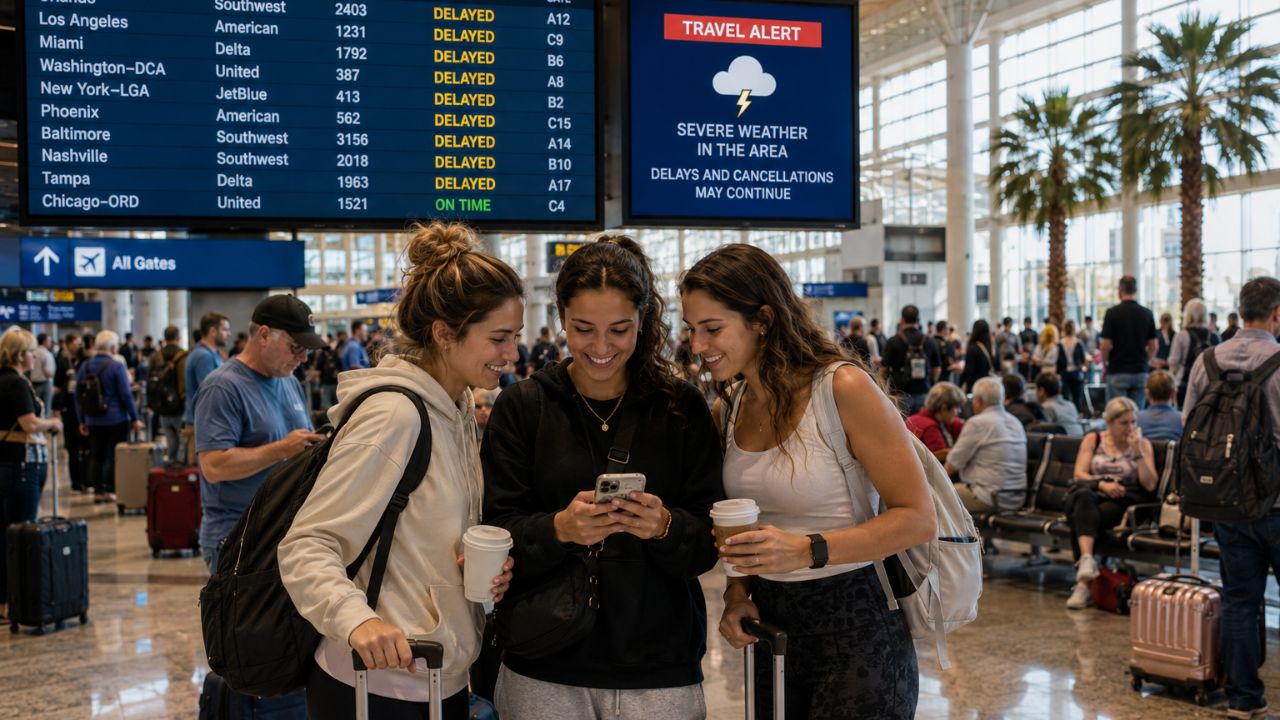
Image generated by AI
Aviation Updates: Massive Travel Chaos Engulfs America as Southwest Airlines and Orlando Face 2,996 Delays
As extreme operational friction and suddenly compounding severe weather bottlenecks continue to terrorize standard travel itineraries, a massive aviation crisis has violently triggered cascading schedule disruptions across Florida, California, Tennessee, and Arizona, paralyzing the United States.
Image generated by AI
As high-impact airline news platforms rapidly issue continuous, grim aviation updates regarding the intense fragility of massively congested primary transit grids, a severe logistical meltdown is actively rocking the American homeland. Amidst widespread rolling travel chaos and severe airport disruptions, a devastating wave of 2,996 scheduled flight delays and 90 outright flight cancellations violently slammed into global aviation today. Massive thunderstorms recently ripped through highly critical flight paths, completely shattering the baseline scheduling buffers across the domestic network. As critical domestic corridors violently backed up, major carriers including Southwest, Hawaiian, SkyWest, PSA, JetBlue, and United were forced to aggressively scramble, subjecting exhausted travelers to grueling terminal waits and entirely upending premium corporate and leisure itineraries.
Expanded Overview: The Collapse of Frictionless Transit
To fully comprehend the sheer scale of this severe network degradation, commercial aviation analysts must closely examine how rapidly localized scheduling friction violently reshapes continental hub-and-spoke connectivity.
The massive disruption pattern actively terrorizing the US grid is primarily defined by high-volume scheduling friction affecting absolutely critical domestic transfer routes. Severe storm cells explicitly targeted major regional hubs in Florida, California, Tennessee, and Arizona hardest. Because of these persistent ground halts, airport terminals are filling up incredibly fast. The exceptionally high delay-to-cancellation ratio actively suggests that airlines are desperately attempting to maintain schedules, but severe operational bottlenecks are violently slowing turnaround times. Consequently, thousands of travelers actively face massive, terrifying disruptions as critical hubs frantically struggle to safely manage the rapidly mounting chaos, heavily forcing desperate flyers into overcrowded, chaotic terminals.
Section-Wise Breakdown: The Continental Bottleneck
Terminal operations are violently degrading across the entire United States, forcing major legacy and low-cost operators to furiously deploy rolling delays to strictly ensure passengers are not totally stranded overnight.
The Florida Epicenter: An analysis of the raw telemetry completely reveals that the state of Florida was the absolute epicenter of today’s severe travel disruptions. Orlando International Airport (MCO) topped the list as the most heavily impacted hub in the nation, registering 18 cancellations and 324 delays. Thunderstorms directly triggered a formal Ground Delay at MCO, violently resulting in an average delay of 89 minutes for incoming traffic, while departure delays averaged 30 minutes and continued to massively increase. Miami International Airport (MIA) followed incredibly closely behind in total cancellations with 11, alongside 108 delays. Further west, Tampa International Airport (TPA) managed to escape the worst but still recorded 2 cancellations and 21 delays.
Coast-to-Coast Gridlock: Beyond Florida, major metropolitan areas faced severe cascading effects. On the West Coast, Los Angeles International Airport (LAX) saw massive congestion, racking up 158 delays and 5 cancellations. The Northeast corridor also severely suffered, with LaGuardia (LGA) reporting 94 delays (4 cancellations) and Reagan National (DCA) seeing 102 delays (7 cancellations). Baltimore/Washington International (BWI) added another 74 delays (4 cancellations). In the Southwest, Phoenix Sky Harbor International (PHX) dealt with 93 delayed flights (5 cancellations), while Nashville International (BNA) rounded out the major disruptions with 69 delays (5 cancellations).
Disruption Details: Verified United States Delay Matrix
To ensure stranded passengers and commercial aviation analysts can accurately track the incredibly precise operational telemetry of this massive network slowdown, the verified structural data has been consolidated into the exact, mandatory matrix below.
| Airport / Carrier | Verified Delays | Cancellations | Total Disrupted |
|---|---|---|---|
| Southwest Airlines | 596 | 15 | 611 |
| American Airlines | 465 | 3 | 468 |
| Orlando Intl (MCO) | 324 | 18 | 342 |
| SkyWest Airlines | 248 | 8 | 256 |
| Delta Air Lines | 248 | 1 | 249 |
| United Airlines | 193 | 9 | 202 |
| Los Angeles Intl (LAX) | 158 | 5 | 163 |
| PSA Airlines (AAL) | 120 | 5 | 125 |
| Miami Intl (MIA) | 108 | 11 | 119 |
| JetBlue | 114 | 1 | 115 |
| Reagan National (DCA) | 102 | 7 | 109 |
| Frontier Airlines | 92 | 7 | 99 |
| LaGuardia (LGA) | 94 | 4 | 98 |
| Phoenix Sky Harbor (PHX) | 93 | 5 | 98 |
| Alaska Airlines | 75 | 5 | 80 |
| Baltimore/Wash (BWI) | 74 | 4 | 78 |
| Nashville Intl (BNA) | 69 | 5 | 74 |
| Envoy Air (AAL) | 38 | 5 | 43 |
| Horizon (ASA) | 29 | 2 | 31 |
| Tampa Intl (TPA) | 21 | 2 | 23 |
| Hawaiian Airlines | 8 | 2 | 10 |
(Source: FlightAware and Affected Airports)
Industry Analysis: The Macroeconomic Impact of Point-to-Point Vulnerability
Airline-level data explicitly confirms that specific routing architectures violently suffered during the storms. From an airline perspective, Southwest Airlines violently experienced the most severe disruptions by a incredibly wide margin, logging 15 cancellations and 596 delays (611 total disrupted flights). This incredibly heavy impact is largely tied directly to Southwest’s point-to-point network structure and its massive market presence in Florida hubs like Orlando and Tampa. When severe weather strikes a point-to-point network, the cascading delays severely trap aircraft on the tarmac and stall inbound rotations.
American Airlines also saw incredibly high delay volumes with 465 delayed flights, though it actively kept cancellations down to a mere 3. Legacy carriers Delta Air Lines (248 delays, 1 cancellation) and United Airlines (193 delays, 9 cancellations) faced notable, severe disruptions. Furthermore, regional feeder airlines like SkyWest (248 delays), PSA Airlines (120 delays), Envoy Air (38 delays), and Horizon (29 delays) massively magnified the structural strain on major airline networks. Ultra-low-cost carrier Frontier (92 delays, 7 cancellations) and boutique operators like JetBlue (114 delays), Alaska Airlines (75 delays), and Hawaiian Airlines (8 delays) all explicitly proved that the violent operational hurdles completely spanned the entire industry.
Passenger Impact: Protecting the Vacation Baseline
For the everyday premium domestic traveler and budget-conscious international vacationer, the immediate consequence of this massive structural slowdown directly translates to a monumental, highly verified spike in transit anxiety.
Under strict U.S. Department of Transportation (DOT) regulations, if an airline actively cancels your flight for any reason—including severe weather—and you violently choose not to travel on an alternative flight, you are absolutely entitled to a full cash refund to your original form of payment, strictly not just airline vouchers. However, because today’s primary massive disruptor is weather (thunderstorms), airlines are absolutely not required to provide complimentary hotel vouchers or meals for rolling delays, as weather is firmly classified as an uncontrollable event, completely leaving stranded passengers footing massive out-of-pocket bills.
Conclusion: A Network Stretched to the Limit
Ultimately, the aggressive, massive deployment of 2,996 delays and 90 cancellations actively marks a massively significant stress test of the American aviation system. Florida aggressively remains the epicenter, but brutal ripple effects are heavily visible across the West Coast, the Northeast corridor, and the massive Southwest transit hubs.
With both major legacy airlines and crucial regional feeders violently affected, the massive system-wide congestion heavily indicates that basic recovery will absolutely depend on highly coordinated capacity management. If your flight has been heavily delayed or cancelled, travelers must immediately use the airline’s mobile app to desperately look for alternative routing before physically approaching a heavily jammed customer service desk. Rebooking digitally is often significantly faster than waiting in physical airport lines as the immediate threat of sudden schedule modification heavily persists across the domestic grid.
Key Takeaways
- Massive Tactical Meltdown: Severe thunderstorms violently triggered 2,996 rolling delays and 90 total cancellations across the United States.
- Florida Hub Gridlock: Orlando International (MCO) and Miami International (MIA) actively suffered hundreds of delays each, severely paralyzing East Coast capacity.
- Carrier Collapse: Southwest Airlines violently shouldered the vast majority of the chaos due to its point-to-point network, suffering 596 massive delays.
- Regional Spillover: Massive transit hubs in Los Angeles, Washington D.C., Phoenix, and Nashville were heavily crippled by the cascading logistical failures.
- DOT Consumer Rights: Passengers whose flights are totally cancelled due to weather are legally entitled to a full cash refund if they choose not to fly, though hotels are not covered.
FAQ: US Flight Delays and Travel Chaos 2026
How many flights were cancelled in the US today? Despite fierce efforts to manage terminal traffic, commercial flight data confirms there were exactly 90 flight cancellations and a massive 2,996 delays.
Which airline had the most delays in the US today? Southwest Airlines violently recorded the highest volume by far, suffering 596 massive delays and 15 cancellations, closely followed by American Airlines.
Are flights delayed in Orlando and Miami? Yes, Florida was the absolute epicenter of the network spillover, completely crippling Orlando (324 delays, 18 cancellations) and Miami (108 delays, 11 cancellations).
Can I get a hotel voucher for a weather delay? Under DOT rules, because the primary disruptor is severe weather (thunderstorms), airlines are absolutely not required to provide complimentary hotel vouchers for delays.
Related Travel Guides
Asia Middle East Flight Delays China Eastern Travel Chaos 2026
Frontier Airlines Barclays Mastercard Loyalty Travel Chaos 2026
Newark Liberty Airport Delays United Airlines Travel Chaos 2026
Disclaimer: This article is strictly for informational and global aviation tracking purposes. The specific flight telemetry (2,996 total delays, 90 cancellations, specific airport data) is based on verified FlightAware and regional airport data available at the time of publication. National airspace capacity, specific airline scheduling optimizations, localized severe weather systems, and regional FAA ground stops are highly dynamic and subject to immediate modification by the operating authorities. Passengers holding active tickets should explicitly verify exact itineraries via official airline platforms and secure comprehensive travel insurance prior to departure.
Disclaimer
This article is for informational and educational purposes only. It does not constitute legal, financial, or professional advice. While we strive to provide accurate and up-to-date information, travel policies, regulations, and conditions change rapidly. Always verify information with official sources before making travel decisions. Nomad Lawyer makes no representations about the accuracy, reliability, completeness, or suitability of the information provided. Readers should consult qualified professionals for advice specific to their circumstances. The views expressed in this article are those of the author and do not necessarily reflect the views of Nomad Lawyer.
Raushan Kumar
Founder & Lead Developer
Full-stack developer with 11+ years of experience and a passionate traveller. Raushan built Nomad Lawyer from the ground up with a vision to create the best travel and law experience on the web.
Learn more about our team →