
Aviation Updates: Massive Flight Cancellations Rock US Hubs as American, Southwest, and Delta Trigger Nationwide Travel Chaos
As catastrophic logistical bottlenecks severely paralyze massive US transit grids, over 2,100 flight disruptions trigger widespread travel chaos across Chicago, LAX, Miami, and New York.

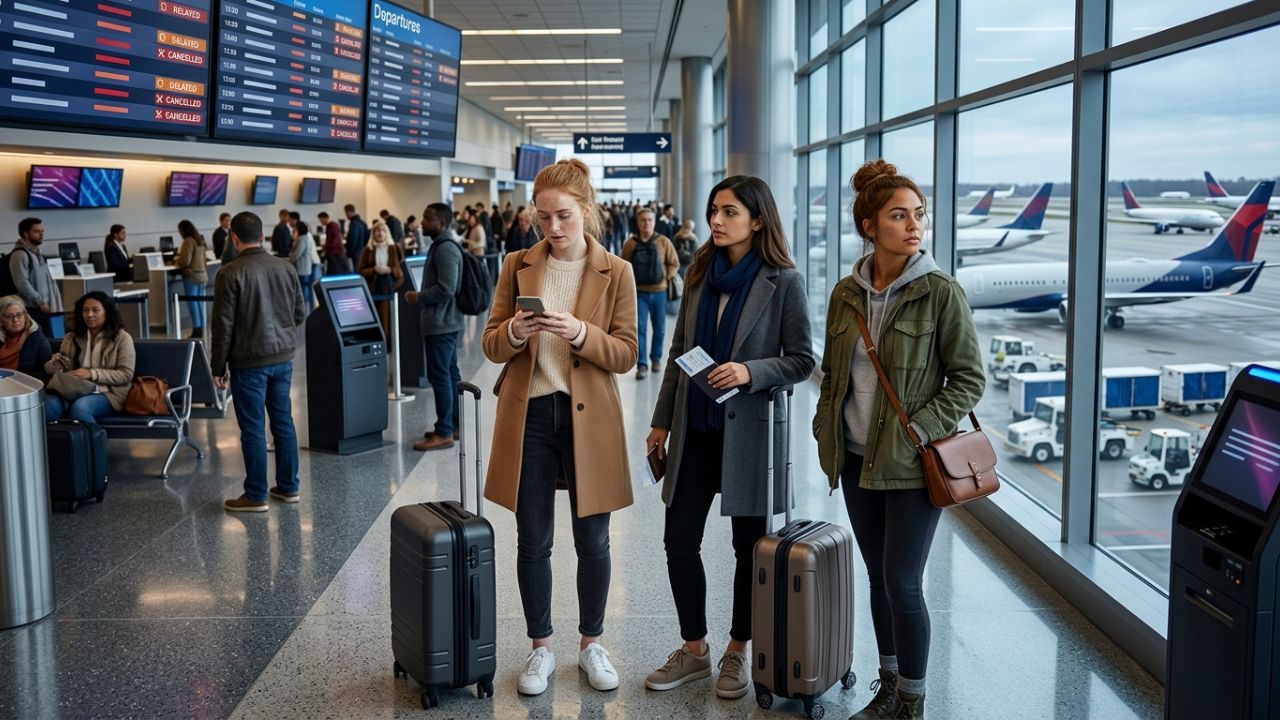
Image generated by AI
Aviation Updates: Massive Flight Cancellations Rock US Hubs as American, Southwest, and Delta Trigger Nationwide Travel Chaos
As extreme operational friction and suddenly compounding infrastructure bottlenecks continue to terrorize standard travel itineraries across the United States, a massive system failure across primary domestic aviation hubs has violently triggered cascading flight delays nationwide.
Image generated by AI
As high-impact airline news platforms rapidly issue continuous, grim aviation updates regarding the intense fragility of massively congested primary transit grids, a catastrophic operational meltdown is directly striking the United States aviation network. Amidst widespread rolling travel chaos, severe airport disruptions, and devastatingly frequent flight cancellations severely plaguing heavily overcrowded national hubs, hundreds of thousands of domestic and international travelers are currently facing extreme uncertainty. Major aviation gateways across Chicago, Los Angeles, Miami, New York, San Francisco, and Puerto Rico are actively reporting critical operational strain. The massive gridlock has forcefully triggered the immediate cancellation of 57 flights while actively delaying an astonishing 2,057 flights. This massive, system-wide failure explicitly reflects extreme pressure on airport capacity and highly degraded air traffic coordination, leaving flagship carriers like Delta, SkyWest, Frontier, United, and American Airlines violently struggling to maintain baseline schedule integrity.
Expanded Overview: The Collapse of Domestic Sequencing
To fully comprehend the sheer scale of this catastrophic network degradation, aviation analysts must closely examine how rapidly highly localized operational bottlenecks violently reshape national air traffic flow and hub-and-spoke connectivity.
The massive disruption pattern actively terrorizing the US network is primarily defined by severe air traffic flow constraints within high-density corridors, sudden runway configuration adjustments forcefully impacting arrival sequencing, and brutal ground delay programs aggressively instituted across major West Coast hubs. The staggering volume of 2,057 total delays strongly indicates a massive network-wide efficiency collapse rather than an isolated weather incident. Even secondary airports with relatively low cancellation counts are aggressively experiencing rising delay averages, proving that the disruption is actively evolving and violently spreading across connected regional networks. Consequently, stranded passengers continue to face an agonizing barrage of missed connections, degraded customer service, and extreme terminal wait times.
Section-Wise Breakdown: The Meltdown of Major US Airports
Terminal operations are violently degrading as heavily congested US airports furiously attempt to optimize massive backlogs of severely delayed aircraft.
Chicago O’Hare International Airport (ORD): Chicago remains the absolute epicenter of the crisis, brutally recording 141 delays and 4 cancellations. As one of the world's most critical transit hubs, ORD is aggressively experiencing massive, systemic strain on its runway capacity and airspace sequencing, indicating a highly sustained failure in departure flow management.
Los Angeles International Airport (LAX): The primary transcontinental gateway is reporting a devastating 91 delays and 3 cancellations. This massive operational congestion heavily highlights sustained ground and airside coordination failures, actively bleeding extreme delays directly into the heavily trafficked Pacific corridor.
Miami International Airport (MIA): Miami is suffering aggressive operational degradation, reporting 58 delays and 10 massive cancellations. This unusually high cancellation rate explicitly indicates that the airport is entirely failing to complete scheduled operations, driven by violent cascading schedule pressure across the Caribbean and South American inbound routes.
San Francisco (SFO) & LaGuardia (LGA): SFO is aggressively reporting extreme ground delay conditions averaging 48 brutal minutes due to airport-wide flow restrictions completely paralyzing departure sequencing. Simultaneously, LaGuardia is suffering compounding arrival delays averaging 15 minutes as extreme air traffic management friction in the ZDC airspace chokes inbound New York operations.
Tampa (TPA) & San Juan (SJU): Tampa reports 17 delays and 3 cancellations, signaling intense regional sensitivity. Meanwhile, Puerto Rico’s Luis Muñoz Marín International Airport reports 17 delays and 5 critical cancellations, violently severing vital Caribbean connectivity.
Flight Details: Verified Disruption Telemetry Matrices
To ensure stranded passengers and commercial aviation analysts can accurately track the incredibly precise operational telemetry of this massive network failure, the verified corporate data has been consolidated into the exact, mandatory matrices below.
Table 1: Airline Disruption Matrix
| Operational Metric | Verified Telemetry (Delays / Cancellations) |
|---|---|
| System-Wide Totals | 2,057 Delays / 57 Cancellations |
| American Airlines | 271 Delays / 1 Cancellation |
| Southwest Airlines | 228 Delays / 2 Cancellations |
| SkyWest | 149 Delays / 5 Cancellations |
| Delta Air Lines | 120 Delays / 1 Cancellation |
| United Airlines | 94 Delays / 5 Cancellations |
| JetBlue | 43 Delays / 1 Cancellation |
| Frontier Airlines | 38 Delays / 3 Cancellations |
| Alaska Airlines | 26 Delays / 2 Cancellations |
| Envoy Air (AAL) | 15 Delays / 5 Cancellations |
| Horizon Air (ASA) | 9 Delays / 2 Cancellations |
| Hawaiian Airlines | 3 Delays / 2 Cancellations |
Table 2: Airport Disruption Matrix
| Airport | Verified Telemetry (Delays / Cancellations) |
|---|---|
| Chicago O’Hare (ORD) | 141 Delays / 4 Cancellations |
| Los Angeles (LAX) | 91 Delays / 3 Cancellations |
| Miami (MIA) | 58 Delays / 10 Cancellations |
| San Francisco (SFO) | 48-Minute Ground Delays |
| LaGuardia (LGA) | 15+ Minute Arrival Delays (Increasing) |
| Tampa (TPA) | 17 Delays / 3 Cancellations |
| Luis Muñoz Marín (SJU) | 17 Delays / 5 Cancellations |
(Source: Flightaware and Affected Airports)
Industry Analysis: A System Under Siege
Air travel explicitly across the massive North American corridor continues to massively struggle, driven violently by incredibly fragile air traffic flow constraints and rigid hub-and-spoke scheduling architectures.
The data aggressively reveals that disruption is brutally concentrated among the massive legacy carriers. American Airlines (271 delays) and Southwest Airlines (228 delays) heavily account for a massive share of total national disruption, indicating intense, system-wide schedule stress. Furthermore, massive mid-level impacts are bleeding directly into regional feed carriers; SkyWest's 149 delays and 5 cancellations violently prove that when massive primary hubs like Chicago and LAX seize up, the critical regional networks that feed them immediately collapse.
Passenger Impact: The Threat of Stranded Itineraries
For the everyday premium domestic traveler and budget-conscious vacationer, the immediate consequence of this massive structural failure directly translates to a monumental, highly verified spike in national transit anxiety.
Travelers desperately attempting to navigate complex domestic itineraries frequently rely heavily on integrated booking options and highly coordinated schedules to survive the massive threat of sudden airport congestion. The violent severing of these ties means passengers must aggressively monitor dynamic delay durations via airline apps. Passengers routing through ORD, LAX, or MIA face the terrifying threat of unprotected missed connections, massive out-of-pocket accommodation costs, and severe disruption to highly sensitive corporate travel schedules.
Conclusion: A Network on the Brink
Ultimately, the aggressive, massive failure of over 2,100 flights actively marks a massively significant degradation in US aviation reliability. By violently exposing the extreme fragility of airspace sequencing and ground movement efficiency, this crisis heavily alters the immediate booking behavior of millions of passengers.
While airlines fiercely attempt to restore operational balance, the massive cascading effects will aggressively dictate schedule volatility for the next 48 hours. This massive operational collapse explicitly proves that modern US carriers remain terrifyingly vulnerable to compounding capacity bottlenecks, heavily leaving passengers to navigate the increasingly volatile, chaotic reality of modern domestic transit.
Key Takeaways
- Massive System Failure: Over 2,057 flights have been violently delayed and 57 cancelled across the United States.
- Epicenter Hubs: Chicago O’Hare (141 delays) and LAX (91 delays) are experiencing massive, sustained departure sequencing failures.
- Airline Collapse: American Airlines (271 delays) and Southwest (228 delays) are actively driving the highest volumes of national schedule instability.
- West Coast Gridlock: San Francisco is forcefully enforcing massive 48-minute ground delays, completely paralyzing regional movement.
- Regional Severance: Critical feed carriers like SkyWest (149 delays, 5 cancellations) are failing as primary hub backlogs violently cascade downward.
FAQ: US Aviation Meltdown July 2026
Which US airports are experiencing the worst delays? Chicago O’Hare (ORD) and Los Angeles International (LAX) are suffering the most massive delays, with 141 and 91 delayed flights respectively, alongside severe ground stops at San Francisco (SFO).
Which airlines are causing the most travel chaos? American Airlines and Southwest Airlines hold the highest delay burdens, violently accounting for nearly 500 combined delays. Delta, SkyWest, and United are also aggressively struggling.
What is causing these massive flight cancellations? The disruptions are violently driven by compounding air traffic flow constraints, severe runway configuration adjustments, and massive cascading delays across highly fragile hub-and-spoke airline networks.
What should I do if my flight is delayed at Miami or LaGuardia? Passengers must aggressively monitor airline apps, completely expect missed connections, and attempt proactive rebooking before arriving at the massively congested terminals.
Related Travel Guides
Aspen Banff Whistler Coolcation Travel Chaos 2026
London Heathrow Glasgow Airport Disruptions Travel Chaos 2026
United States Regional Tourism and Transit Survival Guide 2026
Disclaimer: This article is strictly for informational and aviation tracking purposes. The specific flight telemetry (2,057 delays, 57 cancellations) and airline performance metrics are based on verified FlightAware data available at the time of publication. National airspace conditions, specific airline scheduling optimizations, local airport ground stops, and FAA air traffic control regulations are highly dynamic and subject to immediate modification by the operating carriers and government authorities. Passengers holding tickets on American Airlines, Southwest, Delta, or any affected carrier should explicitly verify their exact flight itineraries via official airline platforms, and secure comprehensive travel insurance prior to departure.
Disclaimer
This article is for informational and educational purposes only. It does not constitute legal, financial, or professional advice. While we strive to provide accurate and up-to-date information, travel policies, regulations, and conditions change rapidly. Always verify information with official sources before making travel decisions. Nomad Lawyer makes no representations about the accuracy, reliability, completeness, or suitability of the information provided. Readers should consult qualified professionals for advice specific to their circumstances. The views expressed in this article are those of the author and do not necessarily reflect the views of Nomad Lawyer.
Kunal K Choudhary
Co-Founder & Contributor
A passionate traveller and tech enthusiast. Kunal contributes to the vision and growth of Nomad Lawyer, bringing fresh perspectives and driving the community forward.
Learn more about our team →