
Aviation Updates: Fort Lauderdale Plunged into Severe Travel Chaos as Spirit, JetBlue, and Avianca Grapple with 62 Flight Cancellations and Delays
As unexpected severe weather and air traffic control restrictions crush the South Florida transit grid, Fort Lauderdale Airport records 59 severe flight delays and 3 cancellations.

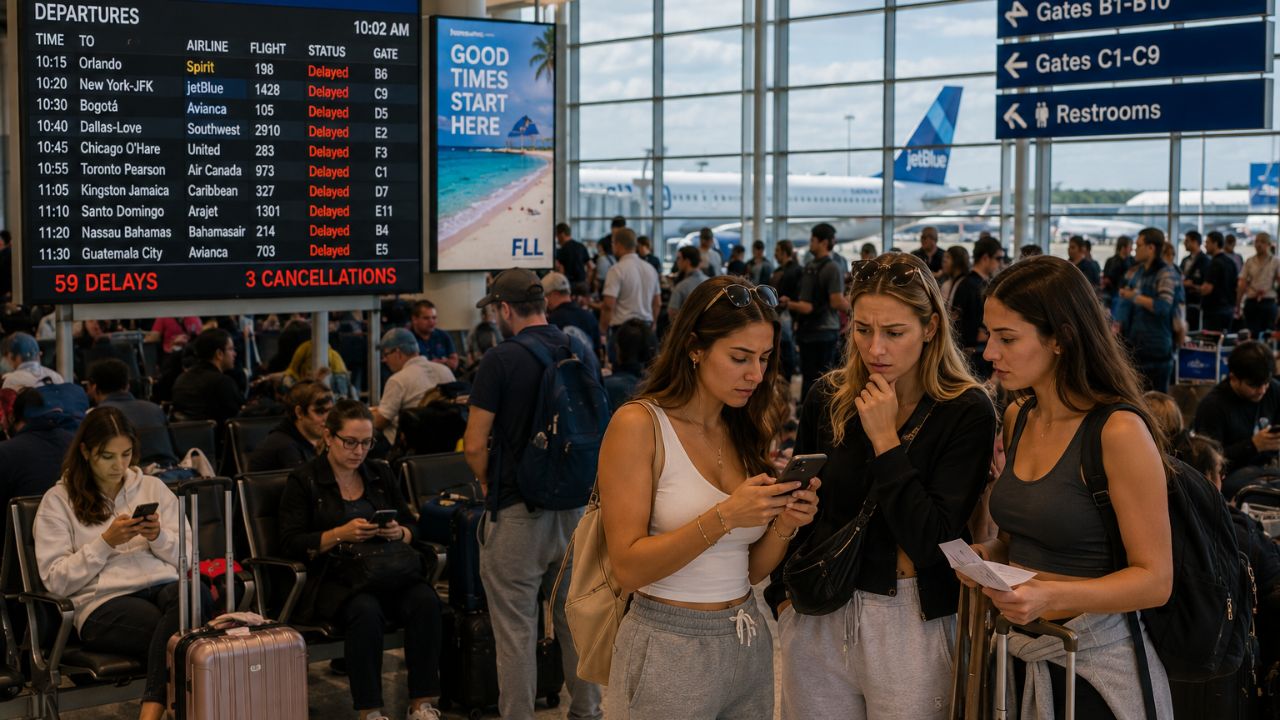
Image generated by AI
Aviation Updates: Fort Lauderdale Plunged into Severe Travel Chaos as Spirit, JetBlue, and Avianca Grapple with 62 Flight Cancellations and Delays
As unexpected severe weather fronts violently collide with sudden air traffic control restrictions, Fort Lauderdale International Airport descends into absolute operational gridlock, stranding thousands of furious passengers along the critical US East Coast corridor.
Image generated by AI
As high-impact airline news platforms rapidly disseminate critical aviation updates regarding the intense volatility of the American air transit grid, a massive operational collapse has just paralyzed South Florida. Fort Lauderdale International Airport (FLL)—an incredibly vital nexus connecting the United States to Latin America and the Caribbean—has been crushed by a devastating wave of severe airport disruptions. Throughout a highly volatile operational window, the airport recorded an unprecedented 59 severe flight delays alongside 3 outright flight cancellations. This systemic failure has instantly crippled both domestic and international operations for massive carriers including Spirit, JetBlue, Avianca, Southwest, and United Airlines. Because the Fort Lauderdale schedules are fiercely interconnected, these rapid ground stops instantly stranded furious passengers across the US, Canada, Colombia, Guatemala, Jamaica, the Dominican Republic, and the Bahamas. As terrified travelers overwhelm customer service counters, this massive wave of localized travel chaos serves as a brutal reminder of how quickly cascading delays can completely destroy the broader East Coast aviation network.
Expanded Overview: The Collapse of South Florida's Grid
To fully comprehend the sheer scale of this logistical disaster, aviation strategists must examine the cascading ripple effect striking the broader region.
The core root of today's massive gridlock at Fort Lauderdale stems from a terrifying combination of unexpected severe weather and sudden, aggressive air traffic control (ATC) restrictions. Because FLL acts as a primary operational base for carriers like Spirit and JetBlue, a disruption here instantly severs critical connectivity between the Mid-Atlantic, the US East Coast, and the entire Caribbean basin. When sudden ATC ground stops are initiated, aircraft cannot depart, inbound planes are forced into multi-hour holding patterns, and terminal crowding reaches extremely unsafe levels. As airline staff work tirelessly to rebook missed connections, the sheer volume of disrupted passengers across multiple countries proves that regional aviation is highly susceptible to total, unrecoverable operational collapse.
Section-Wise Breakdown: Outbound Flight Bottlenecks
A forensic analysis of the outbound FlightAware data reveals that critical domestic corridors bore the absolute brunt of the massive flight schedule failure.
Passengers departing Fort Lauderdale for the Maryland and Washington D.C. areas faced the most terrifying operational friction. The vital outbound route to Baltimore/Washington Intl (BWI) took a direct hit with 1 outright cancellation, instantly erasing 14% of its scheduled daily service. Meanwhile, severe delays were wildly widespread. Dallas-Fort Worth Intl (DFW) suffered 3 delays (compromising 30% of its volume), and Grand Bahama Int’l/Freeport (FPO) suffered 2 massive delays (66%). Unbelievably, several destinations experienced a catastrophic 100% delay rate on their scheduled outbound flights, including Atlantic City (ACY), Charleston (CHS), Wilmington (ILM), Long Island MacArthur (ISP), Concord-Padgett (JQF), and La Aurora in Guatemala (GUA). Single delays aggressively struck major hubs like Atlanta (ATL), Boston (BOS), Charlotte (CLT), New York (JFK), Chicago O'Hare (ORD), and Philadelphia (PHL).
Internationally, outbound travelers attempting to reach the Caribbean and Latin America were brutally impacted. Sangster Int’l in Jamaica (MBJ) and Jose Maria Cordova Int’l in Colombia (MDE) both suffered devastating 50% delay rates. Operations to the Bahamas were severely crippled, with Marsh Harbour (MHH), North Eleuthera (ELH), and Nassau (NAS) all recording significant outbound friction.
Section-Wise Breakdown: Inbound Flight Gridlock
The inbound arrival telemetry tells a similarly terrifying story, proving that the ATC restrictions created a massive blockade preventing aircraft from entering Florida.
Inbound flights originating from the capital region suffered the worst outright failures. Incoming flights from Washington Dulles Intl (IAD) suffered 1 total cancellation (a massive 33% route failure), while flights from Baltimore (BWI) also saw 1 cancellation (14%). Regarding sheer volume, New York's LaGuardia (LGA) recorded the highest inbound delay count, suffering 3 severely delayed flights (23% of its inbound volume). Dallas-Fort Worth (DFW) and Philadelphia (PHL) each recorded 2 delayed arrivals into Fort Lauderdale (20% of their schedules).
Mirroring the outbound collapse, a devastating 100% inbound delay rate was recorded for aircraft arriving from Charleston (CHS), Greenville/Spartanburg (GSP), Concord-Padgett (JQF), Las Americas in the Dominican Republic (SDQ), and Guatemala (GUA). Other major inbound delays crippled traffic from Austin (AUS), Boston (BOS), Los Angeles (LAX), and Raleigh-Durham (RDU). Furthermore, critical international arrivals from Toronto Pearson (YYZ), Jamaica (MBJ), Colombia (MDE), and the Bahamas (ELH, RSD, FPO) were all significantly delayed.
Flight Details: Fort Lauderdale (FLL) Severe Route Disruption Matrix
To fully comprehend the most severely affected routes during this operational collapse, the verified FlightAware disruption telemetry has been consolidated into the mandatory matrix below.
| Disrupted Route Category | Verified Delay/Cancellation Data |
|---|---|
| Outbound Cancellations | Baltimore/Washington (BWI) - 1 Cancel (14%) |
| Outbound Delays (Highest Vol) | Dallas-Fort Worth (DFW) - 3 Delays (30%) |
| Outbound 100% Delay Rate | ACY, CHS, ILM, ISP, JQF, GUA |
| Inbound Cancellations | Washington Dulles (IAD) - 1 Cancel (33%), BWI - 1 Cancel (14%) |
| Inbound Delays (Highest Vol) | LaGuardia (LGA) - 3 Delays (23%) |
| Inbound 100% Delay Rate | CHS, GSP, JQF, SDQ, GUA |
Passenger Impact: Navigating Terminal Frustration
For the thousands of passengers trapped inside FLL's heavily congested terminals, surviving this massive gridlock requires immediate, aggressive action.
Travelers booked on the canceled BWI or IAD routes must legally demand rebooking immediately. Passengers are strongly advised to physically queue at the customer service desk while simultaneously utilizing their airline's mobile app or calling direct support lines to secure the fastest resolution. Crucially, travelers must fiercely advocate for their protections under US Department of Transportation (DOT) guidelines. Depending on whether the airline classifies the cause of these 59 delays and 3 cancellations as controllable operational failures or uncontrollable severe weather, stranded passengers may be legally entitled to meal vouchers, paid hotel accommodations, or a full cash refund if they aggressively refuse to travel on a significantly disrupted itinerary.
Industry Analysis: The Cascading East Coast Ripple Effect
From a macro-logistical perspective, resolving a 62-flight disruption requires massive, highly aggressive recovery protocols from airlines like Spirit, JetBlue, and Southwest.
When severe weather merges with ATC ground stops in South Florida, the resulting bottleneck instantly generates a massive cascading ripple effect up the entire East Coast. Aircraft trapped in Fort Lauderdale cannot physically operate their subsequent legs in Baltimore, New York, or Boston. Passengers are explicitly instructed to relentlessly monitor the physical location of their inbound aircraft using flight tracking tools. If the inbound plane has not taken off from its origin city, the flight will absolutely not board on time at Fort Lauderdale, regardless of what the terminal departure screens indicate.
Conclusion: A Systemic Vulnerability
Ultimately, the unprecedented operational collapse at Fort Lauderdale International Airport serves as a terrifying warning regarding the extreme fragility of the US aviation grid. With major carriers like Spirit, JetBlue, Avianca, Southwest, and United caught in a massive web of 59 severe delays and 3 outright cancellations, the resulting travel chaos completely paralyzed South Florida. As unpredictable weather and complex ATC restrictions continue to trigger massive airport disruptions and sudden flight cancellations, it is abundantly clear that passengers must fiercely advocate for themselves. By understanding their DOT rights, aggressively monitoring physical inbound aircraft movements, and acting instantly when cancellations strike the BWI or IAD routes, travelers can attempt to mitigate the massive physical and financial devastation that inevitably follows a total airport meltdown.
Key Takeaways
- Massive Operational Collapse: Fort Lauderdale International Airport (FLL) suffered a staggering 59 flight delays and 3 flight cancellations, devastating its daily operations.
- Global Airlines Affected: The disruptions paralyzed major carriers including Spirit, JetBlue, Avianca, Southwest, and United Airlines.
- Severe Route Failures: The BWI and IAD routes suffered outright cancellations, while flights to/from DFW, LGA, ACY, CHS, GUA, and SDQ suffered massive volume delays or 100% delay rates.
- Passenger Rights: Stranded travelers must fiercely advocate for US Department of Transportation (DOT) protections, which may include meal vouchers, hotels, or cash refunds depending on the delay's official cause.
- Aggressive Tracking Needed: Passengers are urged to ignore inaccurate terminal screens and directly track their inbound aircraft using third-party apps to determine their actual boarding timeline.
FAQ: Fort Lauderdale Airport Flight Disruptions
How many flights were affected at Fort Lauderdale Airport today? The airport recorded a massive disruption consisting of 59 severe flight delays and 3 outright flight cancellations due to severe weather and sudden ATC restrictions.
Which airlines and international destinations were impacted? Major carriers including Spirit, JetBlue, Avianca, Southwest, and United were all affected. The delays destroyed schedules for flights connected to the US, Canada, Colombia, Guatemala, Jamaica, the Dominican Republic, and the Bahamas.
Which specific routes were completely canceled? The inbound route from Washington Dulles (IAD) suffered 1 cancellation, and the route to/from Baltimore/Washington (BWI) suffered 1 outbound and 1 inbound cancellation.
What should I do if my flight is canceled or severely delayed? Act immediately. Attempt to rebook via the airline's mobile app or customer service line while waiting for the physical desk. Review DOT guidelines to determine if you are legally entitled to meal vouchers, hotel accommodations, or a full cash refund for the disruption.
Related Travel Guides
Copenhagen Airport 203 Delays SAS Lufthansa Travel Chaos 2026
North America Regional Flight Disruption Survival Guide 2026
Southwest WN1693 Denver Richmond Diversion Travel Chaos 2026
Disclaimer: This article is strictly for informational and aviation safety analysis purposes. The specific operational telemetry (59 delays, 3 cancellations), affected airlines (Spirit, JetBlue, Southwest, etc.), and route disruption percentages (BWI 14% canceled, DFW 30% delayed) are based on verified flight tracking data from FlightAware available at the time of publication. American airspace conditions, ATC ground stops, and specific airline schedules are highly dynamic and subject to immediate, unannounced modification by Air Traffic Control or the operating carrier. Passengers traveling through Fort Lauderdale International Airport (FLL) should explicitly prepare for potential severe delays, aggressively monitor their physical inbound aircraft, and verify their exact compensation eligibility directly with their airline prior to departure.
Disclaimer
This article is for informational and educational purposes only. It does not constitute legal, financial, or professional advice. While we strive to provide accurate and up-to-date information, travel policies, regulations, and conditions change rapidly. Always verify information with official sources before making travel decisions. Nomad Lawyer makes no representations about the accuracy, reliability, completeness, or suitability of the information provided. Readers should consult qualified professionals for advice specific to their circumstances. The views expressed in this article are those of the author and do not necessarily reflect the views of Nomad Lawyer.
Preeti Gunjan
Contributor & Community Manager
A passionate traveller and community builder. Preeti helps grow the Nomad Lawyer community, fostering engagement and bringing the reader experience to life.
Learn more about our team →