
Aviation Updates: Seattle-Tacoma International Airport Engulfed in Travel Chaos as 80 Flight Delays and 3 Cancellations Hit Alaska Airlines, Delta Air Lines, United Airlines and American Airlines on Routes to Los Angeles, San Francisco, New York, Vancouver, Tokyo and Seoul
Seattle-Tacoma International Airport (SEA) recorded 80 flight delays and 3 cancellations on June 25, 2026, disrupting Alaska Airlines, Delta Air Lines, United Airlines, American Airlines, and additional carriers across domestic and international routes to Los Angeles, San Francisco, New York, Vancouver, Tokyo, and Seoul.

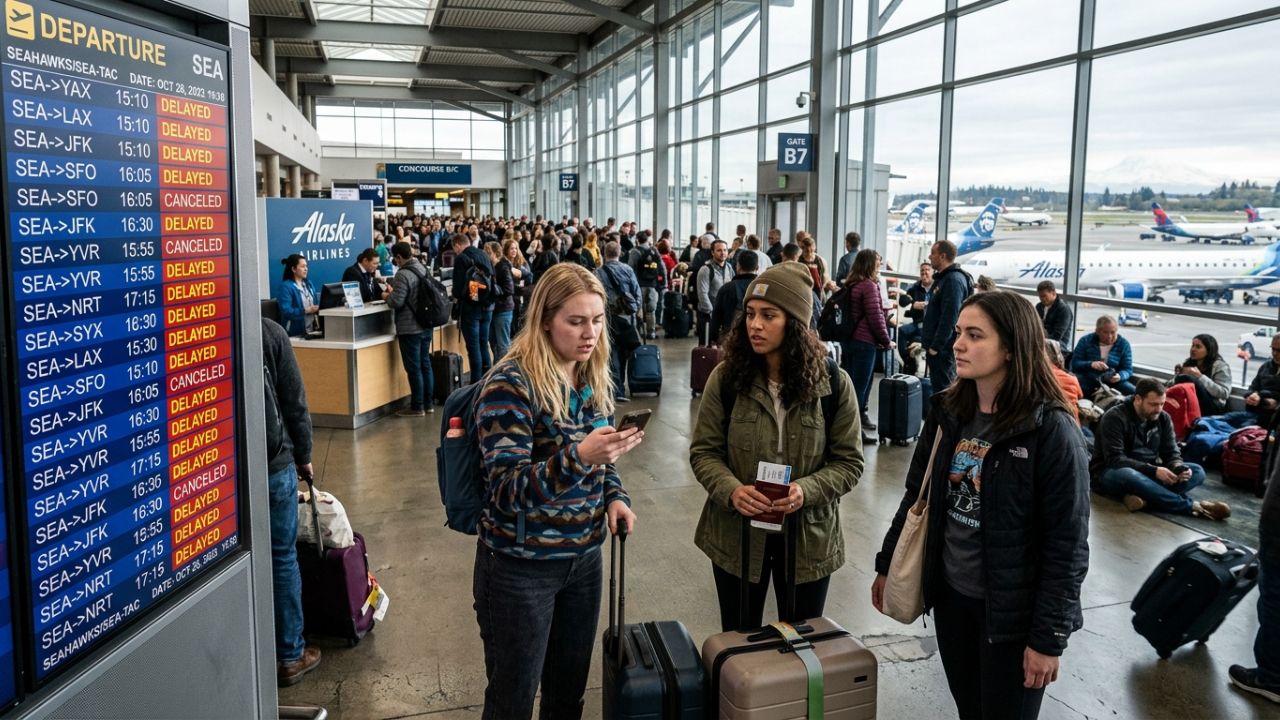
Image generated by AI
Aviation Updates: Seattle-Tacoma International Airport Engulfed in Travel Chaos as 80 Flight Delays and 3 Cancellations Hit Alaska Airlines, Delta Air Lines, United Airlines and American Airlines on Routes to Los Angeles, San Francisco, New York, Vancouver, Tokyo and Seoul
From the departure boards of one of the Pacific Northwest's most strategically vital aviation hubs, a familiar and deeply frustrating story played out on June 25, 2026 — not of catastrophic failure, but of the grinding, accumulative pressure of a modern hub airport operating at maximum capacity with no margin left to absorb the ordinary friction of daily operations.
Breaking airline news confirmed by real-time operational tracking data reveals that Seattle-Tacoma International Airport (SEA) experienced a significant and wide-reaching day of travel chaos on June 25, 2026, with the airport's flight operations network recording a total of 80 flight delays and 3 flight cancellations across its full service cycle. The disruption struck the core of one of America's most important Pacific Rim aviation gateways — a hub whose operational health directly affects connectivity not just within the United States, but across the dense transpacific corridors linking the Pacific Northwest to Tokyo and Seoul, and the cross-border routes connecting Seattle to Vancouver and the broader Canadian network.
Major carriers operating through SeaTac — including Alaska Airlines, which operates the airport as its primary home hub, alongside Delta Air Lines, United Airlines, American Airlines, and additional domestic and international operators — found their scheduled operations compressed and disrupted throughout the day. Passengers targeting Los Angeles, San Francisco, New York, Vancouver, Tokyo, and Seoul were among the most immediately affected, their itineraries stretching well beyond their original departure windows as airport disruptions cascaded through gate assignments, crew rotations, and downstream connection schedules across the national and international network.
Expanded Overview: The Anatomy of a SeaTac Disruption Day
For an airport that handles more than 50 million passengers annually and sits at the geographic intersection of domestic US aviation and Pacific Rim international routes, the operational consequences of a high-volume delay day are never contained within the immediate terminal environment. Seattle-Tacoma International Airport functions simultaneously as Alaska Airlines' home hub, a major Pacific gateway for United Airlines and Delta Air Lines, and a critical North American waypoint for transpacific operations connecting the US West Coast to Northeast Asia. When any of these overlapping operational layers encounters significant schedule compression on the same day, the resulting cascade is both broad and deep.
The 80 delays recorded on June 25 reflect precisely this layered impact. Aircraft returning late from morning Los Angeles or San Francisco turns could not begin their afternoon eastbound departures to New York on schedule. Transpacific arrivals from Tokyo or Seoul — carrying passengers whose biological clocks registered the previous day's dawn — disgorged into a terminal already backlogged from morning delay accumulation, and then had to be cleaned, fueled, and restocked against compressed turnaround timelines before they could depart again. At every stage of that cycle, the absence of schedule buffer — the structural consequence of near-maximum utilization — meant that each individual delay contributed directly to the next one.
The 3 cancellations represent the subset of those cascading failures where a return to operational viability within the same day was determined to be impossible. Whether driven by aircraft availability constraints, crew duty-hour limitations, or the simple arithmetic of an accumulated delay that had grown too large to recover, the decision to cancel rather than delay indefinitely is always operationally rational — but it remains deeply disruptive for the passengers holding reservations on those specific services.
Section-Wise Breakdown: Seattle-Tacoma International Airport Under Sustained Pressure
SeaTac as a Pacific Northwest Aviation Nerve Centre
Seattle-Tacoma International Airport is not a secondary hub managing overflow traffic — it is the primary aviation infrastructure for one of the fastest-growing metropolitan economies in the United States. The Seattle region is home to Boeing's commercial aircraft manufacturing operations, a dense technology sector anchored by Amazon, Microsoft, and a constellation of subsidiary companies, and a rapidly expanding international tourism base drawn by the city's position as the gateway to the Pacific Northwest's extraordinary natural landscape.
The operational vulnerability that produced the June 25 disruption event is rooted in this success. A rapidly growing passenger base has pushed SeaTac toward capacity limits that its existing physical infrastructure — originally designed for a substantially smaller traffic volume — was not built to accommodate without operational friction. The combination of high utilization and geographic sensitivity to Pacific weather patterns, particularly the marine layer conditions that periodically reduce visibility and compress approach capacity, creates a structural predisposition toward exactly the kind of delay accumulation witnessed on June 25.
The Route Footprint: Domestic and International Services Under Strain
The disruption touched every operational segment of SeaTac's flight network. Domestically, the high-frequency shuttle corridors to Los Angeles and San Francisco — routes operated by Alaska Airlines, United, Delta, and American in dense, hourly or better frequencies — experienced the earliest and most sustained delay accumulation as morning schedule compression propagated through afternoon banking waves. The transcontinental corridor to New York — one of the most commercially significant domestic city pairs in the entire US network — saw delayed departures that stretched coast-to-coast journey times for business travelers attempting same-day transits.
Internationally, the Canada-bound corridor to Vancouver — which operates as a short-haul international route within one of the most tightly integrated cross-border aviation markets in the world — was affected by the domestic operational compression rippling through SeaTac's terminal operations. The long-haul transpacific routes to Tokyo and Seoul — typically operated by wide-body aircraft on precisely timed rotation schedules — were subject to the compounding difficulty of managing aircraft that arrive from 9–11 hour transoceanic flights into an already-congested terminal environment, requiring extended ground time for passenger boarding that the day's delay environment made progressively harder to contain.
Flight Details and Verified Disruption Impact Matrix
The following data reflects the official operational snapshot at Seattle-Tacoma International Airport on June 25, 2026, sourced from real-time flight tracking records and FAA operational monitoring data.
Confirmed Disruption Data — Seattle-Tacoma International Airport, June 25, 2026
| Airport | Cancelled Flights | Delayed Flights |
|---|---|---|
| Seattle-Tacoma International Airport (SEA) | 3 | 80 |
Data reflects total confirmed flight disruptions at Seattle-Tacoma International Airport on June 25, 2026. Affected carriers include Alaska Airlines, Delta Air Lines, United Airlines, American Airlines, and additional domestic and international operators. FAA Air Traffic Management initiatives were active during portions of the disruption period.
The 80:3 delay-to-cancellation ratio reveals that carriers uniformly chose schedule absorption over outright groundings — preserving the commercial and regulatory advantages of operating completed services while accepting the passenger experience cost of extended departure delays. For airlines operating within the FAA's Air Traffic Management framework, this reflects the standard operational preference: delays are recoverable, cancellations generate immediate refund and compensation obligations. For passengers, however, the calculus runs in precisely the opposite direction: a 4-hour delay that collapses a connection is operationally less costly to the airline than a formal cancellation but produces an identical outcome for the stranded traveler.
Passenger Impact: The Human Arithmetic of an 80-Delay Day
The passenger experience of June 25 at Seattle-Tacoma was defined by the particular exhaustion of indefinite uncertainty — a state qualitatively worse than a definitive cancellation announcement precisely because it offers neither the clarity of rebooking nor the finality of confirmed non-travel. Families parked at departure gates were told repeatedly that their departure time had shifted by another 45 minutes. Business travelers with afternoon meetings in New York or Los Angeles watched their scheduling windows evaporate in 20-minute increments across multiple board updates. Passengers holding connecting reservations to international services faced the escalating anxiety of a narrowing connection window that the airline's rebooking team could not act upon until an official missed-connection determination was triggered.
For the transpacific traveler, the stakes of a June 25 SeaTac delay were particularly high. Seats on Tokyo and Seoul services — operated by wide-body aircraft on precise, infrequent schedules — are not interchangeable with next-day domestic alternatives. Missing a transpacific departure at Seattle can mean a 24-hour wait at minimum before the next available service on the same routing, during which the passenger absorbs hotel, meal, and ground transport costs that may reach several hundred dollars per person. For families traveling together, those costs multiply to a level that exceeds the original ticket cost on some itineraries.
For passengers whose June 25 delays at SeaTac resulted in missed domestic connections or caused them to arrive at their destination more than three hours after their scheduled arrival time, US Department of Transportation rules provide the right to request a full refund on the cancelled portion of their journey rather than accept rebooking. Retaining all delay notification documentation — including airline app screenshots, SMS messages, and boarding card time stamps — is essential for any subsequent claim submission.
Industry Analysis: FAA Modernization and SeaTac's Structural Constraints
The June 25 disruption at Seattle-Tacoma International Airport sits within a broader industry context that has defined Pacific Northwest aviation operations throughout the 2026 summer season. Several structural factors compound to produce exactly this type of high-delay, low-cancellation disruption pattern at SeaTac.
Air traffic congestion along the West Coast corridor — the north-south spine connecting Seattle, Portland, San Francisco, and Los Angeles — is among the most persistently congested airspace segments in the FAA's National Airspace System during summer months. When weather or ATC flow control programs restrict capacity along this corridor, the upstream effects accumulate rapidly at SeaTac, where Alaska Airlines' dense schedule leaves limited flexibility for absorption.
The FAA's recently announced traffic flow modernization program — a system designed to use advanced data analysis incorporating weather information, airport capacity constraints, airline schedules, and real-time airspace conditions to predict congestion before aircraft depart — represents the federal aviation authority's most ambitious attempt yet to address these structural delay drivers. By shifting from reactive delay management to predictive flow control, the agency aims to reduce the frequency and severity of exactly the kind of accumulating delay cascade witnessed at SeaTac on June 25. Officials expect meaningful improvements in network-wide delay reduction as the system is progressively deployed across major hub airports.
In the immediate term, however, SeaTac passengers navigating the 2026 summer peak must operate within the current system's constraints — which means accepting that delay risk at this particular hub is elevated during periods of maximum seasonal demand, and preparing accordingly.
Conclusion: Recovery and the Path Back to Normal Operations
The 80-delay, 3-cancellation event at Seattle-Tacoma International Airport on June 25, 2026 will require a 12–24 hour normalization window before all affected aircraft are repositioned, crew rotations returned to compliance, and passenger rebooking backlogs cleared. The breadth of affected routes — spanning domestic US, cross-border Canada, and transpacific Asia services — confirms that this was a genuinely systemic disruption with consequences that will have extended into the evening operations and early morning departures of the following day.
For the Pacific Northwest aviation market, and for the millions of passengers who use Seattle-Tacoma International Airport as their primary gateway to domestic and international travel, June 25 serves as a timely reminder that the thin operational margins of peak-season hub aviation require active passenger preparation — not passive assumption that schedules will hold. The FAA's modernization investment is a promising long-term response. In the present summer season, vigilance, buffer time, and real-time monitoring remain the traveler's most reliable tools against travel chaos at one of America's most important Pacific Rim aviation hubs.
Key Takeaways
- 80 Delays, 3 Cancellations: Seattle-Tacoma International Airport (SEA) recorded 80 flight delays and 3 cancellations on June 25, 2026 — a significant disruption at one of America's busiest Pacific Rim aviation hubs.
- Major Carriers Impacted: Alaska Airlines, Delta Air Lines, United Airlines, American Airlines, and additional domestic and international operators were all affected by the operational breakdown.
- Global Route Footprint: Disruptions extended across domestic routes to Los Angeles, San Francisco, and New York, cross-border services to Vancouver, and transpacific long-haul operations to Tokyo and Seoul.
- FAA Involvement: Federal Aviation Administration Air Traffic Management initiatives were in effect during the disruption period, consistent with the agency's peak-season traffic flow management protocols for high-density West Coast airspace.
- FAA Modernization Ahead: The FAA's newly announced traffic flow modernization program — using predictive data analysis to anticipate congestion before flights depart — is expected to reduce the frequency of exactly this type of systemic delay cascade at major hubs like SeaTac in future seasons.
- Passenger Action Required: Affected travelers are urged to actively monitor aviation updates via carrier apps, retain all disruption documentation for potential compensation claims, and contact their airline immediately to confirm rebooking arrangements on alternative services.
Related Travel Guides
Los Angeles Airport Flight Cancellations Delays Travel Chaos 2026
San Francisco Airport 213 Delays 3 Cancellations Travel Chaos 2026
Global Flight Cancellation and Compensation Guide 2026
Disclaimer: This article is strictly for informational purposes only. All disruption data reflects the operational situation at Seattle-Tacoma International Airport on June 25, 2026, sourced from real-time flight tracking and FAA operational monitoring records. Airline schedules, rebooking availability, and route recovery timelines are subject to continuous, real-time revision. Passengers are urgently advised to verify their specific flight status directly via their carrier's official platform prior to departing for the airport.
Disclaimer
This article is for informational and educational purposes only. It does not constitute legal, financial, or professional advice. While we strive to provide accurate and up-to-date information, travel policies, regulations, and conditions change rapidly. Always verify information with official sources before making travel decisions. Nomad Lawyer makes no representations about the accuracy, reliability, completeness, or suitability of the information provided. Readers should consult qualified professionals for advice specific to their circumstances. The views expressed in this article are those of the author and do not necessarily reflect the views of Nomad Lawyer.
Preeti Gunjan
Contributor & Community Manager
A passionate traveller and community builder. Preeti helps grow the Nomad Lawyer community, fostering engagement and bringing the reader experience to life.
Learn more about our team →