
JFK and LaGuardia Flights Halted in US as FAA Outage Disrupts Northeast Travel
JFK and LaGuardia Flights Halted in US as FAA Outage Disrupts Northeast Travel

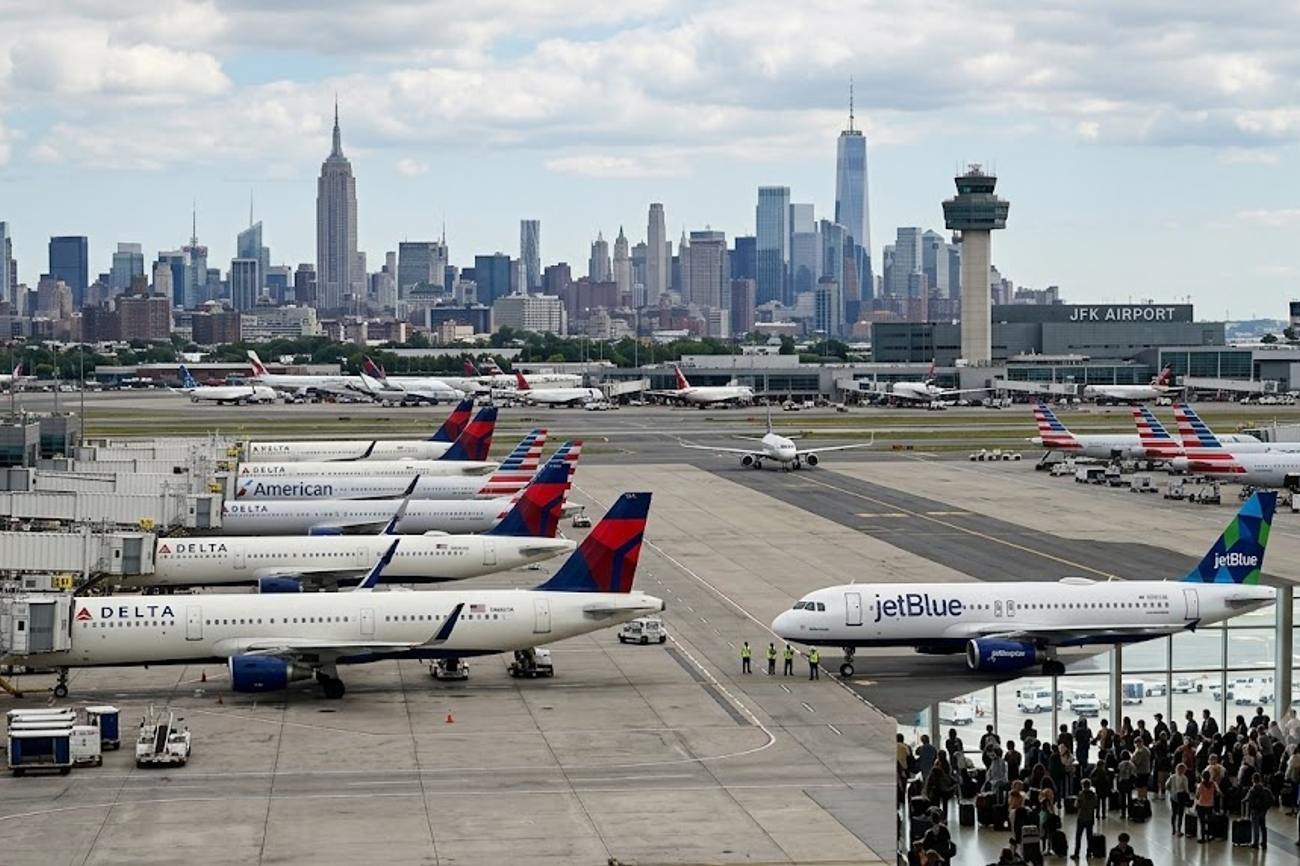
Image generated by AI
[New York, September 21] — The Federal Aviation Administration (FAA) implemented emergency flight restrictions across five major Northeast airports on Monday, triggering massive delays and diversions across one of the world's most congested aviation corridors.
The disruption impacted John F. Kennedy International Airport (JFK), LaGuardia Airport, Newark Liberty International Airport, Philadelphia International Airport, and Teterboro Airport. The restrictions occurred as New York City prepares for the United Nations General Assembly’s High-Level Week, an event expected to bring nearly 130 heads of state and government to the city for the General Debate starting September 22 and running through September 26, with a final session on September 28.
A Severed Fiber Line Triggers Chaos
The operational collapse originated not at a terminal, but at the Philadelphia Terminal Radar Approach Control (TRACON). This facility is critical for managing the flow of aircraft across a wide regional sector, including a significant portion of the traffic destined for Newark. While the Federal Aviation Administration (FAA) initially cited a general equipment outage involving communications frequencies, further details emerged regarding the physical cause of the failure.
FAA Administrator Bryan Bedford confirmed that a construction crew in New Jersey accidentally severed a backup fiber optic line. This physical breach crippled the communications infrastructure essential for air traffic controllers to maintain safe aircraft separation. Despite the agency's stated commitment to redundancy within the National Airspace System—which typically utilizes a network of radar, navigational aids, and backup systems—the loss of this specific line forced an immediate reduction in traffic volume to ensure safety.
Regional Impact and Flight Statistics
The disruption followed a cascading pattern, beginning in Philadelphia and Newark before expanding to the broader New York metropolitan area. As controllers lost critical communications capabilities, ground stops were issued for JFK and LaGuardia to prevent further airspace saturation. The ripple effect extended as far as Boston Logan, which faced restrictions as aircraft were diverted away from the affected Northeast corridor.
The statistical impact of the outage highlights the severity of the bottleneck:
- Philadelphia International Airport: Experienced average delays of approximately 151 minutes.
- Newark Liberty International Airport: Recorded average delays of roughly 112 minutes.
- Combined Volume: More than 600 flights at Newark and Philadelphia were delayed, accounting for over 20% of all scheduled flights at those two hubs during the event.
- Diversions: Multiple aircraft were forced to divert to alternative airports outside the affected TRACON sector.
What This Means for Travelers
For the average passenger, this event demonstrates that a technical failure at one facility can paralyze travel even if their specific airport is functioning perfectly. Because air traffic control is managed by regional sectors rather than individual airport boundaries, a failure at the Philadelphia TRACON effectively "closes the door" to the airspace used by JFK, LaGuardia, and Newark.
Immediate Passenger Impacts:
- Connection Failures: International travelers arriving at JFK from Asia, Europe, or the Middle East face high risks of missing domestic connections. Even if an international flight lands on time, the domestic leg departing from a restricted hub like Newark or Philadelphia may be delayed or cancelled.
- Hub Contagion: Because Philadelphia is a primary hub for American Airlines and Newark is a central hub for United Airlines, the delays are not localized to the Northeast; they are currently propagating through these airlines' national networks as aircraft and crews are displaced from their scheduled rotations.
- Diplomatic Congestion: The arrival of nearly 130 global leaders for the UN General Assembly increases the baseline pressure on ground transportation and security, making the airport delays more acute for diplomatic delegations and journalists.
Recovery and Regulatory Rights
The FAA advises that passengers should not rely on general airport status boards, which may not reflect real-time aircraft repositioning. Travelers are urged to use official airline mobile applications or websites to track specific flight changes, as aircraft substitutions and gate changes are frequent following such a systemic disruption.
Regarding financial recovery, the U.S. Department of Transportation (DOT) maintains strict rules regarding passenger compensation. Travelers are entitled to a full refund if an airline cancels a flight or implements a "significant change" to the schedule, provided the passenger chooses not to travel or rejects the offered alternative. It is important to note that once a passenger accepts and boards an alternative flight, they generally forfeit the right to a refund under these specific DOT mandates.
Infrastructure Vulnerabilities in the Northeast
This incident underscores the fragility of the telecommunications backbone supporting the U.S. Northeast's aviation infrastructure. The fact that a single construction error in New Jersey could trigger ground stops at JFK and LaGuardia suggests a critical vulnerability in the "redundancy" the FAA claims to maintain.
While the agency has previously invested in increasing telecommunications links between New York and Philadelphia, the current outage proves that physical infrastructure remains a single point of failure. As the region enters the high-pressure window of the UN General Assembly, the FAA is under increased scrutiny to ensure that backup systems are truly autonomous and protected from external physical interference.
FAQ: Northeast Aviation Disruptions 2024
Why is my flight delayed if the problem is in Philadelphia? Air traffic is managed by regional sectors. The Philadelphia TRACON controls the airspace for multiple airports, including Newark. If that facility loses communication, the FAA must limit the number of planes entering that entire region to prevent collisions, regardless of where the plane is landing.
Am I entitled to a refund for my delayed flight? According to the DOT, you are entitled to a refund if the airline cancels your flight or makes a significant schedule change and you choose not to fly. If you accept an alternative flight, you are generally not eligible for a refund of the original ticket.
How should I track my flight during this outage? Avoid relying on general airport screens. Use the official app or website of your airline (e.g., United or American Airlines) for the most accurate data on aircraft repositioning, gate changes, and revised departure times.
Did the UN General Assembly cause the airport delays? No. While the event brings massive crowds and diplomatic pressure to New York, the FAA confirmed the delays were caused by a severed fiber optic line in New Jersey, not by the increased volume of UN-related traffic.
A single cut cable has proven that the world's most sophisticated airspace is only as strong as its physical wiring.
#FAA #JFK #EWR #PHL #UNGA2024 #NortheastAirspace
Related Travel Guides
Disclaimer
This article is for informational and educational purposes only. It does not constitute legal, financial, or professional advice. While we strive to provide accurate and up-to-date information, travel policies, regulations, and conditions change rapidly. Always verify information with official sources before making travel decisions. Nomad Lawyer makes no representations about the accuracy, reliability, completeness, or suitability of the information provided. Readers should consult qualified professionals for advice specific to their circumstances. The views expressed in this article are those of the author and do not necessarily reflect the views of Nomad Lawyer.
Naina Thakur
Contributor & Travel Specialist
Travel enthusiast and legal writer covering visa regulations, responsible tourism, and cultural journeys across global destinations.
Learn more about our team →