
Flights Cancelled Across America as Newark, Philadelphia, and Other Airports Face 376 cancellations and 3,710 delays
Flights Cancelled Across America as Newark, Philadelphia, and Other Airports Face 376 cancellations and 3,710 delays

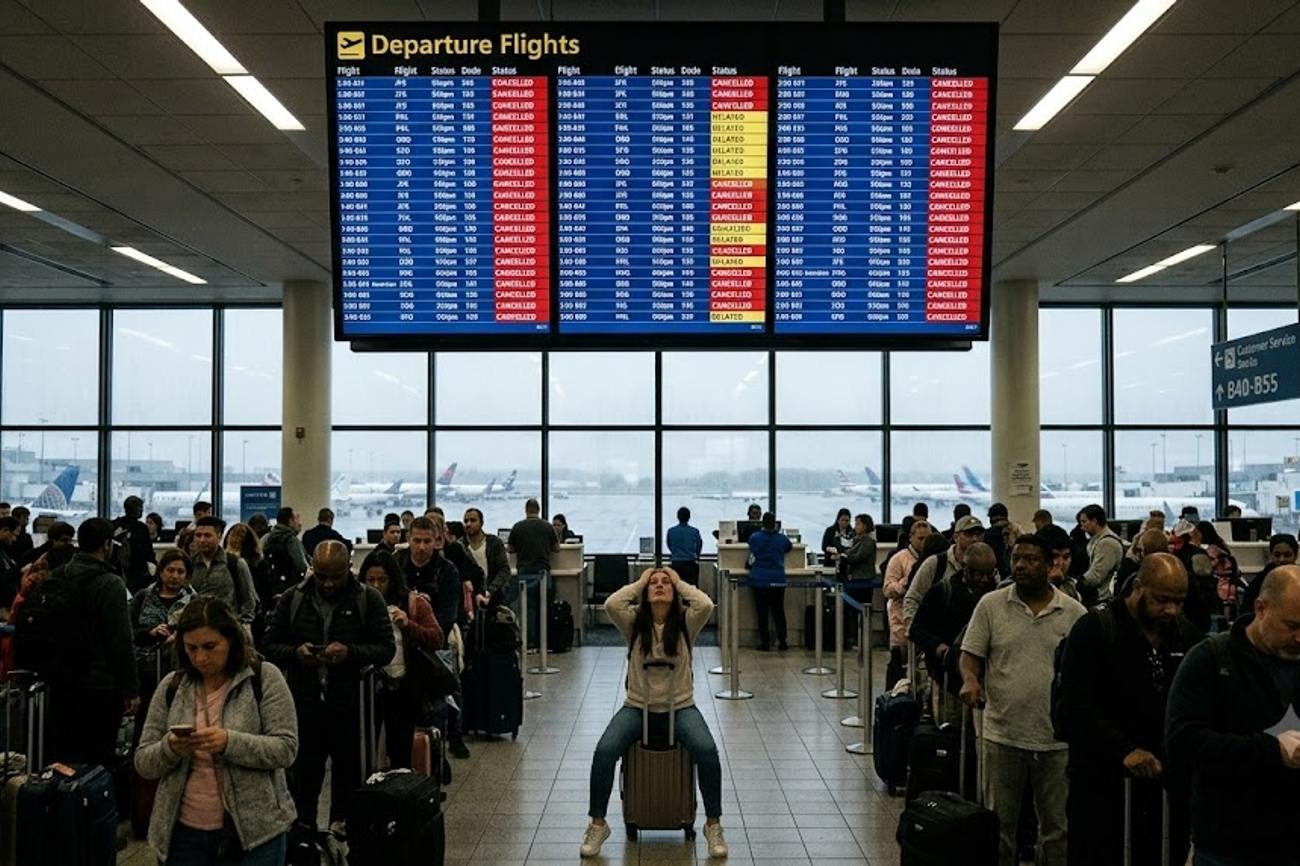
Image generated by AI
title: Navigating the Northeast Corridor During High-Stakes Disruptions description: An insider's guide to surviving air travel chaos in the US Northeast, focusing on the intersection of diplomatic summits and infrastructure fragility. date: 2024-09-24
A single failed telecommunications circuit and an accidentally severed backup fiber cable recently paralyzed air traffic across the US East Coast, proving that the most sophisticated flight networks are only as strong as a few strands of glass. This infrastructure collapse occurred at the worst possible moment: as 130 world leaders and dozens of ministers descended upon New York for the annual high-level meeting of the United Nations General Assembly.
The Fragility of the Northeast Gateway
When you travel through the Northeast Corridor, you are moving through one of the most congested airspaces on the planet. The recent systemic failure highlights a recurring theme for those of us who live and work in this region: the intersection of extreme diplomatic importance and aging technical infrastructure. The Federal Aviation Administration (FAA) was forced to implement ground stops across all three major New York-area airports, as well as Philadelphia and Boston, creating a domino effect that rippled across the continent.
The numbers illustrate the scale of the paralysis. Across the United States, 3,710 flight delays and 376 cancellations were reported. While the disruption felt national, the epicenter was Newark Liberty, which bore the brunt of the chaos with 220 cancellations and 233 delays. For the seasoned traveler, Newark is known as a volatile hub, but seeing an 18% cancellation rate and a 20% delay rate for both originating and destination flights is a stark reminder of how quickly the system can buckle.
This wasn't just a technical glitch; it was a logistical nightmare compounded by the UN General Assembly. When the world's most powerful people arrive in New York, security protocols tighten and airspace priority shifts. When you add a severed fiber cable to that mix, the result is a total operational standstill.
What Makes the US Hub System Different
To understand why a cable cut in one place causes a delay in San Francisco, you have to understand the concept of Irregular Operations (IROPS). In the US aviation model, resources—aircraft, crew, and gates—are tightly linked. If a plane is stuck on the tarmac at Newark Liberty, it cannot fly its next leg to Chicago O’Hare or Los Angeles.
This interdependence is why we saw disruptions far beyond the East Coast. Chicago O’Hare faced 281 delays and 17 cancellations, with originating flights recording a 9% delay rate. Even on the opposite coast, San Francisco dealt with 270 delays and 14 cancellations. While San Francisco's issues were compounded by "low ceilings"—a meteorological term for low cloud cover that restricts visibility—the systemic pressure from the East Coast meant there was less flexibility to absorb those weather delays.
The regional disparities are telling. Philadelphia, for instance, saw a massive spike in delays—390 in total—with an average departure delay of 60 minutes and increasing. For those originating in Philadelphia, the delay rate hit 36%, while destination flights were even higher at 37%. This suggests that Philadelphia often becomes the "pressure valve" for the New York airports, absorbing the overflow and the resulting delays.
Visitor Insider Tips
Navigating these hubs during a crisis requires a different strategy than a standard vacation. If you are traveling through the Northeast during major events like the UN General Assembly, follow these local protocols:
The "Alternative Hub" Strategy When Newark (EWR), JFK, and LaGuardia (LGA) are all under ground stops, do not simply wait at the terminal. If your destination is flexible, check for flights out of Philadelphia (PHL) or Boston Logan (BOS), though be warned that these often experience secondary delays. In the recent disruption, Boston Logan saw average ground delays of 105 minutes.
Timing the Chaos Avoid scheduling connections with less than three hours of buffer time during September in New York. The influx of diplomatic delegations creates an atmosphere of heightened security and unpredictable traffic. Use the FAA's official status tools to monitor ground stops in real-time rather than relying solely on airline apps, which often lag by 30 to 60 minutes.
The Logistics of the "Low Ceiling" When you hear "low ceilings" mentioned for airports like San Francisco or Boston, expect a slow-motion airport experience. This means the acceptance rate for aircraft is reduced. In San Francisco, this recently led to a 62-minute average ground delay. If you see this weather pattern emerging, move your airport arrival time up by two hours.
Airline-Specific Awareness Not all carriers handle IROPS the same way. During this recent event, Southwest faced the heaviest delays, while United saw the highest number of cancellations. If you are flying United through Newark, have a backup plan ready the moment you see a "ground stop" notification.
Cultural and Environmental Context
The tension between global diplomacy and local infrastructure is a defining characteristic of New York City. The annual UN General Assembly is a period of immense pride and internationalism, but for the local resident and the frequent traveler, it is a time of systemic stress. The city's infrastructure is pushed to its absolute limit, and as we saw with the fiber cable incident, the margin for error is non-existent.
There is also an environmental component to these disruptions. The "low ceilings" mentioned in Boston and San Francisco are not just weather inconveniences; they are operational constraints that force planes to circle or hold, increasing fuel burn and carbon emissions. When a hub like Hartsfield-Jackson in Atlanta (which saw 184 delays and 11 cancellations) or Denver (179 delays and 9 cancellations) becomes clogged, the environmental cost of "recovery flights" and rerouting increases.
Furthermore, the reliance on a few critical telecommunications circuits for the entire National Airspace System reveals a vulnerability in how we preserve the continuity of travel. The shift toward more decentralized, redundant communication systems is no longer a luxury—it is a necessity for a city that serves as the diplomatic capital of the world. For more on how these sites are managed, the UNESCO World Heritage guidelines on urban preservation often clash with the need for massive infrastructure upgrades in historic cities like New York and Boston.
FAQ: Visiting the US Northeast 2024
What is the best time to visit New York City to avoid crowds? Avoid the late September window during the UN General Assembly. Instead, aim for late April to early June or October to November. You will find the airports more stable and the city more navigable.
How do I get between the major NY-area airports? Avoid taxis during disruptions. Use the AirTrain and the subway system. If you are moving between Newark and JFK, the most reliable method is often a combination of rail and shuttle, though it takes significantly longer.
Is it safe for solo travelers to navigate these hubs during delays? Yes, but stay vigilant. During mass cancellations, airport lounges and terminals become overcrowded. Keep your electronics charged and use official airport transport services rather than unsolicited offers for rides.
Do I need a visa to visit the US for a short trip? Most visitors require either a visa or an ESTA (Electronic System for Travel Authorization) depending on their nationality. Check the official U.S. Department of State website for the most current requirements.
When the fiber snaps and the clouds drop, the only real luxury in travel is a flexible itinerary.
#NewarkLiberty #UNGA2024 #USAirTravel #NortheastCorridor #FAAgroundstop #FlightDisruptions2024
Related Travel Guides
- USA Travel Alert as FAA Outage Disrupts Six Airports and Triggers Major Flight Delays
- Hundreds of Travelers Affected Around Asia Amid Typhoon Dujuan with 890 Cancellations and 4,632 Delays at Fukuoka, Makassar and More Airports
- Jordan Travel Reconnects With Europe As Airlines Restore Flights Boosting Tourism And Global Accessibility
Disclaimer
This article is for informational and educational purposes only. It does not constitute legal, financial, or professional advice. While we strive to provide accurate and up-to-date information, travel policies, regulations, and conditions change rapidly. Always verify information with official sources before making travel decisions. Nomad Lawyer makes no representations about the accuracy, reliability, completeness, or suitability of the information provided. Readers should consult qualified professionals for advice specific to their circumstances. The views expressed in this article are those of the author and do not necessarily reflect the views of Nomad Lawyer.
Kunal K Choudhary
Co-Founder & Contributor
A passionate traveller and tech enthusiast. Kunal contributes to the vision and growth of Nomad Lawyer, bringing fresh perspectives and driving the community forward.
Learn more about our team →