
Russia-Iran Aviation Ties 2026: Aircraft Parts Production, Maintenance & Travel Guide

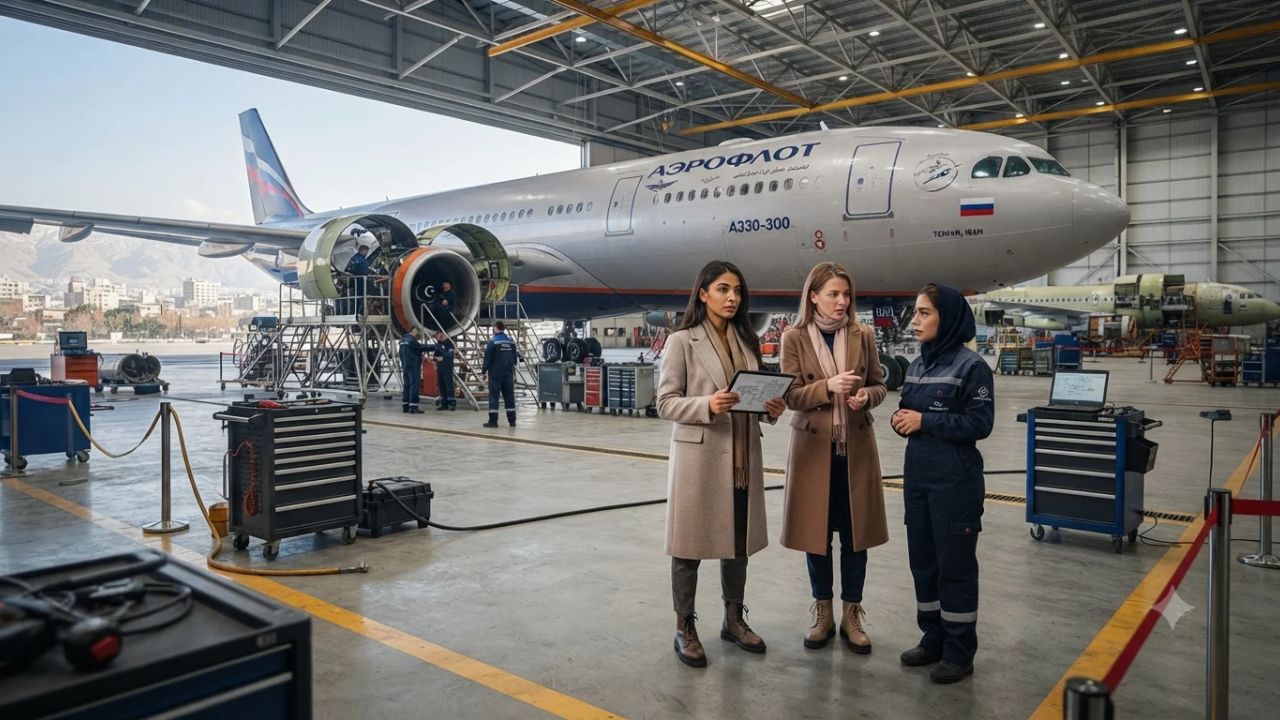
While international sanctions have disrupted standard aerospace supply chains across Eurasia, Iranian aviation engineering facilities in Tehran have successfully completed heavy maintenance on widebody Aeroflot Airbus A330 passenger airliners. That established technical cooperation forms the foundation of an internal 44-page bilateral economic cooperation document approved on the Russian side in September 2024, outlining plans spanning 2024 to 2026 to assess whether Iranian industrial facilities can manufacture certified replacement components and aircraft assemblies for Russian commercial carriers.
The initiative, supervised on the Russian side by civil aviation regulator Rosaviatsiya, has already granted official airworthiness and maintenance certifications to three Iranian aerospace engineering enterprises. Bilateral discussions set a target date of 31 March 2026 to finalize formal manufacturing agreements, with initial prototype component production targeted by the close of 2026. Follow-up talks in February 2025 expanded into broader discussions surrounding joint passenger aircraft manufacturing and aero-engine development. While full commercial production lines remain unconfirmed, the deepening technical alliance provides vital operational context for regional Eurasian air corridors.
| Cooperation Metric / Benchmark | Official Status Detail | Operational Timeline |
|---|---|---|
| Bilateral Strategic Document | 44-Page Internal Accord | Approved September 2024 |
| Cooperation Duration Window | 2024 through 2026 | Multi-Year Technical Scope |
| Verified Heavy Maintenance | Aeroflot Airbus A330 | Completed at Tehran Facilities |
| Certified Iranian MRO Enterprises | 3 Approved Companies | Authorized by Rosaviatsiya |
| Local Production Target Date | 31 March 2026 | Agreement on Parts Fabrication |
| Prototype Manufacturing Goal | By End of 2026 | Initial Component Prototypes |
| Broader Aerospace Ambition | Engine & Airframe Talks | Evaluated in February 2025 |
Decoding the Maintenance Pipeline: MRO Capability vs. Component Production
In modern commercial aviation, heavy maintenance checks—often known as C-checks and D-checks—require structural teardowns, composite skin x-rays, hydraulic system overhauls, and avionics calibrations. Under international oversight frameworks established by the International Civil Aviation Organization (ICAO), airlines must maintain rigorous airworthiness logs to operate passenger flights.
Iran's aerospace sector, having developed domestic maintenance capabilities over four decades of international isolation, provides Russian airlines with specialized maintenance, repair, and overhaul (MRO) facilities. The servicing of Aeroflot's widebody Airbus A330 in Tehran demonstrated that Iranian hangars possess the technical tooling to maintain complex fly-by-wire airframes.
However, transitioning from maintenance servicing to ground-up parts fabrication involves significant industrial hurdles. Manufacturing flight-critical components—such as turbine blades, hydraulic actuators, and pressure seals—demands specialized metallurgy, precision CNC tooling, and stringent quality assurance protocols certified by civil aviation authorities. For international passengers flying through Caucasus, Central Asian, and Middle Eastern corridors, the bilateral arrangement represents an industrial effort to ensure long-term fleet airworthiness rather than an immediate change to passenger booking procedures or scheduled routes.
What Sets Tehran and Iranian Heritage Travel Apart
Beyond aviation industry developments, Iran remains one of the world's most historically profound cultural destinations, showcased through Visit Iran. In the capital city of Tehran, framed against the snowcapped 4,000-meter peaks of the Alborz mountain range, travelers discover a metropolis where royal Persian history intersects with vibrant bazaars.
At the city's historic center lies Golestan Palace, a UNESCO World Heritage site and masterpiece of the Qajar era. The palace complex features ornate mirrored reception halls, windcatcher towers (badgirs), and mosaic-tiled courtyards set around reflecting pools. A short walk south leads into the Tehran Grand Bazaar, an interconnected labyrinth of vaulted brick arcades stretching over ten kilometers, where merchants trade hand-knotted Isfahan silk carpets, copper cookware, Persian pistachios, and crimson strands of Khorasan saffron.
Beyond Tehran, seamless domestic rail and regional flights connect travelers to the turquoise-domed mosques of Isfahan's Naqsh-e Jahan Square, the adobe desert architecture of Yazd, and the 2,500-year-old stone columns of Persepolis near Shiraz.
Visitor Insider Tips
- Understanding Flight Booking and Airline Schedules: The reported bilateral maintenance accords introduce zero changes to international passenger flight schedules or ticketing rules; flights operated by regional carriers continue to follow established civil aviation timetables.
- Navigating Payment Systems in Iran: International Visa, Mastercard, and American Express cards do not function in Iran due to banking disconnections; international visitors must carry cash (EUR or USD) to exchange at licensed Sarafi exchange shops for Iranian Rials (IRR) or purchase a tourist debit card upon arrival at Tehran Imam Khomeini International Airport (IKA).
- Airport Transit Between IKA and Mehrabad: Note that international flights land at Imam Khomeini International Airport (IKA), located 45 kilometers south of Tehran, while domestic flights depart from Mehrabad International Airport (THR) in the city center; allow a minimum of 3.5 hours for transfers across the capital.
- Cultural Dress Codes and Social Etiquette: Modest attire is required in public spaces throughout Iran: women must wear a headscarf (rousari) and loose clothing covering the body, while men should avoid wearing shorts in city centers and sacred sites.
- Sampling Regional Persian Gastronomy: In traditional restaurants, order classic Persian saffron rice dishes like Tahchin (crispy saffron rice cake layered with chicken) or Fesenjan (slow-cooked chicken in a rich pomegranate and walnut sauce) paired with fresh mint tea and doogh (herbal yogurt drink).
Cultural and Environmental Context
Iran's ancient urban centers have long pioneered ingenious desert ecological architecture. In historical cities like Yazd and Kashan, traditional windcatchers (badgirs) and subterranean water channels (qanats) provided passive air conditioning and water management for thousands of years without fossil fuels. Today, local preservation trusts work closely with international conservators to safeguard these fragile earthen structures from groundwater depletion and seismic activity.
Within the aviation sector, the focus on fleet airworthiness directly impacts the safety and connectivity of millions of domestic passengers traveling across vast mountainous terrain. Cultural travelers venturing into Iran are encouraged to support independent artisan workshops, respect sacred mosque protocols by removing shoes before entering carpeted prayer halls, and engage licensed local guides who offer authentic historical context on ancient Persian civilizations.
FAQ: Russia-Iran Aviation Cooperation & Regional Travel 2026
Did Russian aircraft parts production officially start in Iran?
No. While an internal document targeted local production agreements by 31 March 2026 and prototypes by late 2026, component manufacturing has not been independently verified.
Which Russian aircraft has undergone maintenance in Tehran?
At least one Aeroflot Airbus A330 widebody passenger jet has undergone heavy maintenance at Iranian facilities.
How many Iranian aerospace companies are certified by Russia?
Russia's civil aviation authority, Rosaviatsiya, has officially authorized three Iranian companies for aircraft maintenance and airworthiness-related work.
Do these aviation agreements affect current passenger flight schedules?
No. The bilateral initiative focuses on technical maintenance and supply chain logistics, introducing no immediate changes to passenger flight schedules or routes.
[From the mirrored halls of Golestan Palace to the soaring snows of the Alborz, the ancient crossroads of Persia continue to demonstrate remarkable resilience and cultural depth.]
Related Travel Guides
Disclaimer
This article is for informational and educational purposes only. It does not constitute legal, financial, or professional advice. While we strive to provide accurate and up-to-date information, travel policies, regulations, and conditions change rapidly. Always verify information with official sources before making travel decisions. Nomad Lawyer makes no representations about the accuracy, reliability, completeness, or suitability of the information provided. Readers should consult qualified professionals for advice specific to their circumstances. The views expressed in this article are those of the author and do not necessarily reflect the views of Nomad Lawyer.
Raushan Kumar
Founder & Lead Developer
Full-stack developer with 11+ years of experience and a passionate traveller. Raushan built Nomad Lawyer from the ground up with a vision to create the best travel and law experience on the web.
Learn more about our team →