
Hundreds of Travelers Affected Around Asia Amid Typhoon Dujuan with 890 Cancellations and 4,632 Delays at Fukuoka, Makassar and More Airports
Hundreds of Travelers Affected Around Asia Amid Typhoon Dujuan with 890 Cancellations and 4,632 Delays at Fukuoka, Makassar and More Airports

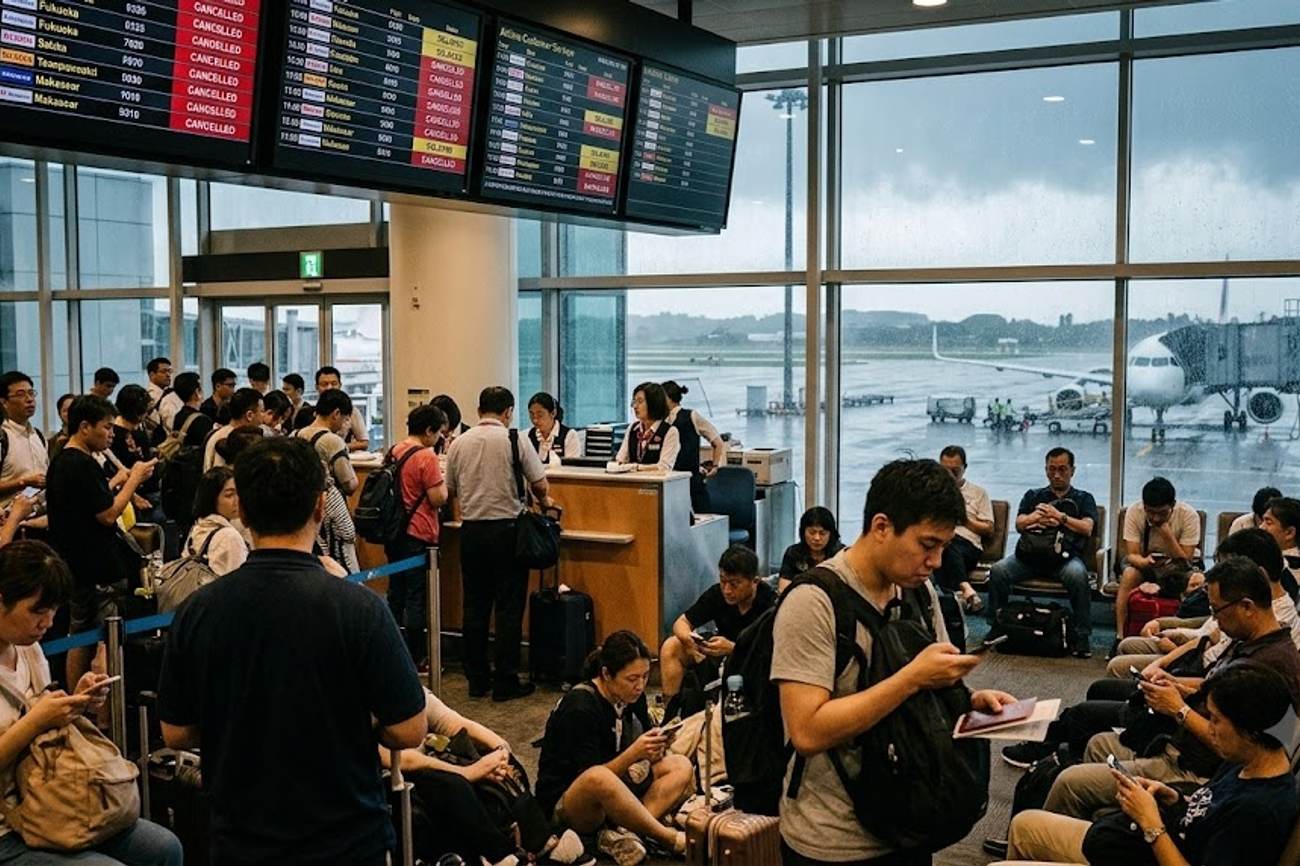
Image generated by AI
4,632 flight delays and 890 cancellations have paralyzed aviation networks across Asia, signaling the immense operational volatility triggered by Typhoon Dujuan. This scale of disruption reflects more than just localized weather; it demonstrates the fragility of the "hub-and-spoke" model in the Asia-Pacific region, where a single weather event in Japan creates a cascading failure of aircraft rotation and crew scheduling from India to Indonesia.
The Anatomy of a Regional Aviation Collapse
The operational paralysis caused by Typhoon Dujuan was not evenly distributed, but its effects were systemic. Japan served as the epicenter, with the storm's trajectory creating a bottleneck at the nation's primary gateways. The concentration of disruptions in Tokyo highlights a critical vulnerability: when Haneda and Narita struggle, the entire East Asian transit corridor slows down.
The storm forced airlines to prioritize safety over schedules, leading to a massive reduction in flight frequencies. This was not merely a matter of grounded planes but a complex logistical puzzle involving aircraft rotation. When a plane destined for Tokyo is diverted or delayed, it cannot fulfill its subsequent legs to Bangkok, Jakarta, or Delhi, effectively exporting the disruption across borders.
Quantifying the Operational Chaos
The data reveals a stark disparity between the types of disruptions. While cancellations were high, the volume of delays suggests that airlines attempted to maintain connectivity, resulting in severe airport congestion and passenger backlog.
Airport-Level Disruption Metrics
| Airport | Delays | Cancellations |
|---|---|---|
| Tokyo Haneda (HND) | 516 | 287 |
| Guangzhou Baiyun (CAN) | 334 | 11 |
| Jakarta Soekarno-Hatta (CGK) | 191 | 16 |
| New Chitose (CTS) | 183 | 46 |
| Shanghai Pudong (PVG) | 183 | 25 |
| Suvarnabhumi Bangkok (BKK) | 175 | 5 |
| Indira Gandhi International (DEL) | 147 | 12 |
| Osaka Itami (ITM) | 142 | 21 |
| Fukuoka (FUK) | 131 | 41 |
| Shanghai Hongqiao (SHA) | 113 | 7 |
| Beijing Daxing (PKX) | 107 | 4 |
| Chhatrapati Shivaji (BOM) | 106 | 6 |
| Hangzhou Xiaoshan (HGH) | 100 | 5 |
| Beijing Capital (PEK) | 79 | 16 |
| Kansai International (KIX) | 74 | 11 |
| Da Nang (DAD) | 58 | 8 |
Carrier Performance and Impact Rates
The volatility was most acute for Japanese domestic and regional carriers, who faced the brunt of the weather's direct path.
- Japan Airlines: 295 delays (36%) and 116 cancellations (14%)
- All Nippon Airways: 192 delays (34%) and 86 cancellations (15%)
- Jetstar Japan: 19 delays (18%) and 26 cancellations (25%)
- Skymark: 54 delays (27%) and 34 cancellations (17%)
- Air Do: 41 delays (61%) and 7 cancellations (10%)
- StarFlyer: 29 delays (44%) and 5 cancellations (7%)
- ANA Wings: 115 delays (31%) and 36 cancellations (9%)
International carriers also felt the ripple effects. China Eastern saw 275 delays (12%) and 30 cancellations (1%), while China Southern experienced 224 delays (10%) and 2 cancellations (0%). In Southeast Asia, VietJet Air recorded 124 delays (30%) and 1 cancellation (0%), while Vietnam Airlines reported 79 delays (22%) and 8 cancellations (2%). In India, IndiGo faced 161 delays (8%) and 3 cancellations (0%), and SpiceJet saw 28 delays (37%) and 8 cancellations (10%).
Expert Analysis: The Domino Effect of Hub Congestion
For travelers booking routes through East Asia, the direct consequence of Typhoon Dujuan is the "network contagion" effect. When a primary hub like Tokyo Haneda experiences 516 delays, the impact is not limited to passengers on those specific flights. It triggers a failure in aircraft rotation—the process where a single aircraft performs multiple flights a day. If a Japan Airlines jet is delayed in Tokyo, its scheduled departure to Bangkok is pushed back, which in turn delays its subsequent flight to Singapore.
The pricing pressure this creates is immediate. As capacity drops due to 890 cancellations, the remaining available seats on non-affected routes often spike in price. Furthermore, the sheer volume of delays at Guangzhou Baiyun (334) and Shanghai Pudong (183) indicates that China's aviation infrastructure is struggling to absorb the shock of diverted traffic from Japan.
From a regulatory perspective, this event underscores the necessity of the International Air Transport Association (IATA) standards for crisis management. The high percentage of delays relative to cancellations (4,632 vs 890) suggests that airlines are opting for "rolling delays" to avoid the legal and financial burdens of full cancellations, even if it means passengers spend ten or more hours in terminals. This strategy minimizes immediate refund liabilities but maximizes passenger frustration and airport overcrowding.
For those utilizing FlightAware to track their journeys, the data suggests that "recovery time"—the period it takes for a schedule to return to normal after a storm—is often double the duration of the storm itself. The backlog of displaced passengers and out-of-position aircraft means that even after the skies clear, the system remains fragile for several days.
Key Takeaways
- Tokyo is the Critical Point: With Haneda recording the highest disruption (516 delays/287 cancellations), any weather event hitting the Kanto region effectively throttles Asian air transit.
- Delay vs. Cancellation Strategy: Airlines are heavily favoring delays over cancellations (a ratio of roughly 5:1), leading to extreme congestion in terminals across Japan and China.
- Regional Contagion: Even airports far from the storm's center, such as Delhi (147 delays) and Jakarta (191 delays), suffered due to the interconnected nature of international flight rotations.
- Carrier Vulnerability: Regional carriers like Air Do experienced the highest delay rates (61%), making them the most unreliable options during weather crises.
- Recovery Lag: The systemic nature of the 4,632 delays means that travel schedules will likely remain unstable long after Typhoon Dujuan dissipates.
FAQ: Typhoon Dujuan Travel 2026
What should I do if my flight from Tokyo or Shanghai is delayed? Immediately check your airline's official app or website for real-time updates. Because of the high volume of delays at hubs like Haneda and Pudong, avoid calling customer service lines; use digital rebooking tools to secure alternative flights before capacity vanishes.
Will I be entitled to a refund for a Typhoon Dujuan cancellation? Generally, severe weather is considered a "force majeure" event. While airlines may not be legally required to provide cash compensation for weather delays, they are typically obligated to provide rebooking or a travel voucher. Check the Japan Civil Aviation Bureau for local passenger rights.
Why is my flight in India or Thailand delayed if the storm is in Japan? This is due to aircraft rotation. The plane assigned to your route likely originated in Japan or was scheduled to fly there. If that aircraft was delayed or diverted in Tokyo, it cannot arrive at your airport on time.
How much extra time should I allow at the airport during this disruption? Given the congestion at major hubs like Guangzhou and Bangkok, arrive at least 4 hours prior to departure. Long queues at check-in and security are expected as thousands of displaced passengers attempt to re-route.
When the wind stops, the logistical nightmare is only just beginning.
Tags: Typhoon Dujuan 2026, Tokyo Haneda Airport, Japan Airlines, China Eastern Airlines, Asia Aviation Disruption, FlightAware Data
Related Travel Guides
Disclaimer
This article is for informational and educational purposes only. It does not constitute legal, financial, or professional advice. While we strive to provide accurate and up-to-date information, travel policies, regulations, and conditions change rapidly. Always verify information with official sources before making travel decisions. Nomad Lawyer makes no representations about the accuracy, reliability, completeness, or suitability of the information provided. Readers should consult qualified professionals for advice specific to their circumstances. The views expressed in this article are those of the author and do not necessarily reflect the views of Nomad Lawyer.
Kunal K Choudhary
Co-Founder & Contributor
A passionate traveller and tech enthusiast. Kunal contributes to the vision and growth of Nomad Lawyer, bringing fresh perspectives and driving the community forward.
Learn more about our team →