
Strait of Hormuz Blockade Triggers Global Oil Shock as Saudi Arabia, UAE and Qatar Energy Crisis Destabilizes Global Aviation; Emirates, Delta and British Airways Scale Down Operations Amid US-Iran Conflict in May 2026
A strategic blockade of the Strait of Hormuz has ignited a global energy crisis, sending oil prices to record highs. As Saudi Arabia, the UAE, and Qatar face export disruptions, a massive jet fuel emergency is forcing Emirates, Delta, and Air France to scale down operations during the 2026 oil shock.

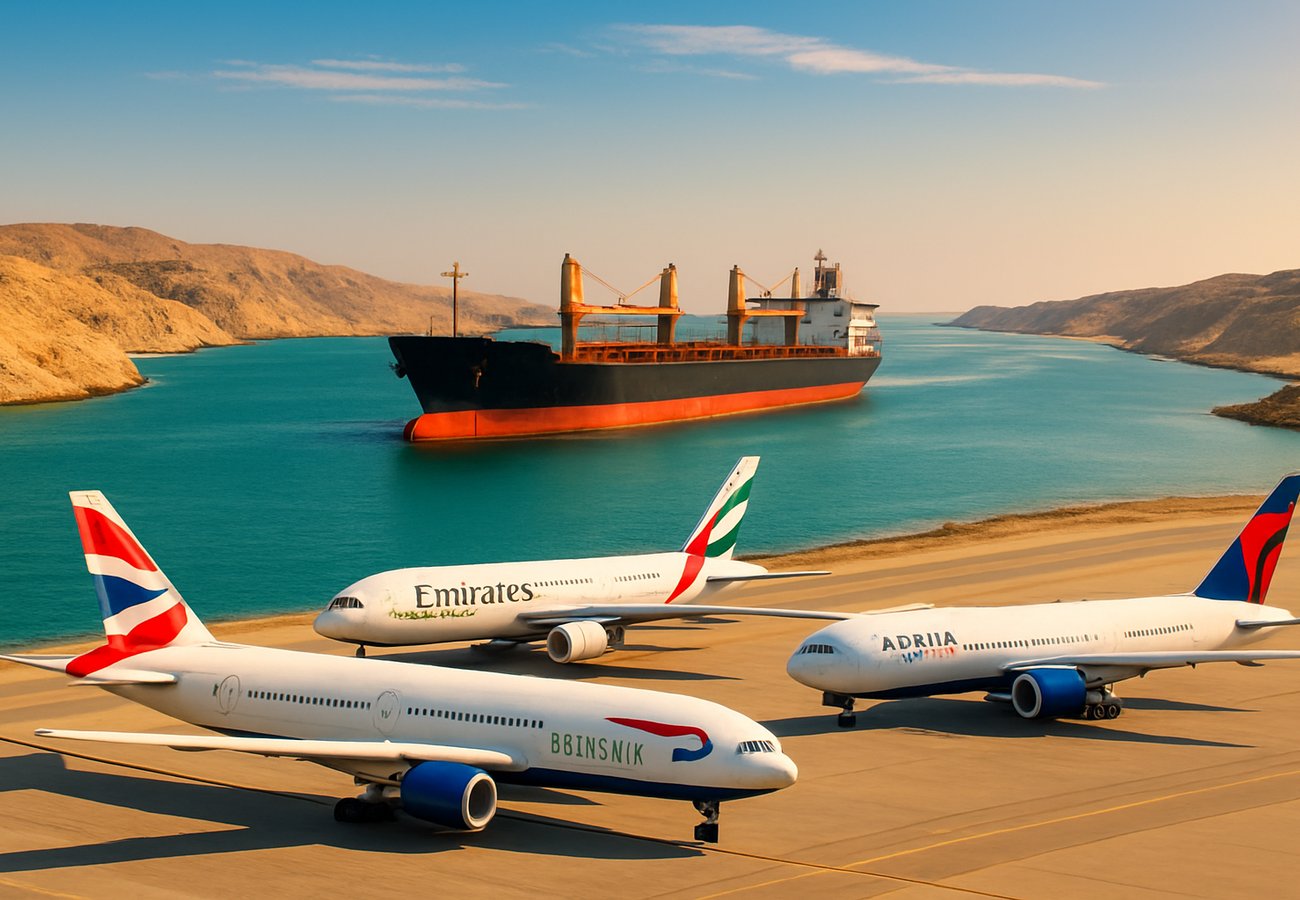
Image generated by AI
A global energy crisis of historic magnitude has erupted following the strategic blockade of the Strait of Hormuz, triggering an immediate oil price shock that has paralyzed the world’s most powerful aviation markets. As the United States, Iran, and Gulf Cooperation Council (GCC) nations including Saudi Arabia, the UAE, and Qatar move to the brink of military conflict, the resulting jet fuel shortage is crippling international connectivity. Today, May 10, 2026, major carriers including Emirates, Delta, Air China, Air France, Turkish Airlines, and British Airways have been forced to scale down operations as the 2026 oil shock destabilizes global fuel supply chains. The crisis, spanning from the UAE to Germany, Turkey, and the United States, has triggered an unprecedented state of travel chaos as the world’s primary energy chokepoint remains a contested military zone.
The blockade of the world’s most critical energy chokepoint has sent crude prices toward $200/bbl, creating a "fuel emergency" that is rewriting the rules of international travel. For the UAE, where Emirates relies on a massive long-haul network, the vulnerability is acute. The collapse of maritime logistics in the Persian Gulf has severed the "refined fuel" artery that feeds the world's flagship hubs, forcing a contraction of the aviation industry not seen in decades.
Expanded Overview: The Fuel Shock and the Global Hub Collapse
The blockade of the Strait of Hormuz — a narrow chokepoint through which 21 million barrels of oil per day (approximately 21% of global petroleum consumption) pass — represents a total collapse of international energy security. For major petroleum exporters like Kuwait, Iraq, and Bahrain, and the world’s leading LNG supplier, Qatar, the inability to access the sea has rendered their primary economic assets unreachable.
As the International Energy Agency (IEA) activates emergency protocols, the US-Iran conflict has triggered a global refining bottleneck. This aviation update confirms that the "refined product" deficit is now more dangerous to global trade than the crude shortage itself. Airlines are responding by cancelling low-yield routes, grounding fuel-heavy aircraft, and implementing "war-premium" ticket price hikes to offset the skyrocketing cost of Jet A1.
Section-Wise Breakdown: Nations at the Epicenter
The UAE: A Hub Under Siege
The United Arab Emirates is facing an existential threat to its aviation-led economy. Emirates, the world’s premier long-haul carrier, has been forced to scale back flights as soaring fuel costs and supply disruptions hit Dubai International Airport. The nation’s reliance on the Persian Gulf for both its crude exports and refined fuel imports has left its massive fleet of A380s and B777s particularly vulnerable to the current maritime blockade.
Germany & The UK: The European Gridlock
Europe’s primary hubs—Frankfurt, Munich, and London Heathrow—are in a state of gridlock. Lufthansa and British Airways have removed tens of thousands of flights from their summer schedules. The UK government has introduced emergency "slot alleviation" measures to prevent airlines from losing their airport slots while they ground aircraft to conserve fuel. The travel chaos at Heathrow is being exacerbated by a "fuel security" panic as the UK struggles to secure non-Hormuz supply lines.
The United States & France: The Atlantic Contraction
At JFK, LAX, and Paris CDG, Delta and Air France are feeling the brunt of the Atlantic contraction. The 2026 oil shock has made the "fuel-heavy" trans-Atlantic corridors economically unviable for many carriers. Delta has announced significant operational adjustments, including cutting frequency on select routes and grounded older, less efficient aircraft to prioritize high-yield "essential" services.
China & Turkey: The Strategic Pivot
Air China and Turkish Airlines are facing massive operational challenges as they attempt to reroute east-bound traffic away from the contested Persian Gulf. The US-Iran conflict has made the traditional "Silk Road" corridors too risky for many carriers, leading to increased fuel burn on longer routes and further exacerbating the jet fuel shortage.
Global Jet Fuel Emergency: Market Impact Analysis (May 2026)
| Region | Primary Hubs Affected | Major Carriers Impacted | Impact Severity |
|---|---|---|---|
| Middle East (UAE) | Dubai (DXB), Abu Dhabi (AUH) | Emirates, Etihad | CRITICAL - Direct maritime blockade |
| Europe (GER/UK/FRA) | Heathrow, Frankfurt, CDG | Lufthansa, British Airways, Air France | HIGH - Dependence on Gulf refined fuel |
| North America (USA) | JFK, LAX, Atlanta | Delta, American Airlines | HIGH - Skyrocketing trans-Atlantic costs |
| Asia (China/India) | Beijing, Mumbai, Singapore | Air China, IndiGo, Singapore Airlines | MODERATE-HIGH - Route rerouting costs |
Note: Impact levels are based on fuel-price volatility and schedule stability as of May 10, 2026.
Passenger & Airline Impact: The New Reality of Travel
For passengers, the global fuel emergency represents a total collapse of reliability. With flight cancellations becoming the new norm, travelers are facing overcrowded airports, 5-hour wait times at check-in, and ticket prices that have doubled in a single month. The US-Iran conflict means that rebooking is no longer a certainty; many passengers are being left stranded for days as airlines prioritize "fuel-efficient" load factors over frequency.
Industry Analysis: The End of Global Connectivity?
Aviation analysts suggest that the Strait of Hormuz blockade is a "hard reset" for the industry. "The global oil shock has proved that the hub-and-spoke model of carriers like Emirates is extremely vulnerable to geopolitical chokepoints," says one senior energy strategist. "At $200/bbl, the world is too large to be connected by 500-seat superjumbos. We are seeing a structural shift toward 'Energy Sovereignty' and localized aviation that will define the rest of the decade."
According to the IEA, the global aviation industry’s ability to survive this crisis depends entirely on the speed with which it can transition to non-Persian Gulf fuel sources and Sustainable Aviation Fuel (SAF).
Conclusion: A World Divided by Energy Insecurity
The global jet fuel emergency of 2026 is a devastating reminder that the freedom to fly is tied to the security of the 21-mile-wide Strait of Hormuz. As Saudi Arabia, the UAE, and the United States monitor the military developments in the Persian Gulf, the aviation sector remains in a state of high-alert. For passengers booking their summer travel, the message is clear: the oil shock has arrived, and the world’s wings are being clipped by the realities of energy security.
Key Takeaways
- Strait of Hormuz blockade continues to drive a global energy crisis, grounding major international carriers including Emirates, Delta, and British Airways.
- UAE Vulnerability: Emirates is scaling down long-haul operations as the Persian Gulf refined fuel artery is severed.
- European Chaos: Lufthansa and British Airways ground tens of thousands of flights at Frankfurt and Heathrow.
- US Contraction: Delta implements significant operational adjustments at JFK and LAX to conserve fuel.
- US-Iran Conflict: Geopolitical instability is forcing a "trans-Atlantic contraction" and massive ticket price hikes.
- Global Jet Fuel Shortage: The refining bottleneck is proving more dangerous to trade than the crude shortage itself.
- Travelers are advised to confirm flight status 48 hours prior to departure and be prepared for multi-day delays in rebooking.
Related Travel Guides
Strait of Hormuz Blockade Triggers Global Oil Shock: 119 Flights Delayed at LAX Airport
European Aviation Chaos: 2,233 Flights Delayed as Global Energy Crisis Hits Heathrow and Frankfurt
The Global Jet Fuel Emergency Guide: Navigating Dubai and London During the 2026 Energy Shock
Disclaimer: Jet fuel availability and price data are based on industry reports as of May 10, 2026. Geopolitical events and their impact on global energy markets are subject to rapid change. Travelers are advised to monitor official government travel advisories and verify all flight details directly with their carrier.
Kunal K Choudhary
Co-Founder & Contributor
A passionate traveller and tech enthusiast. Kunal contributes to the vision and growth of Nomad Lawyer, bringing fresh perspectives and driving the community forward.
Learn more about our team →