
Pennsylvania Measles Outbreak Surges Across 37 Counties, Putting US Travel Health Under Scrutiny
Pennsylvania Measles Outbreak Surges Across 37 Counties, Putting US Travel Health Under Scrutiny. Latest travel news, updates, and expert analysis.

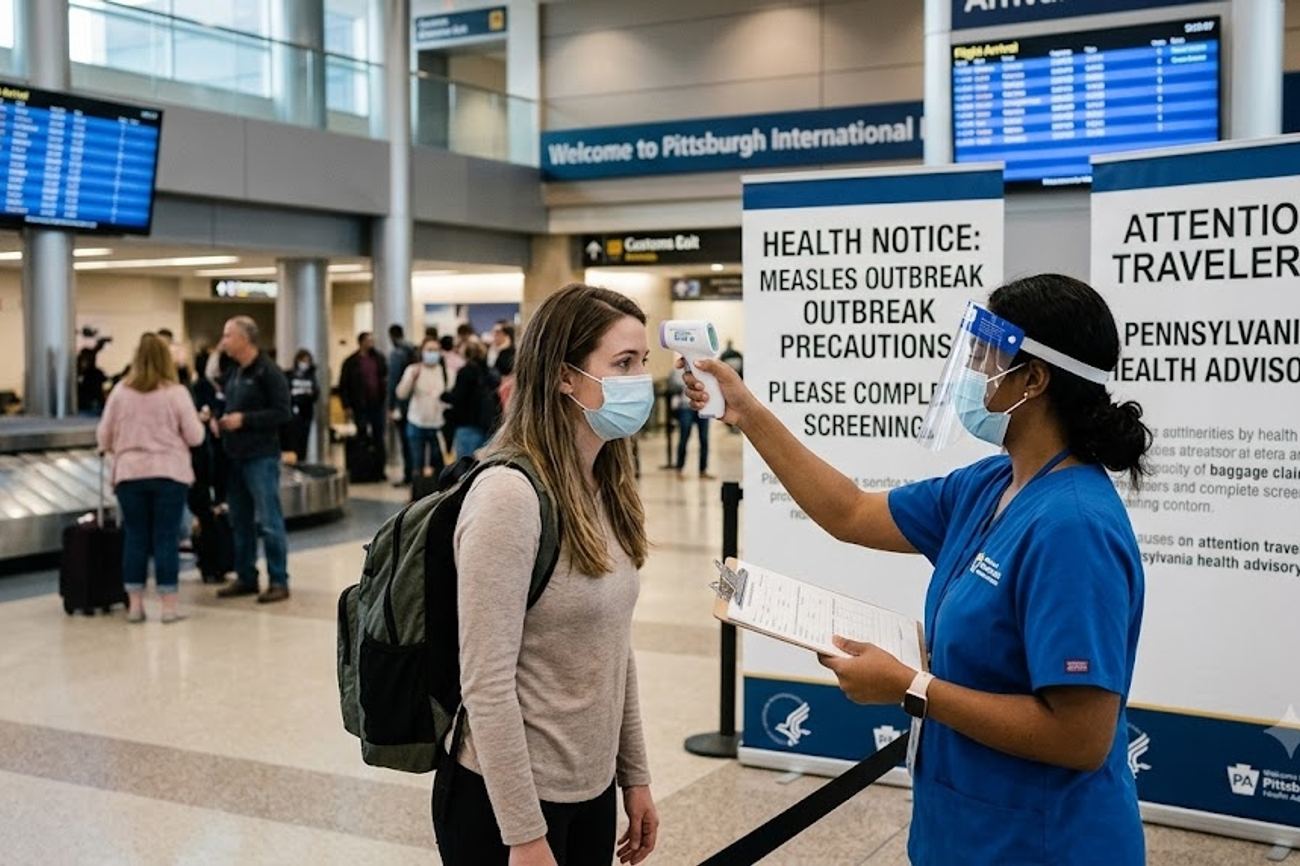
Image generated by AI
Less than 1% of the 676 confirmed measles cases across 37 Pennsylvania counties involved appropriately vaccinated individuals, yet a single exposure at the New Stanton Service Plaza on the Pennsylvania Turnpike demonstrates how swiftly an airborne pathogen can hitchhike across interstate travel corridors. Following the fatal complication of an unvaccinated 40-year-old woman in Jefferson County reported by Coroner Greg Furlong on September 13 (after her passing on September 12), the Commonwealth’s escalating outbreak has thrust travel health into sharp relief. With 124 hospitalizations recorded and 52 new cases reported in just 48 hours between September 9 and September 11, exploring Pennsylvania’s historic boroughs and scenic highways in 2026 requires understanding both regional charm and basic immunization security.
Turnpike Corridors and Pockets of Vulnerability: The 2026 Commonwealth Outbreak
The current health challenge in the Commonwealth of Pennsylvania is an accelerating event that initially sparked in late April 2026. The velocity of transmission is starkly revealed in state surveillance records: Pennsylvania tracked 460 cases across 31 counties on August 28, rising to 497 cases in 34 counties by August 31. By September 4, the tally reached 577 cases across 37 counties with 98 hospitalizations, continuing upward to 594 cases and 104 hospitalizations on September 8, 624 cases and 109 hospitalizations on September 9, and culminating in 676 confirmed cases and 124 hospitalizations across 37 counties by September 11. Over a single two-week window, the state logged 216 additional infections while transmission expanded across six new county jurisdictions.
The biological profile of this surge confirms the power of preventative immunization. State health officials confirmed that only four individuals among the 676 cases were appropriately vaccinated for their age—accounting for less than 1% of all documented infections. Clinical data continues to show that the standard two-dose measles, mumps, and rubella (MMR) regimen is 97% effective against infection. Prior to the recent Jefferson County fatality, the Pennsylvania Department of Health had verified two cumulative measles-associated deaths in its September 11 report.
This regional situation mirrors a widespread national trend across the United States. According to the Centers for Disease Control and Prevention, national confirmed measles cases reached 2,777 across 36 new outbreaks as of August 20, 2026, with 94% linked directly to concentrated outbreak clusters. This nationwide tally has already eclipsed the 2,289 cases and 48 outbreaks recorded throughout all of 2025 (where 90% were outbreak-associated).
Epidemiologists attribute this vulnerability to declining community protection. While a 95% vaccination threshold is required to sustain community herd immunity, CDC surveillance indicates that MMR immunization among American kindergarten children dropped from 95.2% during the 2019–20 school year to 92.4% in 2025–26. Although CDC Director Dr. Erica Schwartz stated that federal databases await formal state notification of the latest fatality and noted that Pennsylvania had not requested a federal CDC Epi-Aid team, local and federal professional staffs maintain regular operational dialogue as pop-up clinics roll out across the state.
What Makes Pennsylvania's Travel Geography Distinct and Susceptible
Pennsylvania occupies an indispensable geographical position as the multimodal bridge connecting the Atlantic seaboard to the Great Lakes and the American Midwest. The state’s vast road network—anchored by the historic Pennsylvania Turnpike (Interstate 76), Interstate 80 cutting across the northern forested plateau, and Interstate 81 winding through the Great Valley—funnels millions of cross-country truckers, vacationers, and business travelers every week.
When an out-of-state infected traveler visited the New Stanton Service Plaza on the Pennsylvania Turnpike on August 17, the incident exposed how shared highway infrastructure becomes an unintentional distribution node. Travelers moving between metropolitan hubs like Philadelphia and Pittsburgh mingle with long-distance drivers in service plazas, hotel lobbies, and roadside diners before dispersing into remote corners of the state.
Yet Pennsylvania’s travel appeal rests precisely in this balance of vibrant cities and serene rural topography. Travelers can explore the cultural institutions of Philadelphia’s Museum District or ride the historic inclines of Pittsburgh’s Mount Washington, and within two hours find themselves among the covered bridges of Lancaster County, the wilderness trails of the Pennsylvania Wilds, or the autumn foliage corridors of Jefferson County. Navigating this diverse terrain requires recognizing that small-town clinics and regional hospitals operate with different resource thresholds than urban medical centers, making responsible personal preparation vital. Travelers can monitor seasonal road updates and scenic route openings via Visit Pennsylvania.
Visitor Insider Tips: Navigating the Keystone State Safely
- Conduct a Pre-Trip Immunization Check: Prior to departing for Pennsylvania, verify your personal immunization history. Under public health guidelines, two documented doses of MMR separated by at least 28 days provide robust lifetime protection. Adults born before 1957 are generally considered to possess presumptive natural immunity. For international arrivals, review recommendations from the World Health Organization at least two weeks before your flight.
- Highway Transit and Meal Timing: When traveling along Interstate 76 or Interstate 80, avoid crowded highway service plaza cafeterias during peak lunch rushes between 12:00 PM and 1:30 PM. Instead, exit into charming borough main streets like Bedford, Ligonier, or Bellefonte to dine in well-ventilated independent diners and open-air farm markets.
- Sample Local Terroir and Comfort Classics: Pass by generic highway chains to experience regional culinary traditions. In Lancaster and Berks counties, stop at family-run farmers markets for warm shoofly pie, homemade apple butter, and fresh-baked sourdough soft pretzels. In Pittsburgh, head to the Strip District for a legendary overstuffed Primanti Brothers sandwich layered with provolone, grilled meats, tart coleslaw, and fresh-cut french fries. In Philadelphia, skip tourist-heavy street intersections to sample slow-roasted pork sandwiches with sharp provolone and garlicky broccoli rabe at Reading Terminal Market.
- Scenic Rail Alternatives: Instead of navigating highway traffic, consider booking Amtrak’s Pennsylvanian train service connecting Philadelphia, Lancaster, Harrisburg, and Pittsburgh. The route cuts through the picturesque Allegheny Mountains and curves around the famed Horseshoe Curve, offering panoramic forest views from wide-windowed passenger cars with modern air-filtration systems.
Rural Communities, Public Health Infrastructure, and Tourism Equilibrium
The intersection of travel and public health in Pennsylvania highlights the delicate relationship between visitor economies and local community welfare. In rural counties like Jefferson, healthcare facilities are built to support close-knit local populations rather than large surges of infectious illness. When outbreaks emerge, rural providers face immediate operational strain managing inpatient triage and airborne isolation protocols.
In response, Pennsylvania’s Department of Health has launched an aggressive field campaign. State health teams have conducted more than 120 mobile pop-up vaccination clinics across affected counties, administering over 4,100 MMR doses directly to residents since April. Across the entire Commonwealth, state health center professionals have delivered more than 6,200 MMR doses throughout 2026 to reinforce local community barriers against transmission.
This proactive, localized containment strategy mirrors successful international models, such as the public health approach deployed during the 2026 measles outbreak in Bangladesh. Rather than imposing blunt, economically damaging travel or trade restrictions, international health agencies prioritized mobile vaccination for front-line hospitality workers, rigorous contact tracing, and public transparency. By taking personal responsibility for vaccine verification, travelers can explore Pennsylvania’s historic battlefields, rolling cider orchards, and vibrant city neighborhoods while safeguarding the health of the host communities who welcome them.
FAQ: Visiting Pennsylvania Amid the 2026 Outbreak
Should travelers cancel upcoming vacations to Pennsylvania?
No. Public health agencies advise that fully vaccinated individuals face negligible risk of infection. The outbreak does not warrant travel cancellations, but visitors should verify their immunization records before departure.
What specific precautions should families traveling with infants take?
Infants aged six through 11 months who are traveling through regions with active outbreaks can receive an early MMR dose after consulting their pediatrician, followed by routine doses after their first birthday.
What should I do if I suspect measles exposure while traveling?
Monitor for fever, cough, runny nose, and red eyes followed by a characteristic rash three to five days later. Contact a healthcare clinic by phone before arriving so staff can prepare proper isolation measures.
Are major attractions in Philadelphia and Pittsburgh operating normally?
Yes. Historic landmarks, national park sites, museums, and hotels across Pennsylvania’s metropolitan centers are operating on standard schedules without regional capacity limits or entry health checks.
The soul of the Keystone State endures in its winding forest roads and welcoming valley towns, where responsible travel keeps the path open for everyone.
Related Travel Guides
- São Paulo, Bogotá and Lima Show How Gastronomy Is Becoming a Major Competitive Force in Latin American Tourism
- Guam Travel Entry Rules Put Mandatory EDF in Focus Ahead of Tumon Fair and Sinajaña Festival Activities
- Cartagena and Florianópolis Lead the Americas' Fastest-Growing Tourist Cities as Secondary Metropoles Reshape Regional Travel in 2026
Disclaimer
This article is for informational and educational purposes only. It does not constitute legal, financial, or professional advice. While we strive to provide accurate and up-to-date information, travel policies, regulations, and conditions change rapidly. Always verify information with official sources before making travel decisions. Nomad Lawyer makes no representations about the accuracy, reliability, completeness, or suitability of the information provided. Readers should consult qualified professionals for advice specific to their circumstances. The views expressed in this article are those of the author and do not necessarily reflect the views of Nomad Lawyer.
Naina Thakur
Contributor & Travel Specialist
Travel enthusiast and legal writer covering visa regulations, responsible tourism, and cultural journeys across global destinations.
Learn more about our team →