
Guam Travel Entry Rules Put Mandatory EDF in Focus Ahead of Tumon Fair and Sinajaña Festival Activities
Guam Travel Entry Rules Put Mandatory EDF in Focus Ahead of Tumon Fair and Sinajaña Festival Activities. Latest travel news, updates, and expert analysis.

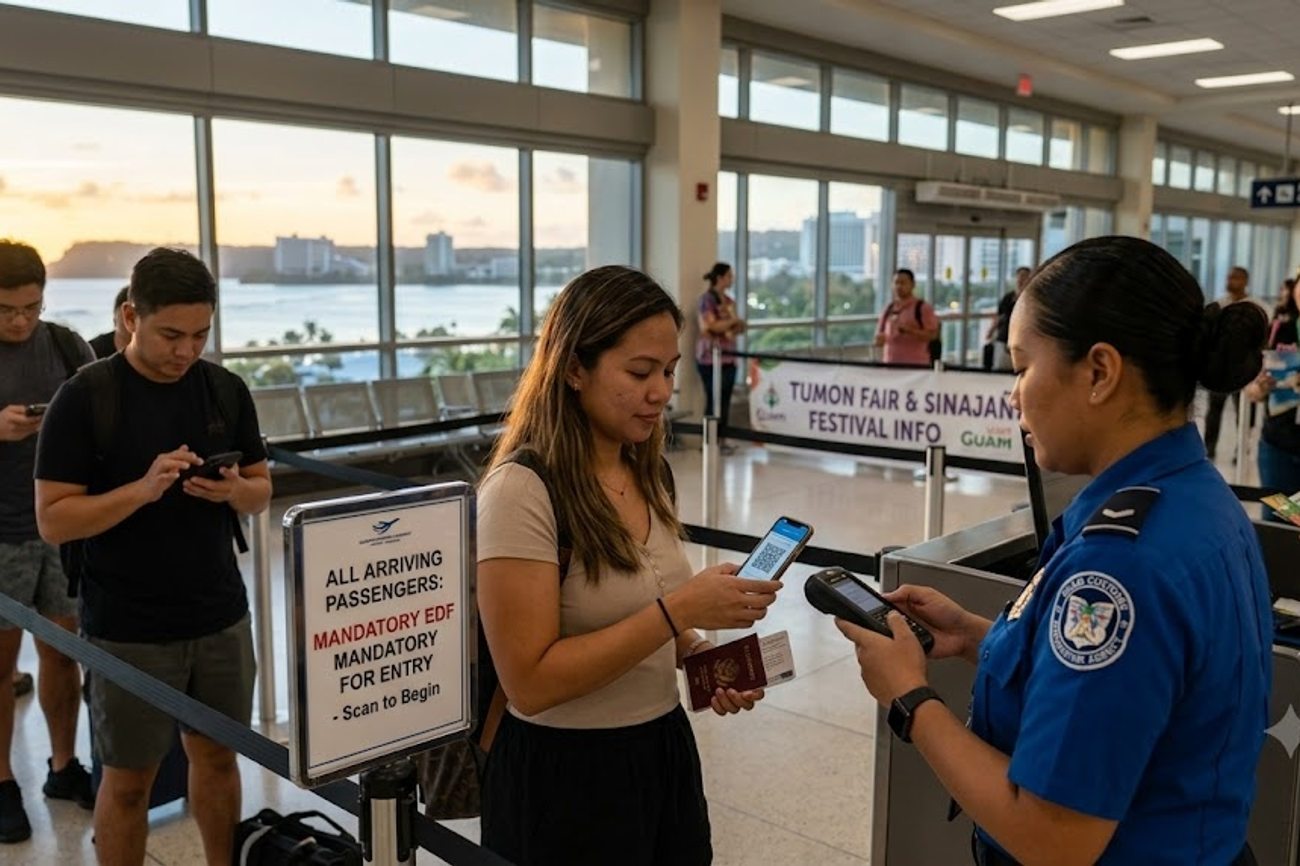
Image generated by AI
While many travelers imagine Guam as a single resort strip, this westernmost United States territory is organized into nineteen distinct villages, welcoming over 700,000 annual arrivals who must now navigate two separate digital border checkpoints before ever stepping onto the sand. International festival attendees flying in for late-2026 cultural celebrations cannot simply pack an airline boarding pass and expect an effortless stroll through customs at Tamuning. Arriving passengers face a mandatory online customs declaration completed within seventy-two hours of landing, while eligible visa-waiver travelers across twelve Asia-Pacific and British territories must hold an approved electronic travel authorization before airlines will even permit boarding.
Digital Gateways and Village Stages: How Late-2026 Reshapes Guam Travel
Travel throughout Guam during the final quarter of 2026 pairs indigenous heritage with rigorous border administration. The 38th Guam Micronesia Island Fair takes over Governor Joseph Flores Memorial Park along Ypao Beach in Tumon from 23 to 25 October 2026, gathering master navigators, artisans, and performers from across the Caroline, Marshall, and Mariana archipelagos. Just weeks later, the Guam International Dance Festival welcomes global performance troupes on 1 December 2026, staging community exchanges at the Sinajaña Fine Arts Center, Micronesia Mall, and Tsubaki Plaza on 2 and 3 December, followed by main championship events from 4 to 6 December 2026.
Reaching these open-air celebrations requires strict adherence to digital administrative sequences. Every inbound traveler, regardless of nationality, must submit the electronic Guam Electronic Declaration Form (EDF). Originally introduced in March 2021 as a touchless health and customs initiative backed by CAT6A wiring, redundant servers, and dedicated 100Mbps fiber connections at A.B. Won Pat International Airport, the declaration officially eliminated paper documents on 4 February 2025. Today, declarations open precisely 72 hours before flight arrival, must be completed in English, and permit a single responsible head of household to cover all qualifying family members traveling together. While physical kiosks remain stationed in the Tamuning airport baggage-claim hall as an arrival fallback, completing the form on a mobile device before departure prevents lengthy terminal bottlenecks.
A distinct regulatory layer governs foreign travelers arriving via the Guam-Commonwealth of the Northern Mariana Islands Visa Waiver Program. Under U.S. Customs and Border Protection mandates instituted in late November 2024, the historical paper Form I-736 was retired in favor of the mandatory online G-CNMI electronic travel authorization (eTA). Eligible passport holders from Australia, Brunei, Hong Kong, Japan, Malaysia, Nauru, New Zealand, Papua New Guinea, South Korea, Singapore, Taiwan, and the United Kingdom must secure this digital authorization before departure. An approved G-CNMI eTA remains valid for up to two years, allows stays up to 45 days, and applies individually to each traveler rather than per family group.
Critically, entry under the G-CNMI program strictly limits movement to Guam and the Northern Mariana Islands; it cannot be used to transit forward into Hawaii or the continental United States without a standard ESTA or federal visa. For visitors coordinating their flights, the Guam Visitors Bureau has established promotional booking windows via United Meetings utilizing promo code ZRFV299162, offering waived reservation service fees and standard MileagePlus mileage accrual for journeys between 14 October and 5 November 2026 for the island fair, and 24 November through 16 December 2026 for the international dance competition.
What Makes Guam Distinct From Typical Pacific Island Getaways
Guam defies simplistic island stereotypes through its layered colonial history and enduring indigenous Chamorro identity. As the southernmost and largest island in the Mariana chain, it does not function through municipal cities. Instead, administrative life flows through nineteen historical villages, stretching from the northern limestone plateaus down through southern volcanic hills and tranquil bay inlets.
Tamuning operates as the island's primary commercial crossroad and aviation gateway, housing A.B. Won Pat International Airport at 355 Chalan Pasaheru. Adjacent Tumon functions as the beachfront hospitality corridor, wrapping around the turquoise shallows of Tumon Bay. Yet moving just fifteen minutes inland toward Sinajaña reveals a quiet, elevated community known for steep residential hills, rich red clay soil, and deep Catholic parish traditions anchored by Saint Jude Thaddeus Church. The presence of the Sinajaña Fine Arts Center provides a community venue where village youth practice traditional chants and stick dances far removed from hotel ballrooms.
Beyond the resorts, visitors can inspect ancient haligi and tasa megaliths—the two-piece limestone latte stones erected by ancient Chamorro seafarers as home foundations starting around 800 CE. At the War in the Pacific National Historical Park, historic coastal gun emplacements and coral-fringed invasion beaches at Asan and Agat document the fierce 1944 Pacific fighting, grounding tropical leisure in profound historical memory.
Visitor Insider Tips: Navigating Island Pacing, Customs, and Logistics
- Sun Timing and Coastal Rhythms: Equatorial sun on Guam is intense. Schedule coastal walking, historic village exploration, and snorkeling between 7:00 AM and 9:30 AM, or after 4:30 PM. Sunset along Ypao Beach is a communal ritual where local families gather to swim, grill, and listen to island reggae as the trade winds pick up.
- Chamorro Hospitality and Village Etiquette: If invited to a village fiesta or family gathering, always greet the eldest hosts first. Practicing mannginge'—bowing slightly to press an elder's right hand to your forehead while saying "Håfa Adai"—signals deep respect. When taking food from a fiesta buffet table, accept an offered balutan plate to pack leftovers for later, which hosts consider a compliment to their cooking.
- Local Culinary Essentials: Pass by commercial franchise strips to sample authentic island fare. Order chicken kelaguen—finely chopped chicken cured in fresh calamansi juice, grated coconut, and fiery donne' peppers, scooped with warm handmade flour titiyas. Pair it with hineksan aga'ga' (red rice infused with achote seeds) and smoked pork ribs glazed in tart, soy-vinegar finadene sauce. Visit the Wednesday Night Market at Chamorro Village in Hagåtña for street food skewers, fresh tuba (fermented coconut sap), and live island bands.
- Island Mobility and Transit Hacks: Public bus networks on Guam are sparse and irregular. The Red Guahan Shuttle links major Tumon hotels with shopping centers like Micronesia Mall and Guam Premier Outlets, but cannot reach inland venues like Sinajaña or southern heritage trails. Renting a vehicle from airport concessions in Tamuning is the most reliable way to explore. Alternatively, download the Stroll Guam ride-hailing app, which operates reliably across Tumon, Tamuning, and Hagåtña.
Cultural Identity, Coastal Preservation, and Island Stewardship
Guam’s cultural calendar serves as a vital tool for environmental and indigenous survival. Over decades of Spanish colonial rule, Japanese wartime occupation, and ongoing American military presence, the Chamorro people faced severe cultural suppression. Today, events like the Micronesian Island Fair and the International Dance Festival are active declarations of cultural sovereignty. Island youth are reclaiming Fino' CHamoru (the native language), mastering the construction of traditional sakman ocean-going outrigger canoes, and reviving indigenous weaving arts utilizing aggak (pandanus leaves).
Environmental stewardship remains inextricably linked with island heritage. Tumon Bay, Pago Bay, and Piti Bomb Holes are designated marine preserves subject to strict no-take fishing and conservation regulations. These shallow lagoon reefs protect the shoreline from typhoons and sustain green sea turtles, stingrays, and over four hundred species of marine life. Visitors should apply only reef-safe, non-nano zinc oxide mineral sunscreens, avoid stepping on fragile brain coral heads during low tide, and stay on marked paths around sensitive coastal limestone forests where endangered Mariana fruit bats and native tree snails cling to survival.
FAQ: Visiting Guam in 2026
Can I travel onward to Hawaii using an approved G-CNMI eTA?
No. The G-CNMI Visa Waiver Program permits entry only into Guam and the Commonwealth of the Northern Mariana Islands. Travelers heading onward to Hawaii or the continental United States must obtain a federal ESTA or a valid United States non-immigrant visa before departure.
What happens if I forget to submit the Guam EDF prior to flying?
While pre-arrival digital filing within 72 hours of departure is strongly recommended, travelers who forget can complete the form on dedicated self-service electronic kiosks in the baggage-claim hall at A.B. Won Pat International Airport before passing customs.
What is the ideal season to experience Guam's cultural festivals?
Late October through December provides an exceptional balance of cultural programming and comfortable weather. Tropical trade winds moderate coastal humidity, while signature gatherings like the Micronesia Island Fair and International Dance Festival showcase traditional arts and regional cuisine.
Is a rental car required to explore beyond Tumon Bay?
Yes. Public transit options outside the primary resort district are extremely limited. A rental vehicle is essential for visiting southern coastal villages, inland cultural venues in Sinajaña, historic parks, and quiet southern beaches like Inalåhan and Talofofo.
Guam reveals its truest spirit when travelers look beyond the neon hotel fronts of Tumon and follow the trade winds inland to the village fires where ancient Micronesian memory burns bright.
Related Travel Guides
- Japan Rises With Finland And More As UAE Travellers Embrace A New Era Of Winter Ski Travel Holidays
- Netherlands Stands Alongside France And More As Germany Issues New Travel Advisory Due To Identification, Security And Entry Risks
- Vietnam’s Quy Nhon And Pleiku Boost Tourism With A Bold 2050 Urban Vision For Smart And Sustainable Growth
Disclaimer
This article is for informational and educational purposes only. It does not constitute legal, financial, or professional advice. While we strive to provide accurate and up-to-date information, travel policies, regulations, and conditions change rapidly. Always verify information with official sources before making travel decisions. Nomad Lawyer makes no representations about the accuracy, reliability, completeness, or suitability of the information provided. Readers should consult qualified professionals for advice specific to their circumstances. The views expressed in this article are those of the author and do not necessarily reflect the views of Nomad Lawyer.
Kunal K Choudhary
Co-Founder & Contributor
A passionate traveller and tech enthusiast. Kunal contributes to the vision and growth of Nomad Lawyer, bringing fresh perspectives and driving the community forward.
Learn more about our team →