
Middle East Aviation Gridlock: 1,307 Delays and 71 Cancellations Hit Jeddah, Riyadh, Dubai, and Regional Hubs
Over 1,307 flight delays and 71 cancellations disrupted Middle Eastern air travel, with heavy operational bottlenecks concentrated across Jeddah, Riyadh, and Dubai.

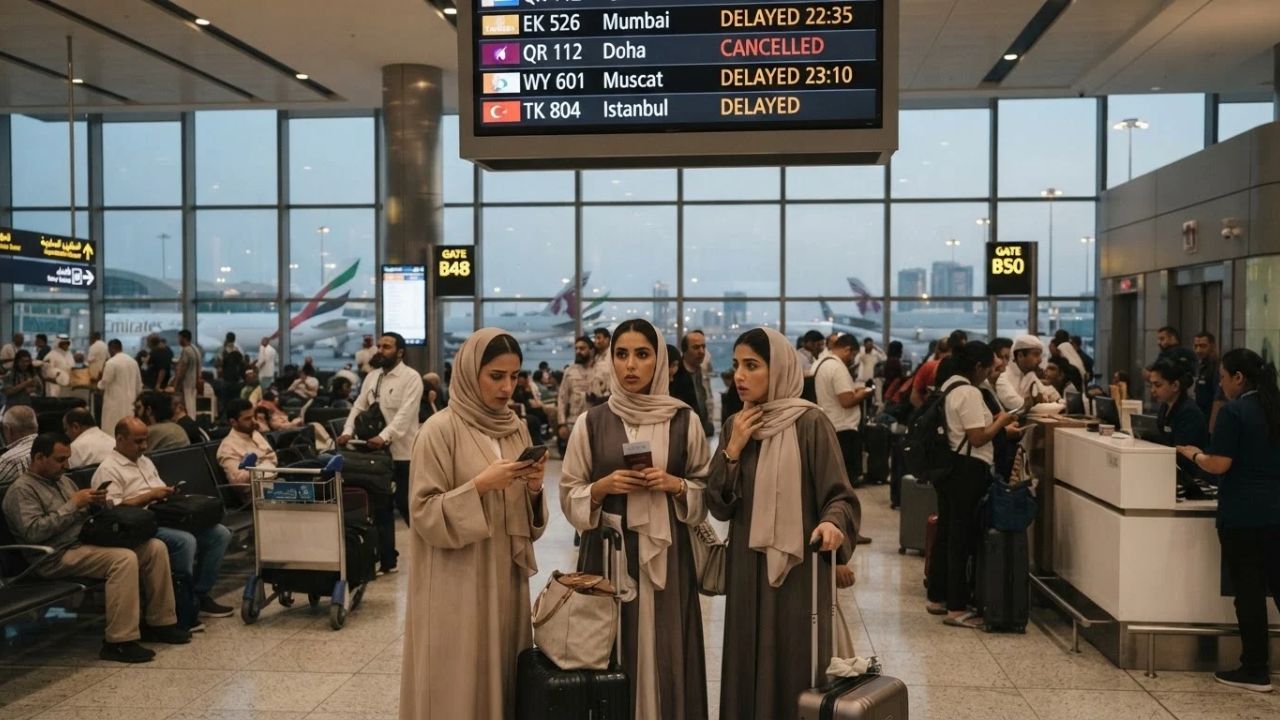
Image generated by AI
When operational friction cascades across Middle Eastern aviation networks, the epicenter is rarely a remote desert outpost—it is the dual commercial and religious gateways of Saudi Arabia, where Jeddah and Riyadh absorbed a combined 436 delays and 24 cancellations in a single day. Real-time flight tracking intelligence from FlightAware recorded on September 15, 2026, at 5:05 pm ET (September 16 at 1:06 am GST) reveals a sharp escalation across the region, totaling 1,307 flight delays and 71 cancellations. This steep operational surge, up dramatically from 490 delays and 70 cancellations recorded the previous day, placed unprecedented pressure on long-haul transfer passengers connecting across Europe, Africa, and Asia.
The Regional Bottleneck: Major Hubs Under Operational Strain
The brunt of the disruption centered on King Abdulaziz International Airport in Jeddah, Saudi Arabia's premier entry point for international travelers and Red Sea commerce. Jeddah recorded 268 delays and 9 cancellations, representing the single highest delay volume of any facility in the region. To the east, King Khalid International Airport in the capital of Riyadh logged 168 delays and 15 cancellations, establishing the highest individual cancellation tally among all monitored terminals. Regional secondary airfields across the Kingdom also felt the shockwave, with Abha Regional Airport reporting 43 delays and 10 cancellations, Najran Domestic Airport recording 4 cancellations, and Gizan Regional Airport handling 3 cancellations.
Across the Gulf, the United Arab Emirates faced significant ground pressure. Dubai International Airport, the busiest international passenger airport on the planet, recorded 139 delays and 11 cancellations, while nearby Sharjah International Airport logged 63 delays and 2 cancellations. Because Dubai operates as an intricate global transfer gear connecting flights from North America and Europe with South Asia and Australasia, even modest thirty-minute ground holds triggered missed connections down the line.
Outside the Arabian Peninsula, transfer choke points absorbed secondary schedule friction. Istanbul Airport in Türkiye recorded 174 delays and 5 cancellations, reflecting heavy congestion along European and Asian air corridors. Cairo International Airport, North Africa's primary connecting junction, logged 170 delays and 3 cancellations. In Israel, Ben Gurion International Airport in Tel Aviv registered 213 delays alongside 3 cancellations. Further regional delays occurred at Queen Alia International Airport in Amman, Jordan (42 delays, 1 cancellation), Bahrain International Airport (22 delays, 1 cancellation), and Imam Khomeini International Airport in Tehran, Iran (5 delays, 4 cancellations).
Airline Network Disruption: Flag Carriers and Budget Fleets
Operational stability varied widely between national legacy operators and regional low-cost carriers:
- Saudia: The Kingdom's flag carrier absorbed the heaviest overall operational strain, recording 173 delayed flights (representing a 31% delay rate across its daily schedule) and 20 cancellations (a 3% cancellation rate). Because Saudia coordinates multi-leg domestic pilgrimages alongside long-haul international routes, equipment displacement in Jeddah rapidly cascaded throughout provincial domestic airports.
- Flynas: The Saudi budget carrier logged 94 delays, translating to an elevated 33% delay rate against just 2 cancellations, illustrating how tight aircraft turnaround windows leave little buffer when airport gates face air traffic ground holds.
- Air Arabia: Operating out of its primary Sharjah hub, the low-cost carrier posted 55 delays (a 24% delay rate) and 2 cancellations.
- Flydubai: The regional carrier experienced 41 delays (a 14% delay rate) and 2 cancellations across its short- and medium-haul network.
- Emirates: The Dubai-based widebody operator demonstrated strong schedule resilience, logging 57 delays (a 10% delay rate) and only 1 cancellation across its massive global fleet.
- Regional and International Lines: Mahan Air recorded 4 cancellations (12%) and 3 delays (9%). Royal Jordanian logged 21 delays (14%) and 2 cancellations (1%). Israir registered 38 delays (a 40% delay rate) and 1 cancellation (1%). Gulf Air experienced 12 delays (8%) and 1 cancellation. Syrian carrier Fly Cham absorbed 4 delays (50%) and 2 cancellations (25%), while Yemenia (Yemen Airways) experienced extreme schedule vulnerability with 11 delays (a 91% delay rate) and 1 cancellation (8%).
What Makes Middle Eastern Air Transit Different
Navigating a flight disruption in the Middle East is fundamentally different from experiencing a weather delay in Chicago or Frankfurt. Mega-airports like Dubai, Doha, and Istanbul do not rely on local origin-and-destination passenger volume; over seventy percent of their passengers never set foot outside the terminal walls. These facilities operate as round-the-clock transit machines where flight banks arrive in massive waves during the middle of the night to optimize long-haul connections between global time zones.
When a flight bank slips off schedule in Jeddah or Riyadh, the entire ecosystem must adapt under strict regulatory frameworks enforced by the General Authority of Civil Aviation (GACA). Furthermore, Middle Eastern airspace architecture is uniquely constrained. Narrow commercial transit corridors squeezed between military restricted zones, oceanic boundaries, and fluctuating regional air corridors require air traffic control to hold aircraft on the ground rather than allowing extensive airborne holding patterns.
The human element is equally distinct. Thousands of travelers passing through Jeddah at any given hour are dressed in the white terrycloth ihram garments of Islamic pilgrimage, traveling on specialized religious visas that carry strict movement parameters. Managing displaced passenger flows under these conditions requires specialized ground logistics, bilingual passenger care desks, and designated prayer and ablution zones that standard Western aviation facilities simply do not possess.
Visitor Insider Tips
When transit delays strike Middle Eastern hubs, experienced travelers rely on specific tactical measures to protect their itineraries:
- Secure transit hotel vouchers before leaving the international airside concourse: If your connecting flight through Dubai, Jeddah, or Istanbul is delayed past eight hours due to airline scheduling, visit the airline's transfer customer service desk immediately. Under international aviation conventions and regional passenger charters, carriers are obligated to provide transit hotel accommodation, meal vouchers, and airport transport. Leaving the secure transit zone without obtaining these vouchers makes retroactive compensation difficult to claim.
- Understand the ninety-minute minimum connection safety threshold: While airlines routinely sell tickets with tight fifty-minute layovers in Dubai or Istanbul, these bookings are hazardous during peak operating banks. Both airports feature terminals stretching over a mile in length, where transferring between remote satellite gates requires internal train rides and secondary security checkpoints. Never accept an itinerary with less than a two-hour transfer window.
- Take advantage of world-class terminal amenities during daytime delays: Rather than waiting on plastic gate chairs, explore terminal facilities designed for multi-hour stays. In Dubai's Concourse A and B, quiet relaxation snooze lounges, complimentary shower suites, and twenty-four-hour health clubs with swimming pools are accessible for small walk-in fees. In Jeddah's Terminal 1, dedicated family lounges provide comfortable reclining seating away from main concourse boarding announcements.
- Keep digital and hard-copy transit visas readily accessible: If forced into an unplanned overnight stay, travelers carrying passports eligible for on-arrival electronic visas in the UAE or Saudi Arabia can clear immigration within minutes. Ensure you have digital copies of your passport biographical page and return flight confirmation saved offline on your mobile device to complete e-gate procedures smoothly.
- Carry a dedicated multi-currency payment card for unexpected layovers: Duty-free concessions and airport dining outlets in Istanbul, Cairo, and the Gulf accept major credit cards, but secondary currency conversion fees add up quickly. Carry a digital fintech card loaded with local dirhams, riyals, or US dollars to purchase meals and essentials without unfavorable terminal currency exchange markups.
Cultural and Environmental Context
The operational challenges confronting Middle Eastern aviation hubs underscore the region's ambitious transformation from oil-dependent economies into global tourism and logistics nerve centers. Under Saudi Arabia's Vision 2030 and similar economic diversification strategies in the UAE and Qatar, commercial aviation is viewed as a vital pillar of national development. The Kingdom is investing hundreds of billions of dollars to expand airport infrastructure, launch new national carriers, and transform the Red Sea coast into an international travel destination.
However, rapid capacity expansion intersects with environmental and climatic realities. Summer and early autumn temperatures across the Arabian Peninsula routinely exceed 115°F (46°C). Extreme surface heat thins the air density, reducing aircraft engine lift capacity and forcing airlines to recalculate takeoff weights, passenger payloads, and fuel reserves. These extreme thermal conditions impose heavy physical wear on ground support equipment, aircraft air conditioning systems, and baggage handling networks.
Simultaneously, religious tourism creates intense seasonal demands unlike anywhere else in global aviation. Millions of pilgrims travel to Mecca and Medina year-round for Umrah, creating continuous passenger movements through Jeddah and Madinah. Balancing these holy journeys with business transit, leisure travel, and international cargo requires unprecedented coordination between civil aviation regulators, immigration authorities, and airline operations centers. For travelers traversing this dynamic global crossroads, schedule resilience remains the defining asset.
FAQ: Navigating Middle East Flight Disruptions in 2026
What rights do passengers have during flight delays in Saudi Arabia?
Under GACA passenger rights regulations, airlines operating in Saudi Arabia must provide complimentary drinks and snacks after three hours of delay, accommodation and ground transport after six hours, and full ticket refunds if delays exceed five hours.
Can travelers leave the airport during an extended layover in Dubai?
Yes. Citizens from over seventy countries, including the United States, Canada, the United Kingdom, and the European Union, receive free 30-day visas on arrival, allowing travelers to clear customs and explore Dubai via the Dubai Metro during long delays.
What happens to checked baggage during a missed connection in Istanbul or Jeddah?
Baggage remains tagged to your final destination and transfers automatically to your newly rebooked flight. Always pack essential medications, phone chargers, and a fresh change of clothes in your cabin carry-on bag in case your connection is missed.
How can passengers track real-time schedule changes across Middle East hubs?
Download your airline's dedicated mobile app and enable push notifications. Cross-reference terminal gate screens with real-time flight tracking platforms to verify actual aircraft arrival times before proceeding through security check lines.
In the high-stakes transit hubs of the Middle East, a well-planned layover turns an unexpected delay into a masterclass in modern global travel.
Related Travel Guides
10 Essential Transit Hacks for Long Layovers in Dubai and Doha, According To Reddit
Disclaimer
This article is for informational and educational purposes only. It does not constitute legal, financial, or professional advice. While we strive to provide accurate and up-to-date information, travel policies, regulations, and conditions change rapidly. Always verify information with official sources before making travel decisions. Nomad Lawyer makes no representations about the accuracy, reliability, completeness, or suitability of the information provided. Readers should consult qualified professionals for advice specific to their circumstances. The views expressed in this article are those of the author and do not necessarily reflect the views of Nomad Lawyer.
Raushan Kumar
Founder & Lead Developer
Full-stack developer with 11+ years of experience and a passionate traveller. Raushan built Nomad Lawyer from the ground up with a vision to create the best travel and law experience on the web.
Learn more about our team →