
Middle East Aviation Crisis 2026: 910 Delays and 36 Cancellations Hit Dubai, Erbil and Saudi Airports
Operational failures across Dubai, Erbil, and Saudi Arabian hubs have triggered 910 flight delays and 36 cancellations, disrupting major carriers like Turkish Airlines and Air India.

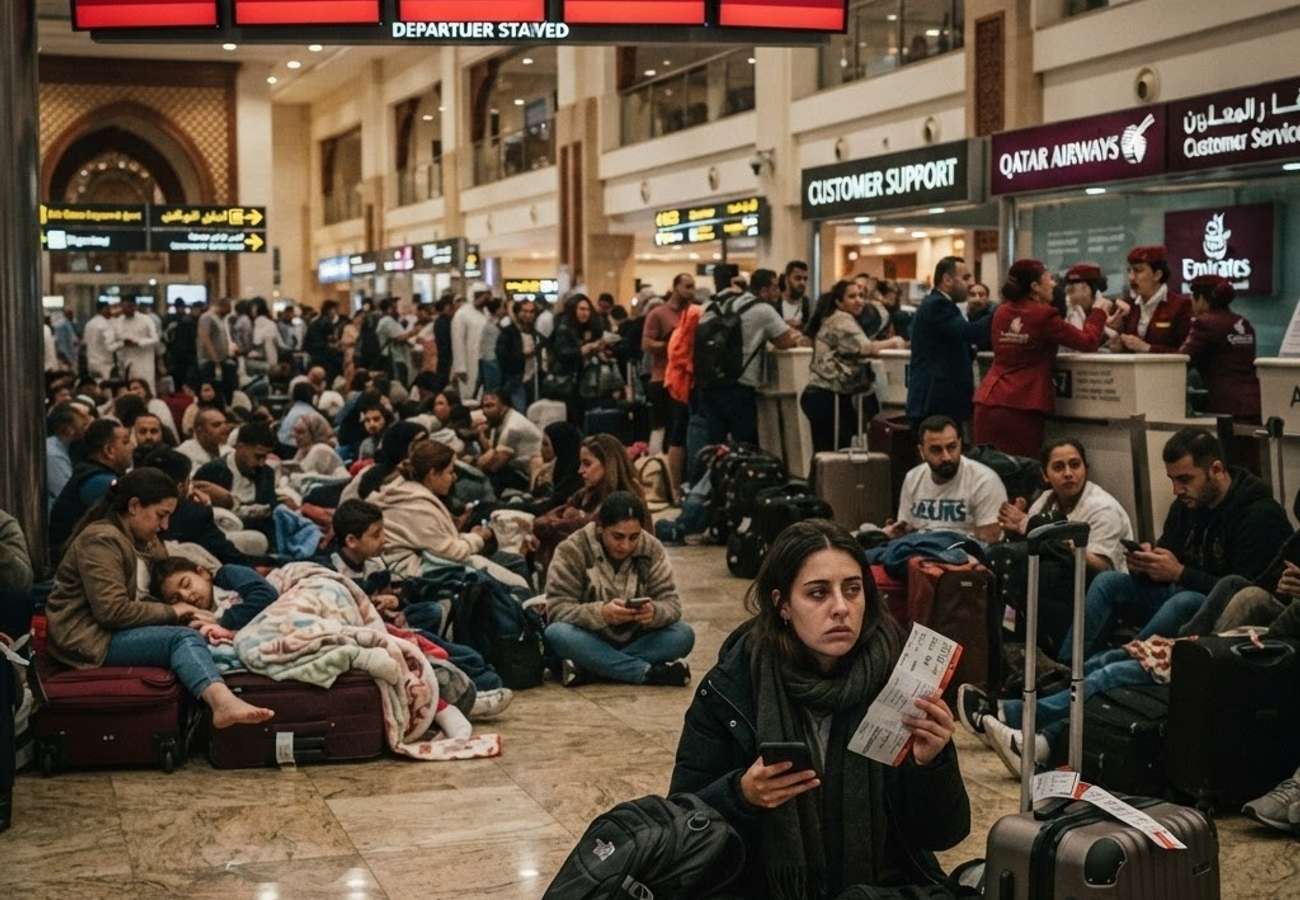
Image generated by AI
A wave of operational failures across the Middle East has resulted in 910 flight delays and 36 cancellations, paralyzing travel at major hubs in the UAE, Saudi Arabia, Turkey, and Iraq. Passengers connecting through these critical aviation gateways face significant unpredictability as regional security concerns and airspace volatility force major airlines to overhaul their schedules.
The disruptions center on some of the world's most high-traffic transit points, where a combination of shifting airspace conditions and airline schedule modifications has created a bottleneck. Major carriers, including Air India, Turkish Airlines, FlyDubai, Air Arabia, and Saudia, have all reported interrupted operations, leaving thousands of international travelers stranded or delayed.
Dubai and Istanbul Hubs Face Maximum Operational Pressure
The most severe impact has been concentrated at the region's primary international gateways. Dubai International Airport (DXB) in the UAE emerged as the most affected site, recording 255 delays and 7 cancellations. Given DXB's status as a global nexus connecting Asia, Europe, and Africa, these disruptions have a cascading effect, triggering secondary delays for passengers who are merely transiting through the UAE.
Similarly, Istanbul Sabiha Gökçen International Airport in Türkiye has seen massive instability, with 237 delays and 2 cancellations. This volume of disruption underscores the immense pressure currently placed on connectivity between European markets and Middle Eastern destinations.
Saudi Arabian Aviation Network Records Widespread Instability
The Kingdom of Saudi Arabia has seen disruptions spread across multiple cities, affecting both religious pilgrimage travel and business corridors. King Abdulaziz International Airport in Jeddah reported 122 delays and 5 cancellations, while King Khalid International Airport in Riyadh saw 120 delays and 7 cancellations.
The instability extends beyond the primary hubs into regional airports. Combined data from the Kingdom's network—including Dammam, Abha, Jizan, and Najran—reveals a total of 336 delays and 24 cancellations, signaling a systemic challenge across the Saudi aviation infrastructure.
Regional Airport Disruption Statistics
The following data outlines the specific impact across the most affected airports in the region:
| Airport | Country | Delays | Cancellations |
|---|---|---|---|
| Dubai International Airport | UAE | 255 | 7 |
| Istanbul Sabiha Gökçen International Airport | Türkiye | 237 | 2 |
| King Abdulaziz International Airport | Saudi Arabia | 122 | 5 |
| King Khalid International Airport | Saudi Arabia | 120 | 7 |
| Sharjah International Airport | UAE | 76 | 2 |
| King Fahd International Airport | Saudi Arabia | 50 | 1 |
| Abha Regional Airport | Saudi Arabia | 44 | 4 |
| Erbil International Airport | Iraq | 6 | 1 |
| Gizan Regional Airport | Saudi Arabia | 0 | 3 |
| Najran Domestic Airport | Saudi Arabia | 0 | 4 |
Major Carriers Struggle with Schedule Volatility
The operational strain is reflected in the performance of the airlines operating these routes. Turkish Airlines recorded the highest volume of delays with 273 incidents, a result of its vast network spanning three continents. Air India followed closely with 255 delays and 7 cancellations, highlighting the vulnerability of the critical India–Middle East aviation corridor.
UAE-based carriers also faced significant hurdles. FlyDubai reported 89 delays and 1 cancellation, while Air Arabia saw 72 delays and 2 cancellations. Meanwhile, Saudia recorded the highest number of total cancellations among the listed airlines, with 12 flights scrubbed and 69 delays.
| Airline | Country / Region | Cancellations | Cancellation Rate | Delays | Delay Rate |
|---|---|---|---|---|---|
| Saudia | Saudi Arabia | 12 | 2% | 69 | 12% |
| Air India | India | 7 | 0% | 255 | 35% |
| Air Arabia | UAE (Sharjah) | 2 | 0% | 72 | 28% |
| Turkish Airlines | Türkiye | 1 | 0% | 273 | 15% |
| FlyDubai | UAE (Dubai) | 1 | 0% | 89 | 25% |
Passenger Rights and Mitigation Strategies
For travelers currently caught in this disruption, immediate action is required to minimize travel loss. Industry observers suggest that passengers should not rely on airport screens alone but should verify flight status via official airline mobile applications before departing for the terminal.
When faced with a cancellation or significant delay, passengers are advised to:
- Initiate Immediate Contact: Reach out to the carrier to secure rebooking options.
- Verify Refund Eligibility: Check if the disruption qualifies for a full refund or travel credit under the airline's specific policy.
- Buffer Travel Time: Anticipate longer queues at check-in and customer service desks due to the volume of affected passengers.
- Document Everything: Maintain a digital and physical trail of all communication and booking references for potential insurance claims.
Why This Matters: The Legal and Logistical Reality
For the modern traveler, these figures represent more than just numbers on a spreadsheet; they signal a period of extreme volatility in Middle Eastern airspace. From a logistical standpoint, the high delay rates—particularly the 35% delay rate for Air India—suggest that the "hub-and-spoke" model is currently failing. When a primary hub like Dubai or Istanbul falters, it creates a domino effect that can strand a passenger thousands of miles away from their original destination.
From a legal perspective, passengers should be aware that "operational issues" and "airspace circumstances" are often cited by airlines to limit liability for compensation. However, depending on the jurisdiction of the ticket purchase or the destination, travelers may still be entitled to duty of care (meals and hotels) during these extended delays. The reliance on "real-time data" from sources like FlightAware indicates that these disruptions are fluid, and the lack of stability suggests that flight schedules in the region should be viewed as provisional rather than guaranteed for the immediate future.
Travelers are urged to maintain maximum flexibility as regional aviation networks struggle to regain stability.
Related Travel Guides
Disclaimer
This article is for informational and educational purposes only. It does not constitute legal, financial, or professional advice. While we strive to provide accurate and up-to-date information, travel policies, regulations, and conditions change rapidly. Always verify information with official sources before making travel decisions. Nomad Lawyer makes no representations about the accuracy, reliability, completeness, or suitability of the information provided. Readers should consult qualified professionals for advice specific to their circumstances. The views expressed in this article are those of the author and do not necessarily reflect the views of Nomad Lawyer.
Raushan Kumar
Founder & Lead Developer
Full-stack developer with 11+ years of experience and a passionate traveller. Raushan built Nomad Lawyer from the ground up with a vision to create the best travel and law experience on the web.
Learn more about our team →