
Malaysia and Russia Eye Direct Flights and Visa-Free Access to Fuel 2027 Tourism Surge

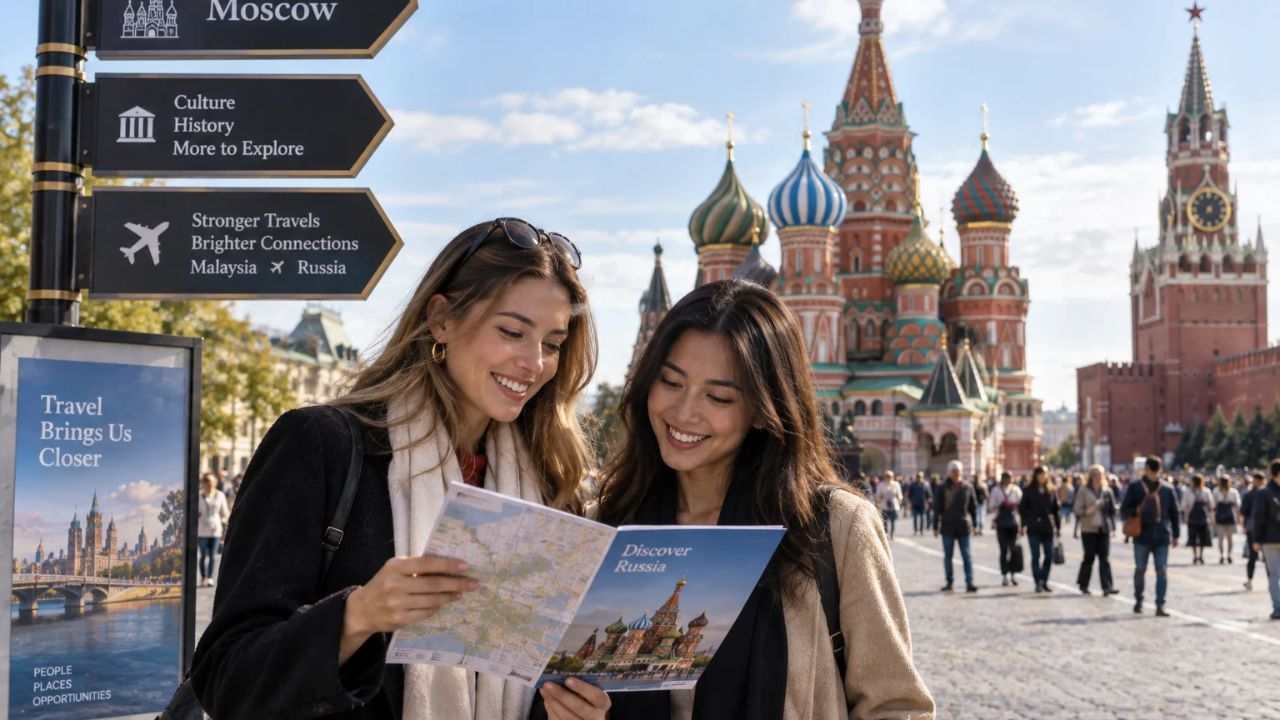
Following bilateral discussions between Malaysian Prime Minister Datuk Seri Anwar Ibrahim and Russian President Vladimir Putin at the 18th BRICS Leaders’ Summit in New Delhi, Malaysia and Russia are advancing plans to introduce direct non-stop flights and reciprocal visa-free travel arrangements. Building on a bilateral trade relationship that generated RM8.72 billion in 2025, the proposed mobility framework aims to remove transit barriers, open direct air corridors, and stimulate long-haul leisure travel between Eurasia and Southeast Asia.
The high-level talks mark an accelerating effort by Tourism Malaysia and the Ministry of Tourism, Arts and Culture (MOTAC) to diversify long-haul international visitor arrivals. Currently reliant on multi-stop flight itineraries through Middle Eastern or Central Asian hubs, travel between Moscow, St. Petersburg, and Malaysian destinations like Kuala Lumpur, Penang, and Langkawi could see journey times reduced by six to eight hours once non-stop air links and simplified entry protocols are implemented.
The Local Trend Revealed: High-Level Bilateral Talks at the 18th BRICS Summit
The diplomatic encounter between Prime Minister Anwar Ibrahim and President Vladimir Putin alongside the 18th BRICS Leaders’ Summit in New Delhi centered on transforming long-standing diplomatic ties into frictionless economic and tourism exchanges.
Diplomatic relations between Malaysia and Russia date back to 1967, spanning nearly six decades of cooperation across science, education, defense, and trade. The current discussions represent a strategic evolution, prioritizing civilian aviation, consumer travel mobility, and bilateral market diversification.
Under existing arrangements, travelers moving between Russia and Malaysia must navigate connecting flights in third-country hubs, which inflates travel costs and extends transit times to 16 hours or more. Establishing direct scheduled passenger services would create direct access to Malaysia’s tropical islands, historic colonial towns, and rainforest reserves, while offering Malaysian business travelers streamlined entry into major Russian commercial centers.
Key Milestones in Malaysia-Russia Travel and Economic Cooperation
| Cooperation Dimension | Historical Benchmark / Current Status | Projected Travel & Strategic Impact |
|---|---|---|
| Diplomatic Foundation | Formal bilateral relations established in 1967 | Nearly six decades of diplomatic continuity supporting multi-sector cooperation |
| High-Level Summitry | Bilateral meeting at 18th BRICS Summit in New Delhi | Leaders prioritize direct aviation connectivity and visa liberalization |
| 2025 Bilateral Trade | RM8.72 billion in total bilateral trade | Russia ranked as Malaysia’s ninth-largest European trade partner by value |
| Aviation Status | Indirect multi-hub connecting flights | Direct scheduled passenger routes proposed between major metropolitan hubs |
| Border Protocols | Standard visa and entry requirements | Reciprocal visa-free travel proposed to facilitate tourism and corporate exchanges |
Economic Foundations: RM8.72 Billion in Bilateral Trade Supporting Air Corridors
The push for direct passenger connectivity is underpinned by expanding commercial and commodity ties between the two nations.
In 2025, total bilateral trade reached RM8.72 billion, establishing Russia as Malaysia's ninth-largest trading partner among European nations by trade value. Trade flows reflect deep economic complementarity:
- Malaysian Exports: Key export categories include electrical and electronic goods, industrial machinery, mechanical equipment, engineering components, and processed food products. During the summit talks, Prime Minister Anwar highlighted plans to expand certified sustainable palm oil exports to the Russian market.
- Russian Imports: Malaysia imports petroleum products, industrial minerals, organic chemicals, and chemical-based goods, alongside technical energy expertise.
This robust trade baseline provides a critical commercial anchor for airlines. Direct flights between Kuala Lumpur and Russian gateways would benefit from reliable belly-hold air cargo demand for electronic components and perishables, ensuring year-round route profitability beyond seasonal tourist passenger waves.
Malaysia-Russia Bilateral Trade Dynamics (2025)
| Trade Stream | Core Commodity & Industrial Sectors | Economic Role in Bilateral Ties |
|---|---|---|
| Malaysian Exports to Russia | Electrical & electronics, machinery, processed foods, and palm oil | Diversifying European export destinations for manufactured goods |
| Malaysian Imports from Russia | Refined petroleum, industrial minerals, and agricultural chemicals | Supplying raw materials and industrial inputs for regional manufacturing |
| Strategic Energy Sector | Technological collaboration, engineering expertise, and energy security | Fostering long-term industrial partnerships and joint investments |
Aviation and Mobility: The Case for Direct Non-Stop Flights and Visa-Free Entry
The primary constraint facing Malaysia’s inbound Russian tourism market has been transit friction. While regional competitors like Thailand and Vietnam have long maintained direct charter and scheduled connections with Russian cities, visitors bound for Malaysia must connect through intermediate hubs like Doha, Dubai, Tashkent, or Almaty.
Direct flight corridors—potentially linking Moscow’s Sheremetyevo (SVO) or Domodedovo (DME) airports with Kuala Lumpur International Airport (KLIA Terminal 1) and Langkawi International Airport (LGK)—would cut travel times to approximately 9.5 to 10 hours.
Simultaneously, the introduction of visa-free travel arrangements would eliminate administrative visa application backlogs. For leisure travelers planning extended "winter sun" holidays during the sub-zero Eurasian winter, visa-free access makes Malaysia an immediate, spontaneous option for beach vacations, family touring, and wellness retreats.
Cultural & Environmental Value: Expanding Ecotourism from Langkawi to Borneo
Direct flight links and simplified visas align with Malaysia’s national strategy to distribute tourism revenue into regional eco-destinations and cultural heritage centers.
The Tropical Island Appeal of Langkawi and Penang
Langkawi, Southeast Asia’s first UNESCO Global Geopark, offers ancient geological formations, mangrove boat tours along the Kilim River, and luxury seaside resorts. Penang provides a rich cultural contrast in George Town, a UNESCO World Heritage site known for British colonial architecture, Chinese clan houses, vibrant street art, and legendary street food hawker stalls.
Rainforest Immersion in Malaysian Borneo
For eco-conscious travelers, direct access opens pathways to Malaysian Borneo:
- Sabah: Home to Mount Kinabalu (a UNESCO World Heritage site), river safaris along the Kinabatangan River to view wild proboscis monkeys and pygmy elephants, and world-class scuba diving at Sipadan Island.
- Sarawak: Featuring ancient cave networks in Gunung Mulu National Park, indigenous longhouse communities along the Skrang River, and coastal rainforest trails in Bako National Park.
By encouraging longer-stay visitors who spend across local homestays, licensed boat operators, and regional nature guides, expanded tourism links directly support conservation efforts and regional livelihoods.
Visitor Insider Tips: Winter Sun Timing, Transit Hubs, and Street Food Staples
For international travelers exploring Malaysia, understanding seasonal weather patterns, transport options, and cultural etiquettes ensures a smooth trip:
- Seasonal Travel Strategy: The premier travel window for Malaysia’s west coast (Langkawi, Penang, Pangkor) coincides with the Eurasian winter from November through March, bringing calm seas and sunny skies. For diving and beach exploration on the east coast (Perhentian Islands, Redang, Tioman) or in Malaysian Borneo (Sabah and Sarawak), visit between April and October to avoid the heavy monsoon rains (Tengkujuh).
- Airport Transit Navigation: When arriving at Kuala Lumpur International Airport (KLIA Terminal 1), bypass highway taxis and take the high-speed KLIA Ekspres train. The electric train reaches KL Sentral Station in 28 minutes flat with departures every 15 to 20 minutes. Pick up a reusable Touch 'n Go transit card at the station for seamless access across Kuala Lumpur’s integrated LRT, MRT, and monorail lines.
- Cultural Etiquette & Respectful Conduct: Malaysia is a multicultural, predominantly Muslim nation. Dress modestly when visiting sacred spaces, covering shoulders and knees. Remove shoes before entering private homes, mosques, or Hindu and Buddhist temples. When greeting locals or handing over payments, use the right hand, as the left hand is traditionally reserved for personal hygiene.
- Iconic Street Food Staples:
- Nasi Lemak: Malaysia’s national dish—fragrant rice steamed in coconut milk and pandan leaves, served with fiery sambal, crispy fried anchovies (ikan bilis), toasted peanuts, and hard-boiled egg.
- Char Kway Teow: Flat rice noodles stir-fried over roaring charcoal wok flames with fresh tiger prawns, cockles, scrambled egg, bean sprouts, and chives in dark soy sauce.
- Roti Canai & Teh Tarik: Flaky, hand-tossed flatbread paired with warm dhal curry, accompanied by frothy, hot pulled milk tea (Teh Tarik).
Tourism Outlook: Diversifying Long-Haul Arrivals for Visit Malaysia Year
The bilateral momentum generated by Prime Minister Anwar and President Putin at the BRICS Summit signals a decisive step toward expanding Malaysia's international tourism reach.
By combining direct aviation corridors with liberalized visa entry, Malaysia is strategically positioning its hospitality sector to capture high-yield, extended-stay travelers seeking nature, wellness, and heritage. As technical talks advance toward implementation, the elimination of travel friction will strengthen Malaysia’s position as a premier, accessible gateway to the natural wonders of Southeast Asia.
Related Travel Guides
Philippines Travel Boom 2026: Riyadh Air Launches Manila Route and Vietjet Expands Clark Gateway
Australia Air Travel Competition Takes Centre Stage: ACCC Briefs Industry on 2027 Airfares
10 Best Ecotourism Escapes and Island Sanctuaries in Malaysia for 2027
Disclaimer
This article is for informational and educational purposes only. It does not constitute legal, financial, or professional advice. While we strive to provide accurate and up-to-date information, travel policies, regulations, and conditions change rapidly. Always verify information with official sources before making travel decisions. Nomad Lawyer makes no representations about the accuracy, reliability, completeness, or suitability of the information provided. Readers should consult qualified professionals for advice specific to their circumstances. The views expressed in this article are those of the author and do not necessarily reflect the views of Nomad Lawyer.
Raushan Kumar
Founder & Lead Developer
Full-stack developer with 11+ years of experience and a passionate traveller. Raushan built Nomad Lawyer from the ground up with a vision to create the best travel and law experience on the web.
Learn more about our team →