
Aviation Updates: Massive Travel Chaos Paralyzes Copenhagen Airport as SAS, Lufthansa, and KLM Suffer 209 Flight Cancellations and Delays
As unexpected operational bottlenecks completely crush Northern Europe's primary aviation gateway, Copenhagen Airport records 203 severe flight delays and six outright cancellations.

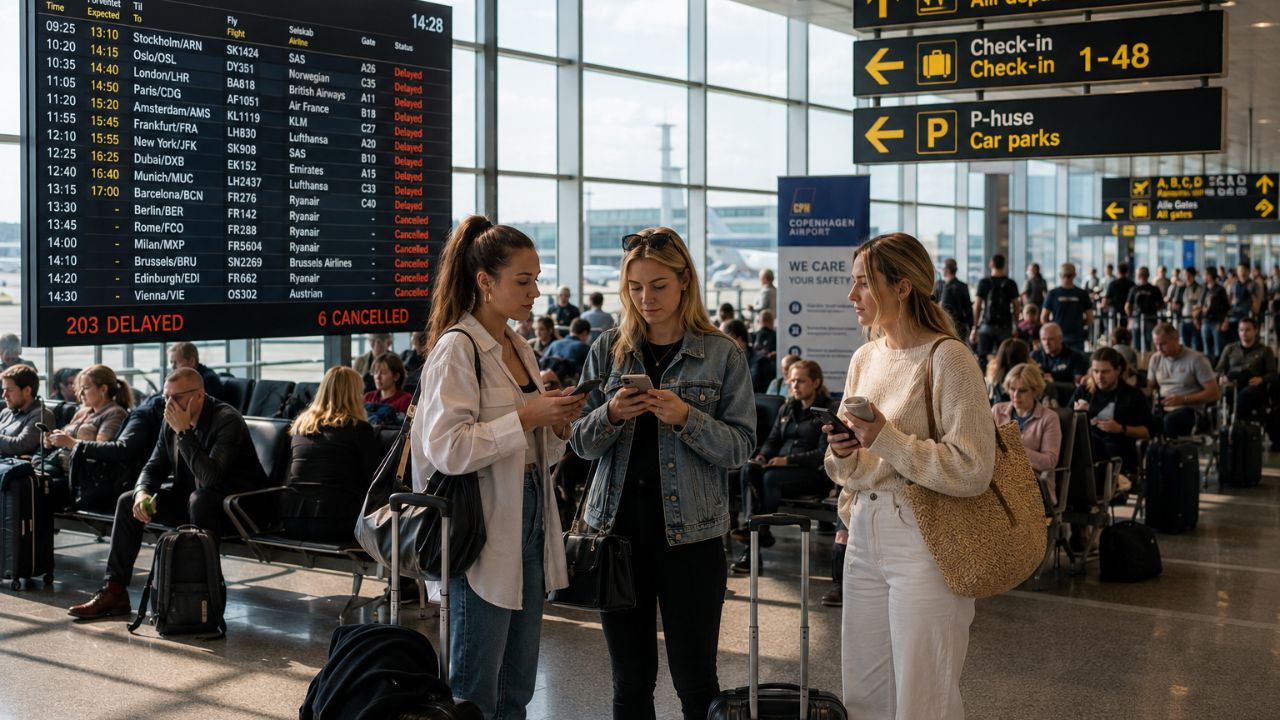
Image generated by AI
Aviation Updates: Massive Travel Chaos Paralyzes Copenhagen Airport as SAS, Lufthansa, and KLM Suffer 209 Flight Cancellations and Delays
As systemic operational failures violently collide with high-volume international schedules, Copenhagen Airport has descended into absolute gridlock, leaving thousands of furious passengers physically stranded across Scandinavia's largest transit hub.
Image generated by AI
As high-impact airline news platforms rapidly disseminate urgent aviation updates regarding the intense fragility of the European transit grid, a massive operational collapse has just paralyzed Denmark's primary aviation gateway. Copenhagen Airport—the absolute critical transfer point between Scandinavia and the rest of the globe—has been crushed by a catastrophic wave of severe airport disruptions. Throughout a highly volatile 24-hour period, the airport recorded an unprecedented 203 massive flight delays alongside six outright flight cancellations. This systemic failure has instantly crippled critical domestic and international routes, devastating operations for massive carriers including SAS, Norwegian Air Shuttle, Lufthansa, Ryanair, KLM, Air France, and British Airways. With critical connections to Stockholm, Oslo, London, Paris, Amsterdam, Frankfurt, New York, and Dubai completely shattered, thousands of business travelers and tourists have been violently thrust into a nightmare scenario of localized travel chaos, exposing the terrifying vulnerability of Northern Europe’s highly integrated aviation network.
Expanded Overview: The Collapse of Scandinavia's Gateway
To fully comprehend the sheer scale of this logistical disaster, aviation analysts must examine the massive operational dependency placed upon Copenhagen.
Copenhagen Airport serves as Denmark’s absolute largest international aviation gateway. Every single day, tens of thousands of passengers rely on its highly complex network for seamless connecting journeys across Europe, North America, the Middle East, and Asia. When a hub of this massive scale suffers 209 combined disruptions, the damage instantly reverberates globally. Because modern aviation is fiercely interconnected, a delay affecting one aircraft instantly triggers severe scheduling adjustments across multiple routes. As airlines desperately attempt to reposition aircraft, flight crews, and ground handling resources, the initial bottleneck transforms into a massive, unstoppable ripple effect, destroying itineraries far beyond the borders of Denmark.
Section-Wise Breakdown: The European Network Gridlock
A forensic look at the affected airlines reveals that no carrier, regardless of size or operational budget, was immune to the failure.
The delays aggressively devastated both legacy flag carriers and budget operators. SAS (Scandinavian Airlines) and Norwegian Air Shuttle bore a massive burden regarding intra-Scandinavian routes, watching their critical connections to Stockholm and Oslo severely delayed. Simultaneously, European titans like Lufthansa, KLM, Air France, and British Airways suffered catastrophic timing failures on their massive feeder routes to Frankfurt, Amsterdam, Paris, and London. Even ultra-low-cost carriers like Ryanair were severely impacted. The sheer diversity of the airlines affected proves that the operational strain was entirely systemic, making recovery physically impossible without enduring multi-hour tarmac holds and massive terminal crowding.
Section-Wise Breakdown: Factors Driving the Strain
While the physical symptoms of the disruption are obvious, the root causes highlight the extreme complexity of European air traffic management.
Aviation experts confirm that disruptions of this sheer magnitude rarely result from a single, isolated cause. The massive accumulation of 203 delays is the result of compounding operational friction. This includes misaligned aircraft rotations, severe weather conditions affecting earlier flights, aggressive air traffic management (ATC) restrictions, unexpected technical inspections, and severe staffing limitations. Because aircraft frequently operate several consecutive flights daily, a minor ATC restriction early in the morning can continue devastating subsequent services throughout the entire day, ultimately forcing the cancellation of high-value long-haul routes to destinations like New York and Dubai.
Flight Details: Copenhagen Airport Operational Disruption Matrix
To fully comprehend the exact volume of delayed flights, the massive scope of the affected airlines, and the legal frameworks protecting stranded passengers, the verified operational telemetry has been consolidated into the mandatory matrix below.
| Operational Metric | Verified Disruption Data |
|---|---|
| Total Flight Delays | 203 Flights |
| Total Cancellations | 6 Flights |
| Primary Airlines Affected | SAS, Norwegian, Lufthansa, Ryanair, KLM, Air France, British Airways |
| Key European Routes | Stockholm, Oslo, London, Paris, Amsterdam, Frankfurt |
| Long-Haul Routes | New York, Dubai |
| Regulatory Authority | Danish Civil Aviation and Railway Authority |
| Passenger Rights | EU Regulation (EC) No. 261/2004 |
Passenger Impact: Enforcing EU Regulation 261 Rights
For the thousands of passengers trapped inside Copenhagen Airport, the statistical failure instantly translated into a grueling physical ordeal requiring legal intervention.
Travelers completely stranded by these delays and cancellations are heavily protected under European Union Regulation (EC) No. 261/2004. Depending on the exact duration of the delay, passengers are legally entitled to immediate assistance. This includes mandatory meals, refreshments, communication support, and, critically, paid hotel accommodation and ground transportation if an overnight stay is forced upon them. Furthermore, unless the airline can legally prove the disruption was caused by "extraordinary circumstances" (such as severe weather or ATC restrictions), passengers are entitled to direct financial compensation. The Danish Civil Aviation and Railway Authority urges all affected travelers to retain their boarding passes, save all expense receipts, and instantly demand assistance from airline representatives.
Industry Analysis: The Brutal Reality of Operational Recovery
From a macro-logistical perspective, resolving a 209-flight disruption requires massive, highly aggressive recovery protocols.
Once a hub like Copenhagen sustains this level of damage, airlines must immediately prioritize repositioning aircraft and reallocating flight crews who have legally timed out of their shifts. While airport authorities continue processing flights, revised boarding times will constantly fluctuate depending on physical aircraft availability. This recovery phase is highly volatile; passengers are explicitly instructed to maintain extreme flexibility, monitor airline mobile applications relentlessly, and arrive at the airport with massive amounts of extra time to survive the heavily congested security and boarding procedures.
Conclusion: A Warning to European Transit
Ultimately, the unprecedented operational collapse at Copenhagen Airport serves as a terrifying warning regarding the extreme fragility of modern European aviation. With SAS, Norwegian, Lufthansa, KLM, and British Airways caught in a massive web of 203 severe delays and six outright cancellations, the resulting travel chaos completely paralyzed Scandinavia's premier transit hub. As complex ATC restrictions and compounding logistical failures continue to trigger massive airport disruptions and sudden flight cancellations across the continent, it is abundantly clear that passengers must fiercely advocate for themselves. By understanding their rights under EU Regulation 261 and maintaining aggressive, real-time vigilance over their itineraries, travelers can attempt to mitigate the physical and financial devastation that inevitably follows a total airport meltdown.
Key Takeaways
- Massive Operational Collapse: Copenhagen Airport suffered a staggering 203 flight delays and 6 flight cancellations, devastating its daily operations.
- Global Airlines Affected: The disruptions paralyzed major carriers including SAS, Norwegian, Lufthansa, Ryanair, KLM, Air France, and British Airways.
- Widespread Route Failure: Critical connections to Stockholm, Oslo, London, Paris, Amsterdam, Frankfurt, New York, and Dubai were severely compromised.
- Passenger Rights: Stranded travelers are legally protected by EU Regulation (EC) No. 261/2004, which mandates meals, hotel accommodations, and potential financial compensation.
- Aggressive Recovery: Airlines are currently executing massive recovery operations to reposition aircraft and crews, requiring passengers to maintain extreme flexibility and heavily monitor flight statuses.
FAQ: Copenhagen Airport Flight Delays and Cancellations
How many flights were affected at Copenhagen Airport? The airport recorded a massive disruption consisting of 203 severe flight delays and six outright flight cancellations across a single operational period.
Which airlines and routes were impacted? Major carriers including SAS, Norwegian Air Shuttle, Lufthansa, Ryanair, KLM, Air France, and British Airways were all affected. The delays destroyed schedules for flights bound for Stockholm, Oslo, London, Paris, Amsterdam, Frankfurt, New York, and Dubai.
Are passengers entitled to compensation for these delays? Yes. Under European Union Regulation (EC) No. 261/2004, eligible passengers facing significant delays or cancellations are entitled to meals, hotel accommodations, and potential financial compensation, provided the disruption was not caused by "extraordinary circumstances" like severe weather.
Who enforces these passenger rights in Denmark? Passenger rights and compensation claims are overseen and enforced by the Danish Civil Aviation and Railway Authority, working in conjunction with European Union aviation regulations.
Related Travel Guides
Split Airport easyJet Lufthansa KLM Delays Travel Chaos 2026
Europe Regional Flight Disruption Survival Guide 2026
American AAL2416 Dallas Richmond Diversion Travel Chaos 2026
Disclaimer: This article is strictly for informational and aviation safety analysis purposes. The specific operational telemetry (203 delays, 6 cancellations), affected airlines (SAS, Lufthansa, KLM, etc.), and passenger compensation guidelines (EU Regulation 261/2004) are based on verified flight tracking data and official Danish Civil Aviation statements available at the time of publication. European airspace conditions, ATC congestion, and specific airline schedules are highly dynamic and subject to immediate, unannounced modification by Air Traffic Control or the operating carrier. Passengers traveling through Copenhagen Airport should explicitly prepare for potential delays, aggressively monitor their airline's mobile application, and verify their exact compensation eligibility directly with their airline prior to departure.
Disclaimer
This article is for informational and educational purposes only. It does not constitute legal, financial, or professional advice. While we strive to provide accurate and up-to-date information, travel policies, regulations, and conditions change rapidly. Always verify information with official sources before making travel decisions. Nomad Lawyer makes no representations about the accuracy, reliability, completeness, or suitability of the information provided. Readers should consult qualified professionals for advice specific to their circumstances. The views expressed in this article are those of the author and do not necessarily reflect the views of Nomad Lawyer.
Preeti Gunjan
Contributor & Community Manager
A passionate traveller and community builder. Preeti helps grow the Nomad Lawyer community, fostering engagement and bringing the reader experience to life.
Learn more about our team →