
Europe Flight Chaos 2026: 2,911 Flights Delayed and 83 Cancelled Across 16 Major Hubs
Severe operational strain across Europe's aviation network led to 2,911 delays and 83 cancellations in a single day, impacting major hubs like London Heathrow and Paris CDG.

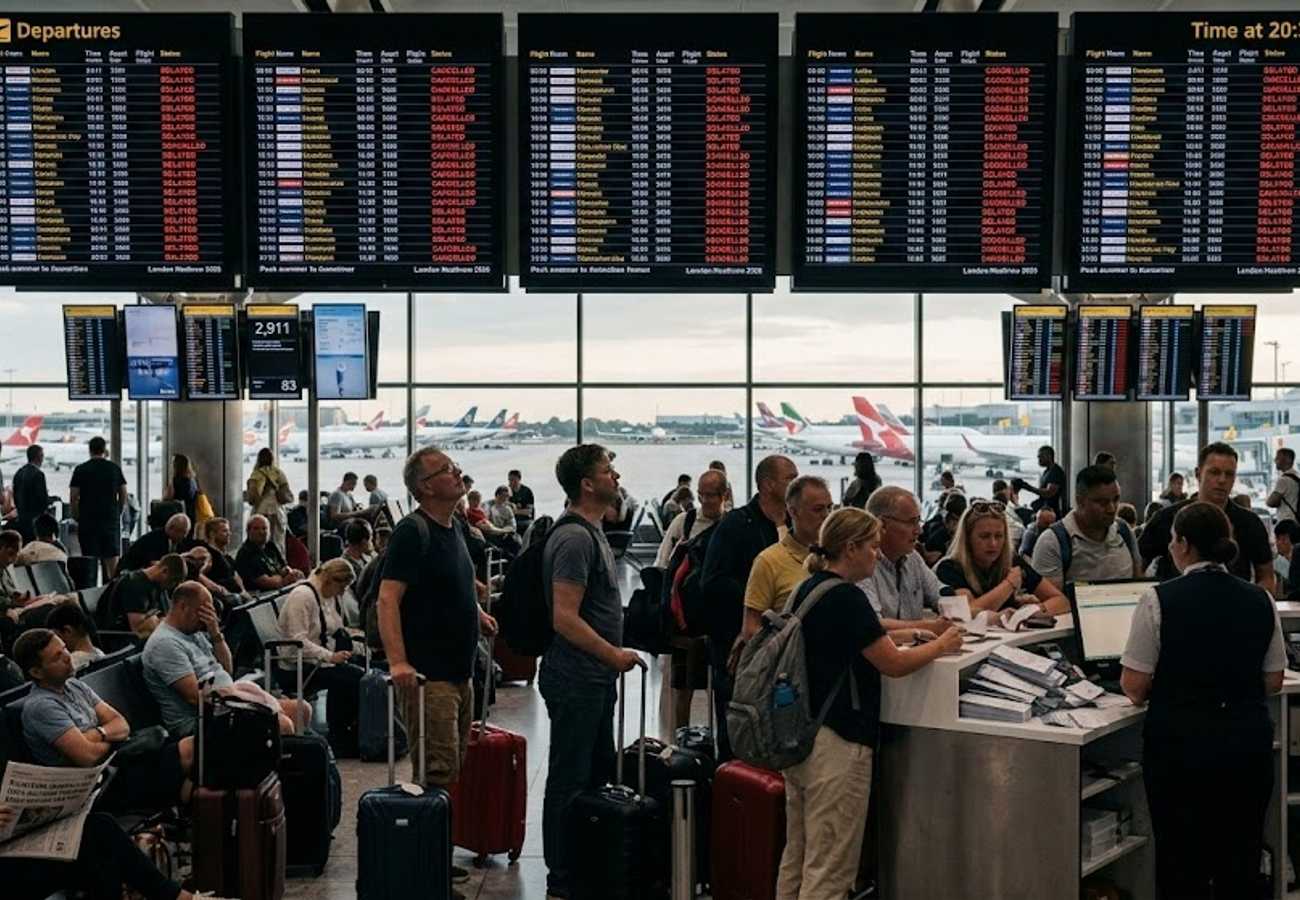
Image generated by AI
A single 24-hour window saw 2,911 delayed flights and 83 cancellations across 16 major European hubs, marking one of the most severe operational collapses of the 2026 peak summer season.
The stability of European air travel has reached a breaking point. On 30 August 2026, a massive cluster of disruptions paralyzed key gateways, including London Heathrow, London Gatwick, London Luton, Dublin, Paris Charles de Gaulle, Amsterdam Schiphol, Frankfurt, Madrid Barajas, and Barcelona El Prat. This spike is not an isolated event but the result of a system operating at absolute capacity, where a minor technical glitch now triggers a continental domino effect.
The Operational Breaking Point
The scale of the 30 August disruption reveals a dangerous lack of resilience in current flight schedules. When airports operate at their ceiling, there is no "slack" to absorb errors. The result is a vicious cycle: aircraft are out of position, crews exceed their legal working hours, and turnaround times stretch, turning a 30-minute delay into a multi-hour ordeal for thousands.
Low-cost, point-to-point carriers bore the brunt of this instability. easyJet recorded the highest volume of late services, with over 550 delayed flights and dozens of cancellations. Ryanair and Air France followed closely, while British Airways, KLM, Jet2, and Vueling also reported significant schedule slippage.
A Convergence of Systemic Failures
This wave of 2,911 delays was the culmination of several overlapping crises that have plagued the region throughout August 2026:
- Technical and Infrastructure Failures: On 24 August, a technical issue at the UK’s National Air Traffic Services, combined with a tightening jet fuel supply, disrupted more than 2,100 flights, primarily centering on London and Manchester.
- Regional Hub Collapses: On 25 August, operational failures at Rome Fiumicino and 12 other airports impacted 1,946 flights, including 1,871 delays and 75 cancellations.
- Geopolitical Airspace Shifts: Ongoing restrictions over parts of the Middle East have forced reroutings. This increases flight times and fuel consumption, leaving hubs like Istanbul, London Heathrow, and Athens with zero margin for error.
- Labor and Weather Volatility: From the Skeyes strike in Belgium in June—which disrupted 6,793 flights across 13 countries—to the control-tower power failure at Barcelona El Prat on 12 August, the infrastructure has been under constant assault.
Cultural & Environmental Value: The Human Cost of Efficiency
For the visitor, the real impact is a shift in how we perceive "efficient" travel. The drive for maximum aircraft utilization has stripped away the buffers that once protected travelers from chaos. We are seeing a transition where the environmental cost of rerouting flights to avoid restricted airspace is colliding with the economic cost of stranded passengers.
The reliance on a few "mega-hubs" creates a fragile ecosystem. When a storm hits Zurich or a power outage strikes Barcelona, the ripple effect is felt in Dublin and Amsterdam. This highlights an urgent need for a more decentralized approach to regional travel, supporting smaller regional airports to reduce the pressure on primary gateways.
Visitor Insider Tips: Navigating the Chaos
Traveling through Europe during peak volatility requires a strategic approach to avoid being stranded.
- The "Buffer" Rule: Avoid tight connections (under 3 hours) at hubs like CDG or Schiphol. If your journey involves two different airlines on separate tickets, allow a full 24 hours between flights.
- Digital Paper Trail: Always take a screenshot of your boarding pass and the "flight status" page the moment a delay is announced. Under EC 261 and UK 261 regulations, the burden of proof for compensation often rests with the passenger.
- Request Written Proof: If a flight is cancelled, do not rely on verbal promises from gate agents. Formally request a written explanation for the delay. This distinguishes "extraordinary circumstances" (weather) from "operational failures" (staffing), which is the key to securing financial compensation.
- Off-Peak Windows: To avoid the worst of the August congestion, target travel between mid-September and early November, when staffing levels stabilize and airspace demand drops.
Tourism Outlook
The long-term trajectory for European aviation suggests a period of painful correction. Until airlines and airport authorities prioritize schedule resilience over maximum capacity, these "spike days" will become the new normal. The industry is now facing a reckoning: either invest in significant staffing redundancies and infrastructure upgrades or accept a permanent decline in reliability during peak seasons.
Travelers should remain vigilant and prioritize flexible bookings as the network struggles to regain its equilibrium.
Related Travel Guides
Disclaimer
This article is for informational and educational purposes only. It does not constitute legal, financial, or professional advice. While we strive to provide accurate and up-to-date information, travel policies, regulations, and conditions change rapidly. Always verify information with official sources before making travel decisions. Nomad Lawyer makes no representations about the accuracy, reliability, completeness, or suitability of the information provided. Readers should consult qualified professionals for advice specific to their circumstances. The views expressed in this article are those of the author and do not necessarily reflect the views of Nomad Lawyer.
Preeti Gunjan
Contributor & Community Manager
A passionate traveller and community builder. Preeti helps grow the Nomad Lawyer community, fostering engagement and bringing the reader experience to life.
Learn more about our team →