
AlUla Manara Transforms Saudi Desert into Global Astrotourism Hub with 4-Metre Observatory and Dark Sky Luxury Lodges
The Royal Commission for AlUla unveils AlUla Manara, a high-value astrotourism development integrating a 4-metre scienti

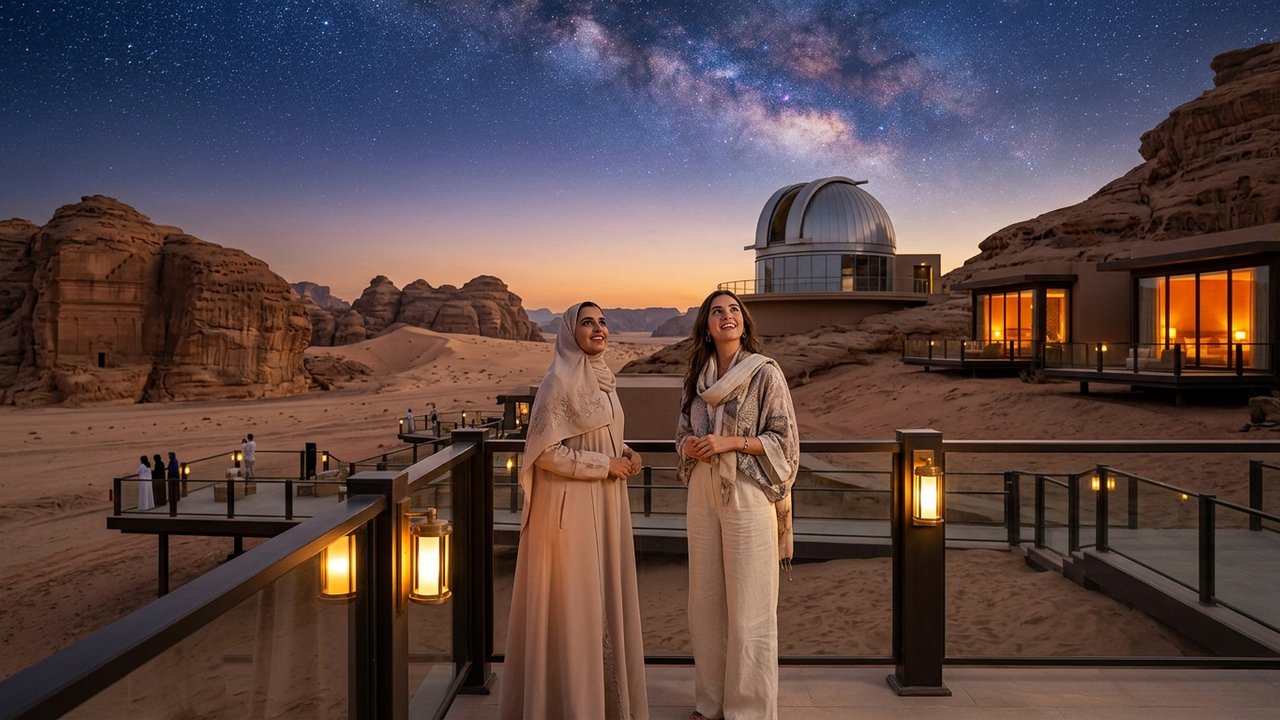
Image generated by AI
The north-western desert region surrounding AlUla, Saudi Arabia, is initiating a strategic expansion into science-based tourism with the development of the AlUla Manara astrotourism centre. Situated approximately 70 kilometres from AlUla's historic core, the project introduces a dedicated destination for night-sky exploration, merging high-performance astronomical infrastructure with luxury hospitality in a certified dark-sky environment.
AlUla has long established itself as a premier destination for cultural tourism, renowned for its archaeological landmarks, including ancient Nabataean sites, and dramatic geological formations. AlUla Manara adds a significant scientific dimension to the destination's portfolio, aligning with the Royal Commission for AlUla's broader mandate to diversify tourism offerings and attract high-value niche segments. The development positions the region as a competitive player in the global market for desert astronomy and experiential night tourism.
Certified Dark Sky Conditions Enhance Celestial Visibility
A foundational element of the AlUla Manara project is its location within one of the Middle East's most significant certified Dark Sky Park regions. The area is characterised by exceptionally low levels of light pollution, creating optimal atmospheric conditions for astronomical observation.
These dark sky parameters allow for the clear visibility of the Milky Way, planetary systems, and deep-space celestial bodies. The site leverages these natural advantages to support both structured scientific research and visitor experiences. Integrated lighting controls and protected viewing zones ensure that human activity does not disrupt the natural darkness, maintaining the integrity of the environment for observation.
This positioning allows AlUla to compete directly with established international dark-sky reserves, offering a unique value proposition for astrotourists seeking pristine night-sky conditions in a desert setting.
Advanced Observatory Infrastructure for Science and Public Access
The technical core of AlUla Manara is its observatory complex, designed to serve dual functions for professional research and public engagement. The facility features a primary telescope with a four-metre aperture, supported by two secondary telescopes, each with a two-metre aperture.
This configuration places the observatory among the most advanced publicly accessible astronomy facilities in the region. The infrastructure enables:
- Scientific Operations: Support for research in planetary science, cosmic evolution, and deep-space monitoring.
- Guided Observation: Opportunities for visitors to participate in live sky monitoring sessions and access real astronomical data.
- Educational Programming: Structured activities focused on astronomy and environmental science for diverse audiences.
Specialised viewing zones are engineered to minimise environmental interference, ensuring consistent observation quality across varying seasonal conditions.
Architectural Integration with Desert and Cosmic Landscapes
The design of AlUla Manara emphasises harmony with the surrounding topography. The architectural concept draws inspiration from cosmic structures—such as galaxies and planetary rings—alongside organic geological patterns found in the desert.
Construction utilises earth-toned materials and flowing, layered forms to ensure the development blends into the landscape rather than dominating it. The spatial layout guides visitors through interconnected zones, transitioning from educational exhibits to observation platforms and open desert viewing areas. This design approach reinforces the connection between terrestrial geology and astronomical phenomena.
Immersive Visitor Facilities and Luxury Hospitality
AlUla Manara functions as a comprehensive tourism destination rather than a standalone observatory. The centre incorporates exhibition halls, immersive galleries, interactive science installations, and a planetarium designed to present complex astronomical concepts in accessible formats.
Hospitality is central to the visitor experience. The development includes a dedicated stargazing lodge offering overnight accommodations tailored for optimal viewing. Additional features include rooftop observation decks and desert-facing accommodation pods, providing guests with uninterrupted access to night-sky experiences.
This combination of science and luxury positions the site within the growing segment of experiential travel, encouraging longer visitor stays and higher-yield tourism packages.
Strategic Diversification and Regional Connectivity
The introduction of AlUla Manara supports the Royal Commission for AlUla's strategy to balance heritage tourism with nature-based and science-driven experiences. By developing night tourism, the destination aims to generate year-round demand and extend visitor dwell time beyond daytime cultural activities.
Accessibility to the region is facilitated by AlUla International Airport, which operates domestic connections to major Saudi hubs including Riyadh and Jeddah. While direct international routes are evolving, the airport's connectivity, combined with regional transit links, is strengthening visitor flow. Ongoing infrastructure development is expected to enhance accessibility as AlUla's global profile expands.
AlUla Manara represents a calculated evolution in Saudi Arabia's tourism landscape, transforming a remote desert zone into a structured hub for astrotourism. By combining advanced telescopic technology, immersive visitor infrastructure, and protected dark-sky conditions, the project establishes a new benchmark for desert-based astronomy travel.
Observatory Infrastructure Specifications
| Facility Component | Specification | Primary Function |
|---|---|---|
| Primary Telescope | 4-metre aperture | Scientific research and guided visitor observation |
| Secondary Telescopes | Two units, 2-metre aperture each | Scientific research and guided visitor observation |
| Location | ~70 km from AlUla historic core | Certified Dark Sky Park region |
| Observatory Model | Dual-use (Science & Tourism) | Live monitoring, research, and educational access |
Key Takeaways
- AlUla Manara Launch: A new astrotourism centre located 70km from AlUla's historic core, developed by the Royal Commission for AlUla.
- Dark Sky Advantage: Situated in a certified Dark Sky Park with low light pollution, offering high visibility of the Milky Way and deep-space objects.
- Observatory Specs: Features one 4-metre primary telescope and two 2-metre secondary telescopes supporting both research and public observation.
- Luxury Hospitality: Includes a stargazing lodge, rooftop decks, and desert-facing pods to support overnight astronomy experiences.
- Strategic Goal: Diversifies AlUla's tourism mix beyond heritage, targeting year-round demand and the high-value astrotourism market.
- Connectivity: Accessible via AlUla International Airport with domestic links to Riyadh and Jeddah.
FAQ
What is the AlUla Manara astrotourism centre? AlUla Manara is a dedicated astrotourism development located approximately 70km from AlUla's historic centre. It combines a scientific observatory with luxury hospitality and educational facilities within a certified Dark Sky Park region.
What telescope equipment is available at the observatory? The observatory features a four-metre primary telescope supported by two additional telescopes with two-metre apertures. These instruments are used for both scientific research and guided visitor observation sessions.
How does AlUla Manara integrate with AlUla's existing tourism offerings? The project complements AlUla's established cultural and heritage tourism by adding science-based and night-sky experiences. This diversification supports longer visitor stays and attracts tourists interested in astronomy and luxury desert travel.
What are the access routes to AlUla Manara? Visitors typically access the region via AlUla International Airport, which provides domestic flights to Riyadh and Jeddah. From the airport, the centre is accessible via road networks connecting to the surrounding desert region.
Is AlUla Manara open for public observation? Yes, the facility offers guided observation sessions and immersive visitor experiences. Guests can access exhibition halls, a planetarium, and observation platforms, with luxury lodges available for overnight stargazing stays.
Related Travel Guides
Disclaimer
This article is for informational and educational purposes only. It does not constitute legal, financial, or professional advice. While we strive to provide accurate and up-to-date information, travel policies, regulations, and conditions change rapidly. Always verify information with official sources before making travel decisions. Nomad Lawyer makes no representations about the accuracy, reliability, completeness, or suitability of the information provided. Readers should consult qualified professionals for advice specific to their circumstances. The views expressed in this article are those of the author and do not necessarily reflect the views of Nomad Lawyer.
Preeti Gunjan
Contributor & Community Manager
A passionate traveller and community builder. Preeti helps grow the Nomad Lawyer community, fostering engagement and bringing the reader experience to life.
Learn more about our team →