
Aviation Updates: Vienna International Airport Plunged into Travel Chaos as Eurowings, Finnair, Lauda Europe and Austrian Airlines Suffer 117 Flight Delays and 6 Cancellations on Routes to Berlin, Frankfurt, London, Amsterdam and Beyond
A devastating operational collapse at Vienna International Airport on June 24, 2026 has trapped hundreds of passengers across Austria as 117 flight delays and 6 cancellations cripple services to Berlin, Stuttgart, Frankfurt, Hamburg, Düsseldorf, Munich, London, Amsterdam and dozens more destinations.

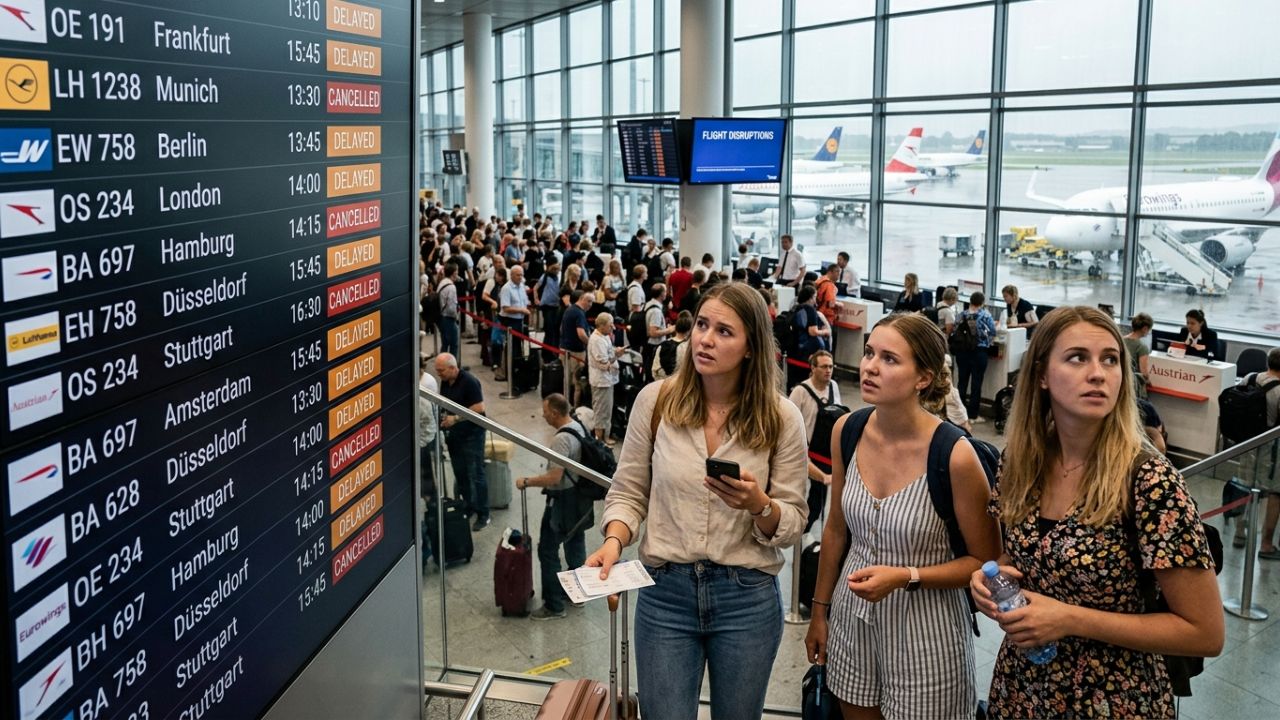
Image generated by AI
Aviation Updates: Vienna International Airport Plunged into Travel Chaos as Eurowings, Finnair, Lauda Europe and Austrian Airlines Suffer 117 Flight Delays and 6 Cancellations on Routes to Berlin, Frankfurt, London, Amsterdam and Beyond
As an exceptionally severe operational gridlock tightens its grip across Central Europe's most critical aviation corridors, a sudden and deeply damaging wave of flight disruptions at Vienna International Airport is forcing thousands of exhausted passengers into an agonizing confrontation with unprecedented regional travel chaos.
Breaking airline news confirmed by real-time tracking data sourced directly from FlightAware reveals that Vienna International Airport — Austria's primary aviation gateway and one of the most strategically vital hub airports in all of Central Europe — suffered a sweeping operational breakdown on June 24, 2026. A staggering 117 flight delays and 6 outright cancellations were officially recorded during a single operational cycle, violently disrupting the travel itineraries of hundreds of passengers scattered across an extensive European and intercontinental route network. Carriers including Eurowings, Finnair, Lauda Europe, Austrian Airlines, KLM, Air France, Iberia, Turkish Airlines, Pegasus Airlines, and more than a dozen other operators found themselves unable to maintain their scheduled departure windows — a multilateral collapse rarely witnessed at this scale in a single day.
The airport disruptions have dealt a direct blow to passengers relying on connections through Vienna for onward travel to Berlin, Stuttgart, Frankfurt, Hamburg, Düsseldorf, Munich, London, Amsterdam, Oslo, Warsaw, Istanbul, Athens, Tel Aviv, Cairo, Lisbon, Montreal, and a vast array of other destinations across four continents. With summer travel demand running at historically aggressive levels, the timing of this breakdown has maximized the impact on thousands of leisure travelers, corporate commuters, and transit passengers attempting to use Vienna as a gateway into the wider European network.
Expanded Overview: The Full Scale of Austria's Aviation Crisis
This particular episode of travel chaos at Vienna International Airport does not read like a routine weather delay or an isolated technical failure. The sheer breadth of carriers affected — spanning low-cost operators, legacy European airlines, Middle Eastern carriers, and intercontinental long-haul services — points to a deeply systemic strain on Vienna's daily operational capacity. When 22 different airlines record disruptions in a single cycle, the cause is rarely singular. It is, instead, the cumulative product of tarmac congestion, compressed aircraft turnaround windows, crew rotational pressures, and the relentless surge in passenger volumes that defines the European summer travel season.
For Austria's broader aviation ecosystem, the consequences extend well beyond the immediate terminal. Vienna functions as a critical connector between Western, Eastern, and Central Europe — a hub whose smooth operation is a prerequisite for the efficient functioning of hundreds of downstream connections every single day. With Austrian Airlines operating the overwhelming majority of Vienna-based services, any operational difficulty at the national carrier immediately triggers cascading consequences across the entire schedule. The 117 delayed flights recorded on June 24 represent not just individual missed connections, but a systemic failure that echoes across airports in Germany, the UK, the Balkans, the Middle East, Scandinavia, the Mediterranean, and North America.
Section-Wise Breakdown: Vienna International Airport Under Siege
Vienna International Airport: Austria's Paralyzed Aviation Core
Vienna International Airport, serving the Austrian capital and functioning as the country's sole Category 1 international hub, bore the entirety of the June 24 operational collapse. With 117 delayed flights and 6 cancellations recorded in a single day, the airport's departure and arrival boards painted an exhausting picture of a network struggling to keep pace with demand. The disruption was not confined to any single terminal or airline zone — it spread laterally across every active gate, affecting both short-haul intra-European operations and long-haul intercontinental services simultaneously.
Routes Severed by Cancellations
The six confirmed cancellations on June 24, 2026 directly eliminated operational connectivity on the following critical routes:
- Vienna → Vantaa (Helsinki): Finland's primary airport connection severed, cutting off passengers bound for Northern Europe.
- Vienna → Berlin: Germany's capital corridor grounded, disrupting high-frequency business and leisure traffic to one of Europe's most heavily traveled city pairs.
- Vienna → Stuttgart: Southwest Germany connectivity eliminated for the day, stranding passengers depending on Eurowings and partner services.
Routes Devastated by Delays
The depth of disruption on delayed services was equally dramatic, spanning a remarkable geographic footprint. Affected departure destinations included Charleroi, Frankfurt, Hamburg, Düsseldorf, Munich, London, Amsterdam, Oslo, Kraków, Warsaw, Vilnius, Las Palmas de Gran Canaria, Cairo, Hurghada, Tirana, Sofia, Dubrovnik, Split, Madrid, Nice, Paris, Athens, Heraklion, Kos, Rhodes, Budapest, Bari, Bologna, Rome, Tel Aviv, Lisbon, Ankara, Antalya, Istanbul, Pristina, Podgorica, Montreal, and Brussels — a route map that effectively touches every corner of the global network connected to Vienna.
Flight Details and Verified Disruption Impact Matrix
To fully document the structural parameters of this massive operational failure, the following data matrix — drawn directly from FlightAware records for June 24, 2026 — provides a precise, verified breakdown of every carrier affected and the exact scale of their individual disruptions.
Confirmed Airline Disruption Matrix — Vienna International Airport, June 24, 2026
| Airline | Cancelled | Cancelled (%) | Delayed | Delayed (%) |
|---|---|---|---|---|
| Eurowings | 2 | 10% | 4 | 21% |
| Finnair | 2 | 50% | 0 | 0% |
| Austrian Airlines | 2 | 0% | 51 | 14% |
| Air France | 0 | 0% | 1 | 16% |
| Blue Bird Airways | 0 | 0% | 1 | 50% |
| Air Baltic | 0 | 0% | 8 | 14% |
| Condor | 0 | 0% | 2 | 33% |
| Corendon Airlines Europe | 0 | 0% | 1 | 50% |
| Air Algerie | 0 | 0% | 2 | 100% |
| El Al | 0 | 0% | 3 | 75% |
| Iberia | 0 | 0% | 2 | 33% |
| KLM | 0 | 0% | 4 | 50% |
| Lauda Europe | 0 | 0% | 19 | 23% |
| Air Cairo | 0 | 0% | 1 | 16% |
| People's | 0 | 0% | 3 | 60% |
| Pegasus Airlines | 0 | 0% | 4 | 40% |
| Qatar Airways | 0 | 0% | 1 | 25% |
| Ryanair | 0 | 0% | 1 | 4% |
| SunExpress | 0 | 0% | 2 | 25% |
| TAP Air Portugal | 0 | 0% | 2 | 200% |
| Turkish Airlines | 0 | 0% | 3 | 18% |
| Transavia France | 0 | 0% | 2 | 66% |
Data sourced directly from FlightAware and reflects the operational disruption recorded at Vienna International Airport on June 24, 2026.
Airline-by-Airline Narrative Breakdown
Austrian Airlines emerged as the single largest source of delay volume, with 51 delayed flights — a figure that reflects the carrier's enormous operational dependency on Vienna as its primary hub. Despite recording no cancellations as a percentage of the tracked metric displayed, the sheer volume of delayed services confirms that the national carrier was battling significant systemic constraints across its entire network. For a carrier that connects Vienna to over 60 international destinations, a day of this scale represents one of the most demanding operational environments of the current summer season.
Lauda Europe, the Ryanair-owned Austrian subsidiary, contributed 19 delayed flights — a 23% delay rate that indicates widespread scheduling pressure across its dense short-haul network serving the leisure travel market out of Vienna.
Eurowings recorded 2 cancellations alongside 4 delays, directly severing the Vienna–Berlin and Vienna–Stuttgart corridors and leaving passengers on those routes to scramble for alternative connections or overnight accommodation.
Finnair suffered a severe blow, with 2 cancellations representing a staggering 50% of its tracked Vienna operation for the day — the highest cancellation rate by proportion among all affected carriers. The complete absence of delayed flights in Finnair's data suggests the carrier opted for outright cancellation over delays in an attempt to protect schedule integrity on its wider network.
Air Baltic recorded 8 delays — a 14% delay rate — impacting Baltic and Northern European connectivity through its Vienna services. KLM suffered 4 delays at a 50% rate, while El Al faced a punishing 75% delay rate across its 3 tracked Vienna services. Air Algerie recorded a 100% delay rate, with both of its Vienna services disrupted. TAP Air Portugal posted a striking 200% delay figure across its 2 tracked services — a statistical anomaly indicating compounded delays on the same aircraft. People's recorded a 60% delay rate, while Pegasus Airlines had 40% of its Vienna flights delayed. Condor, Iberia, and Transavia France each recorded delay rates of 33–66% across their tracked services.
Passenger Impact: The Human Cost of Vienna's Collapse
For the hundreds of passengers directly ensnared in this operational breakdown, the consequences are not merely measured in scheduling inconvenience — they translate into missed business meetings in Frankfurt, destroyed family holidays departing from Berlin, ruined Mediterranean connections through Rome, and derailed long-haul journeys to Tel Aviv or Montreal.
The asymmetry of this disruption is particularly punishing. Because Vienna operates as a major transfer hub for passengers connecting from Eastern and Central Europe toward Western Europe and beyond, a delay or cancellation at the Vienna stage does not simply strand passengers in Austria — it collapses their entire downstream itinerary. A passenger delayed on the Vienna–Frankfurt leg may miss their transatlantic connection. A traveler with a Finnair cancellation to Helsinki loses their onward Scandinavian routing entirely.
The financial dimensions are equally severe. Stranded passengers face the compounding costs of unexpected hotel stays in Vienna, last-minute rebooking fees on alternative services, meal expenses for hours-long terminal waits, and the practical impossibility of immediately recovering missed business appointments or prepaid holiday reservations. Under EU Regulation 261/2004, passengers on flights cancelled or severely delayed from Vienna — an EU-territory airport — may be entitled to compensation of up to €600 per passenger, meal vouchers, hotel accommodation, and alternative rebooking. Exercising these rights requires careful documentation, immediate communication with the operating airline, and persistence at the customer service desk.
Industry Analysis: Why Vienna Is Under Maximum Pressure
The June 24 disruption at Vienna International Airport is not an isolated incident. It is a symptomatic expression of the accumulated pressures bearing down on European aviation infrastructure during the peak summer window of 2026. Several structural forces are converging to produce exactly this type of multilateral breakdown.
First, aircraft utilization rates across European carriers are running at near-maximum levels as airlines attempt to recover post-pandemic revenue losses while simultaneously managing significantly higher operating costs driven by elevated fuel prices and crew wage settlements. Any single delay — whether caused by a late-arriving inbound aircraft, a ground crew shortage, or an ATC slot restriction — now propagates through the network with devastating speed.
Second, Air Traffic Control capacity constraints across the European Functional Airspace Blocks continue to operate below the threshold required to absorb the current volume of scheduled movements. Vienna is positioned at the intersection of several high-density European airspace sectors, meaning that even minor ATC flow management programs imposed elsewhere in the network can trigger significant ground delay programs at VIE.
Third, summer crew availability pressures — including legally mandated rest periods, concurrent holiday demands from ground and cabin crew, and the logistical complexity of managing international crew rotations — are creating narrow windows in which carriers can legitimately launch scheduled services. When multiple carriers simultaneously encounter crew-related constraints at the same hub, the cumulative result is exactly the kind of widespread, multi-airline disruption witnessed on June 24.
Conclusion: Austria's Aviation Challenge and the Road to Recovery
The operational breakdown at Vienna International Airport on June 24, 2026 serves as a powerful reminder of precisely how fragile the interconnected European aviation network remains in the face of sustained, maximum-demand operational pressure. With 117 delayed flights and 6 cancellations spread across 22 airlines serving destinations from Montreal to Cairo and from London to Istanbul, the Vienna disruption has sent a shockwave through Austria's travel ecosystem that will continue to reverberate in missed connections, delayed rebookings, and customer compensation claims for days to come.
For Austria's tourism sector — which depends heavily on Vienna functioning as a seamless, high-capacity gateway — sustained disruptions of this nature carry a genuine long-term reputational risk. International visitors who experience their first contact with Austria as an hours-long wait in a gridlocked terminal are less likely to return, and less likely to recommend Austria as a travel destination to their networks. The efficiency of Vienna as a hub is not simply an operational metric — it is a core component of Austria's global tourism competitiveness.
Recovery from a disruption of this scale typically requires 24–48 hours for carriers to fully reabsorb stranded passengers, reposition aircraft, and return crew rotations to legal compliance. Passengers affected by the June 24 disruptions are urgently advised to monitor their airline's digital application for real-time rebooking updates, to retain all receipts for meals, accommodation, and ground transportation, and to formally submit EU261 compensation claims directly to their operating carrier.
Key Takeaways
- Catastrophic Scale: Vienna International Airport recorded a devastating 117 flight delays and 6 cancellations in a single operational cycle on June 24, 2026 — one of the most severe disruption events at the Austrian hub in recent memory.
- Austrian Airlines at the Core: The national carrier contributed 51 delayed flights, confirming that the disruption penetrated deep into Vienna's primary operational nerve center.
- Eurowings and Finnair Cancellations: Eurowings executed 2 cancellations — severing Berlin and Stuttgart connections — while Finnair recorded a 50% cancellation rate, grounding its Helsinki services entirely.
- Lauda Europe Widespread Delays: The Ryanair subsidiary suffered 19 delays at a 23% rate, reflecting severe scheduling strain across its leisure-focused short-haul network.
- Global Route Footprint: The travel chaos extended across routes to Germany, the UK, the Netherlands, Scandinavia, the Balkans, the Middle East, North Africa, and North America — confirming Vienna's role as a true intercontinental hub whose disruptions echo globally.
- Passenger Survival Strategy: Affected travelers are urgently advised to actively monitor aviation updates via official airline apps, retain all documentation for EU261 compensation claims, and immediately seek rebooking on the next available service.
Related Travel Guides
- Atlanta Airport Meltdown Triggers Epic Travel Chaos as Delta and Southwest Suffer 970 Delays and 73 Cancellations Across the Globe
- Ryanair Passengers Hit With Heavy Fines After Toulouse Diversion in 2026
- Breaking Airline News: Severe Travel Chaos Averted as Riyadh Air Deploys Direct Manchester Route to Bypass Congested European Hubs
Disclaimer: This article is strictly for informational purposes only. Flight disruption data is sourced directly from FlightAware and reflects the operational situation at Vienna International Airport on June 24, 2026. Airline schedules, rebooking availability, and route recovery timelines are highly volatile and subject to continuous, real-time revision based on active carrier operational directives. Passengers are urgently advised to monitor their specific booking status and verify active flight schedules directly via the airline's official platform prior to arriving at the airport.
Disclaimer
This article is for informational and educational purposes only. It does not constitute legal, financial, or professional advice. While we strive to provide accurate and up-to-date information, travel policies, regulations, and conditions change rapidly. Always verify information with official sources before making travel decisions. Nomad Lawyer makes no representations about the accuracy, reliability, completeness, or suitability of the information provided. Readers should consult qualified professionals for advice specific to their circumstances. The views expressed in this article are those of the author and do not necessarily reflect the views of Nomad Lawyer.
Preeti Gunjan
Contributor & Community Manager
A passionate traveller and community builder. Preeti helps grow the Nomad Lawyer community, fostering engagement and bringing the reader experience to life.
Learn more about our team →