
Vancouver International Airport YVR Terminal Map Guide: Navigating Domestic, International and US Gates 2026
Master the layout of Vancouver International Airport (YVR) with this detailed guide to domestic, international, and US transborder zones, including Canada Line access and walking routes.
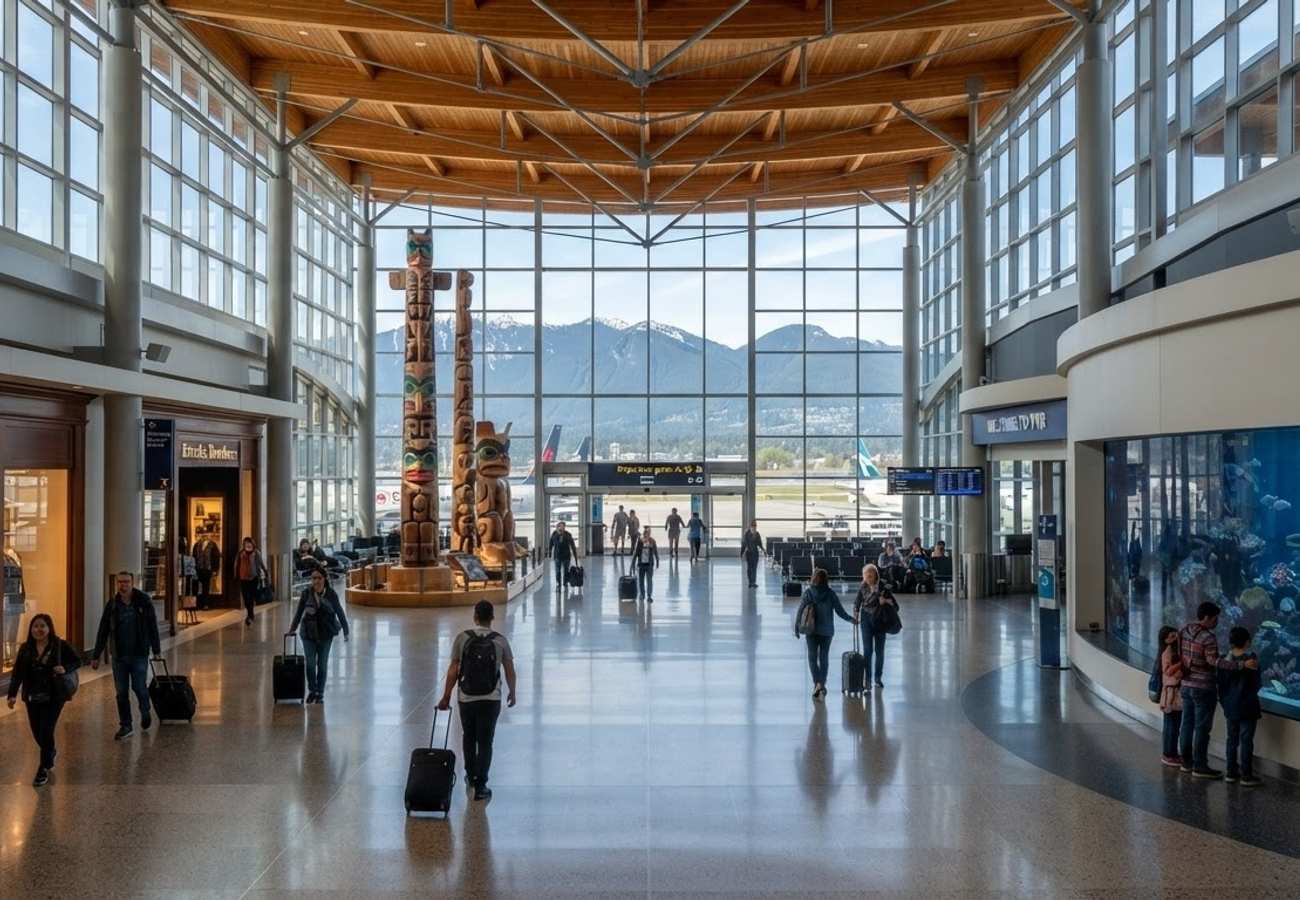
Image generated by AI
YVR operates as a single-terminal hub where domestic, international, and US transborder zones are physically linked, eliminating the need for shuttle buses between main piers.
The Local Trend Revealed: The "Single Spine" Navigation
Modern travelers often mistake Vancouver International Airport (YVR) for a multi-terminal complex, but it actually functions as a streamlined "spine" with radiating branches. The architectural shift toward a unified main terminal means that moving from a domestic food court to the international departures hall is a matter of minutes on foot, rather than a logistical hurdle.
The terminal is organized both horizontally and vertically. Level 3 serves as the primary artery for departures, check-in, and the pedestrian bridge connecting to the Canada Line station. Below this, Level 2 handles the heavy lifting of arrivals and baggage claim. While the main terminal captures the vast majority of traffic, the South Terminal remains a distinct entity on Sea Island, dedicated specifically to regional and seaplane operations, accessible only via a short shuttle.
Navigating the Airside Zones
Domestic Terminal: Gates B & C
The domestic sector is the primary hub for flights within Canada, serving major cities like Toronto, Calgary, Edmonton, Victoria, Kelowna, and Whitehorse. Air Canada and WestJet dominate this space, though Porter, Flair, and Air Transat also operate here.
Passengers enter via Level 3, where digital signage directs them to specific airline check-in rows. After passing through the central security screening, travelers enter the domestic concourses. B gates typically host WestJet and other carriers, while C gates are heavily utilized by Air Canada. Because the pier is linear, walking from B14 to C42 is a straightforward path, though travelers should allow 10 to 15 minutes for connections between distant gates.
International Terminal: The D Pier
The International zone handles long-haul routes to Asia, Europe, Mexico, and the South Pacific. This area is characterized by its Pacific Northwest aesthetic, featuring Indigenous art installations and a central aquarium.
Check-in occurs on Level 3, with counters grouped by airline alliance. The D pier fans out from the main departures hall, with wide-body gates designed for Boeing 777s and Airbus A350s located further along the pier. Notably, some domestic flights occasionally utilize these international-capable gates; travelers should rely on the digital screens to confirm if a domestic flight has been shifted to the D pier.
U.S. Transborder Area: The E Gates and Preclearance
The US transborder zone is a specialized environment where passengers complete U.S. Customs and Border Protection (CBP) preclearance before departure. This means that upon landing in US cities like Seattle, Los Angeles, or New York, travelers arrive as domestic passengers.
The process requires clearing security followed by US immigration booths. Because mid-morning and early afternoon peaks can create significant bottlenecks, a three-hour arrival window is strongly recommended. Once through preclearance, the E gate concourse offers a compact layout where the walk between the first and last gate takes less than 10 minutes.
Cultural & Environmental Value
For the visitor, the real impact of YVR’s design is the integration of regional identity into the transit experience. By incorporating Indigenous art and local ecological themes, the airport functions as a cultural gateway rather than a sterile transit point. This commitment to regional heritage is supported by the Vancouver Airport Authority, ensuring that the terminal reflects the Coast Salish territories it occupies.
The integration of the Canada Line—a rapid transit link—directly into the terminal's Link Building reduces reliance on taxis and ride-shares, significantly lowering the carbon footprint of the "last mile" of the journey.
Visitor Insider Tips
- The "Hidden" Connection: If you are moving between Domestic and International zones, stay on Level 3. You can walk between the two without ever exiting the building or going outdoors.
- US Preclearance Strategy: Avoid the mid-morning rush. If your flight is between 10:00 AM and 2:00 PM, the US preclearance lines are historically the longest.
- Quiet Zones: For those needing a break from the terminal noise, the areas surrounding the Indigenous art installations in the International hall offer a more meditative atmosphere than the food courts.
- Transit Hack: Use the Canada Line for the fastest route to downtown Vancouver; it is significantly cheaper and often faster than ride-shares during rush hour.
Tourism Outlook
YVR continues to evolve as a primary Pacific gateway. The long-term strategy focuses on enhancing the "passenger flow" experience, reducing friction at US preclearance, and expanding the integration of sustainable transit. As travel volumes increase in 2026, the efficiency of the single-spine layout will be the primary factor in maintaining YVR's status as one of North America's most intuitive airports.
Seamless transit is the ultimate luxury in modern travel.
Related Travel Guides
Disclaimer
This article is for informational and educational purposes only. It does not constitute legal, financial, or professional advice. While we strive to provide accurate and up-to-date information, travel policies, regulations, and conditions change rapidly. Always verify information with official sources before making travel decisions. Nomad Lawyer makes no representations about the accuracy, reliability, completeness, or suitability of the information provided. Readers should consult qualified professionals for advice specific to their circumstances. The views expressed in this article are those of the author and do not necessarily reflect the views of Nomad Lawyer.