
216 Flight Cancellations, 671 Delays Hit US Aviation as O'Hare, Atlanta, Newark Face July 4 Meltdown
Chicago O'Hare records 91 cancellations during peak holiday period as United, SkyWest, Delta, American Airlines face cascading disruptions affecting transatlantic and Gulf services.

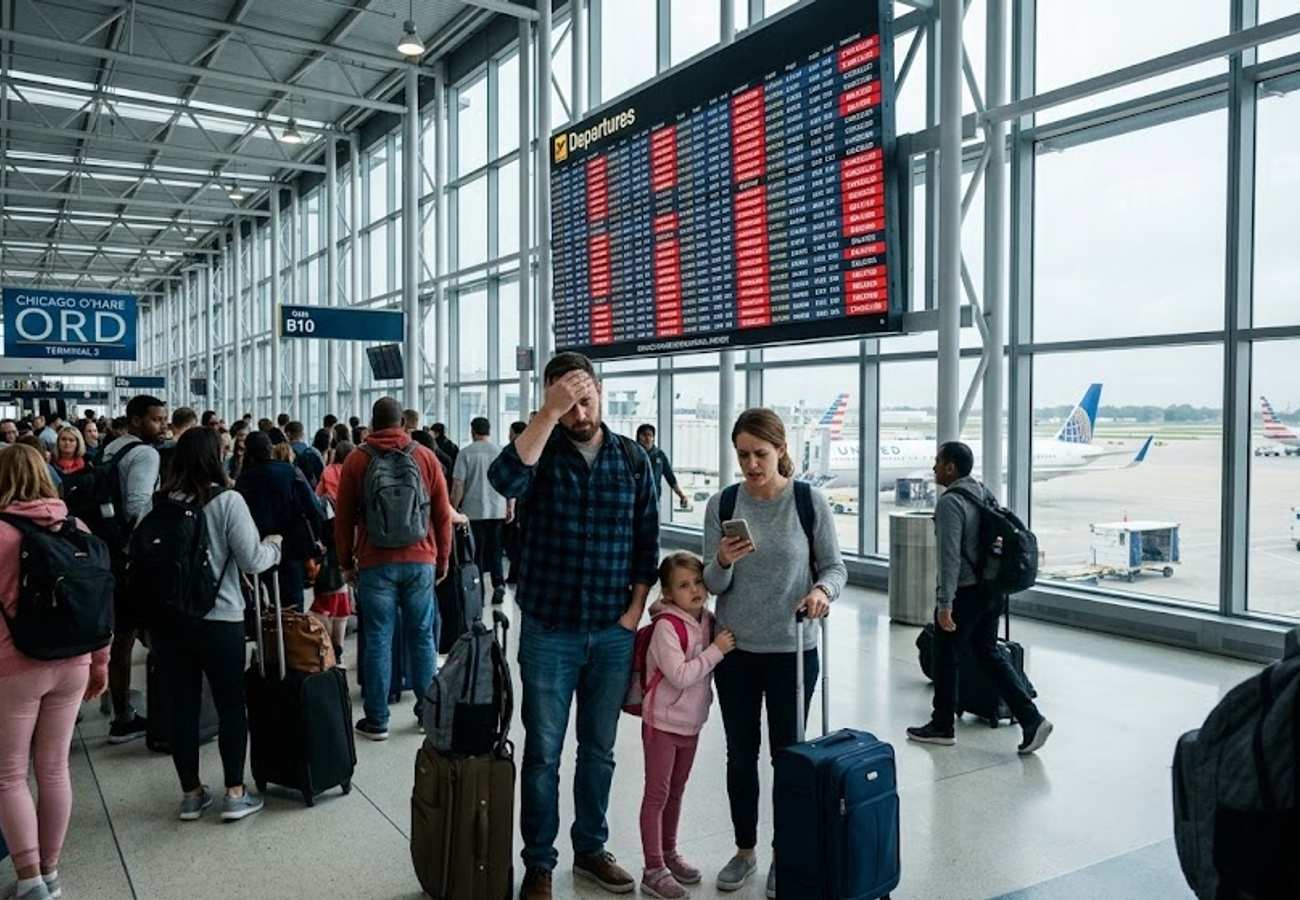
Image generated by AI
The United States aviation network experienced severe operational strain on July 4, 2026, as 216 flight cancellations and 671 delays spread across five major states during peak summer holiday demand. Chicago O'Hare International Airport (ORD) emerged as the focal point of disruption, accounting for 91 cancellations—42% of the national total—alongside 100 delays that cascaded through both domestic and international schedules.
The scale of today's disruption underscores a critical vulnerability in America's hub-and-spoke aviation structure. When major connection points falter, the ripple effects extend far beyond their physical boundaries. Passengers booked on transatlantic flights to the United Kingdom, Germany, Türkiye, and the United Arab Emirates, as well as services into Canada, faced knock-on delays as aircraft rotations and crew assignments compressed across airline networks.
The Hub Collapse Effect: How O'Hare Disruption Spread Nationally
United Airlines bore the heaviest operational burden at O'Hare, recording 35 cancellations and 24 delays across its extensive hub operations. The airline schedules hundreds of daily departures from Chicago, making any operational disturbance a network-wide event. SkyWest Airlines followed with 30 cancellations and 41 delays—the highest delay count among all carriers—underscoring the vulnerability of regional feeder operations that funnel passengers into long-haul networks.
American Airlines reported 13 cancellations and 7 delays, while Delta Air Lines posted 4 cancellations across its smaller Chicago footprint. Regional operators including GoJet (UAL), Endeavor Air (DAL), Republic Airlines, and Envoy Air (AAL) added further disruption counts, illustrating how today's chaos distributed across multiple carrier networks simultaneously.
International carriers including British Airways, China Airlines, Cathay Pacific, Lufthansa, Turkish Airlines, Emirates, TAP Air Portugal, and Air Canada largely avoided outright cancellations but absorbed significant delays, suggesting that aircraft sequencing and gate congestion forced schedule compressions across inbound and outbound traffic flows.
| Airline | ORD Cancellations | ORD Delays | Impact Classification |
|---|---|---|---|
| United Airlines | 35 | 24 | Primary Hub Carrier |
| SkyWest Airlines | 30 | 41 | Regional Affiliate (UAL/DAL/AAL) |
| American Airlines | 13 | 7 | Secondary Hub Carrier |
| GoJet (United) | 6 | 1 | Regional Affiliate (UAL) |
| Delta Air Lines | 4 | 1 | Non-Hub Carrier |
| Endeavor Air (Delta) | 1 | 3 | Regional Affiliate (DAL) |
| Republic Airlines | 1 | 4 | Regional Affiliate (Multiple) |
| Envoy Air (American) | 1 | 1 | Regional Affiliate (AAL) |
| International Carriers | 0 | 14+ | Delay-Only Disruptions |
Hartsfield-Jackson Atlanta Handles Disruption More Effectively
Hartsfield-Jackson Atlanta International Airport (ATL) reported 16 cancellations and 47 delays—a substantially lower impact than Chicago despite serving as the world's busiest airport by passenger volume. Delta Air Lines, which operates its largest global hub from Atlanta, recorded 9 cancellations and 31 delays, with regional affiliate Endeavor Air (DAL) adding 2 cancellations and 8 delays.
The differential between O'Hare and Atlanta suggests that not all major hubs experienced equivalent operational stress today. However, Delta's concentration of disruptions at its primary hub still threatened to compromise connecting schedules across its extensive transatlantic and Asia-Pacific networks.
Newark, JFK, and Boston Contribute to Northeast Corridor Strain
Newark Liberty International Airport (EWR) and John F. Kennedy International Airport (JFK) in the New York metropolitan area, alongside Boston Logan International Airport (BOS) in Massachusetts, all recorded operational disruptions that compounded Northeast Corridor strain during the heaviest holiday weekend of the summer season.
The geographic distribution—Illinois, Georgia, New Jersey, New York, and Massachusetts—suggests that today's disruption stemmed from system-wide operational pressure rather than localized weather or infrastructure failure. Simultaneous hub stress across multiple carrier networks and geographic regions indicates demand compression, crew scheduling constraints, or broader air traffic management challenges.
Transatlantic and International Services Face Cascading Delays
Passengers booked on services connecting through major U.S. hubs toward European and Middle Eastern destinations faced significant delay risk. Flight crews approaching federally regulated duty-time limits required replacements, aircraft awaiting maintenance completed rotations behind schedule, and gate availability constraints forced sequential departure delays.
A British Airways service delayed at O'Hare illustrates the vulnerability of international operations to domestic hub disruption. Similarly, Lufthansa, Air Canada, and Emirates services reported delays despite no direct cancellations, indicating that American hub operations directly compromised their on-time performance.
What Passengers Should Know
Travelers affected by today's disruptions should contact their booking agent or airline directly for rebooking options. United Airlines, American Airlines, and Delta Air Lines typically offer rebooking on next-available flights or alternative routing when cancellations occur. International carriers often coordinate ground transportation for multi-day delays exceeding 24 hours.
Holiday weekend travel demand exacerbates recovery time. Airlines prioritize rebooking passengers on flights within their own networks before accommodating competitive carriers, meaning passengers booked on regional affiliates may face extended rerouting delays. Passengers entitled to compensation under U.S. Department of Transportation regulations should document their cancellation and delay times for potential claims.
The operational data underscore why hub concentration creates systemic vulnerability. When Chicago O'Hare falters, the entire national network feels the impact within hours.
Today's disruption proved that America's hub-dependent aviation model can falter rapidly when multiple major carriers experience simultaneous operational stress—a lesson particularly acute during peak summer demand.
Related Travel Guides
Disclaimer
This article is for informational and educational purposes only. It does not constitute legal, financial, or professional advice. While we strive to provide accurate and up-to-date information, travel policies, regulations, and conditions change rapidly. Always verify information with official sources before making travel decisions. Nomad Lawyer makes no representations about the accuracy, reliability, completeness, or suitability of the information provided. Readers should consult qualified professionals for advice specific to their circumstances. The views expressed in this article are those of the author and do not necessarily reflect the views of Nomad Lawyer.
Preeti Gunjan
Contributor & Community Manager
A passionate traveller and community builder. Preeti helps grow the Nomad Lawyer community, fostering engagement and bringing the reader experience to life.
Learn more about our team →