
Asia's Top Airlines Bet on Clean Fuel to Save $300B Tourism Sector
Singapore Airlines, Thai Airways, and AirAsia are accelerating Sustainable Aviation Fuel adoption across Southeast Asia, aiming to cut aviation carbon emissions by up to 80% and future-proof the region's $300 billion tourism industry against rising climate pressure.

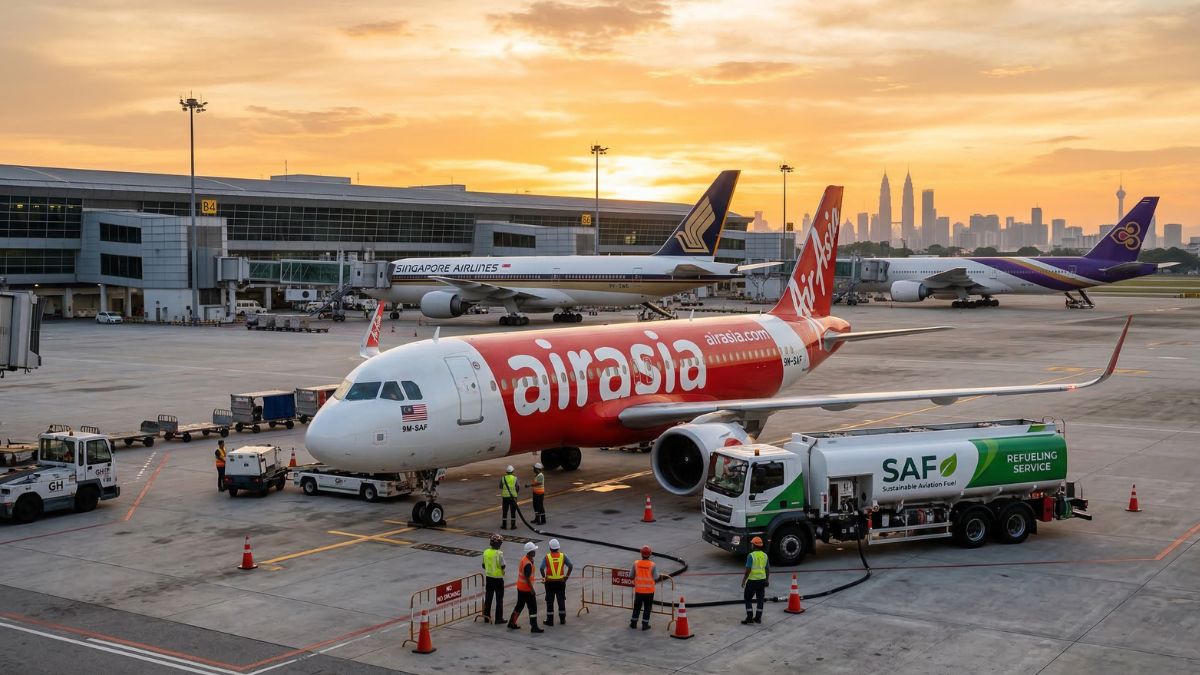
Image for illustrative purposes
Quick Summary
- Singapore Airlines, Thai Airways, and AirAsia are leading SAF adoption across Southeast Asia, targeting up to 80% lifecycle carbon emission reductions versus conventional jet fuel
- The region's $300 billion tourism sector — spanning Thailand, Malaysia, Singapore, and beyond — depends on aviation decarbonisation to remain competitive as eco-conscious travel demand rises
- Singapore Airlines has committed to a 30% carbon emission reduction by 2030, with SAF at the centre of its strategy; Thai Airways and AirAsia are building parallel roadmaps
- Key challenges remain: SAF costs significantly more than conventional fuel, and regional production and distribution infrastructure is still developing
Three of Southeast Asia's most prominent carriers — Singapore Airlines, Thai Airways, and AirAsia — are placing Sustainable Aviation Fuel at the heart of their climate strategies, targeting dramatic reductions in aviation carbon emissions as the region's $300 billion tourism industry faces growing pressure to decarbonise. SAF, produced from renewable feedstocks including waste oils and agricultural residues, can cut lifecycle carbon emissions by up to 80% compared to conventional jet fuel — making it one of the most powerful tools available to an industry that accounts for roughly 3% of global CO2 emissions.
Why SAF Matters So Much for Southeast Asia
Aviation and tourism are inseparable in Southeast Asia. Thailand, Malaysia, and Singapore collectively receive tens of millions of international visitors every year, with the aviation sector functioning as the engine that delivers those arrivals and the revenue that sustains them. As global travelers grow more environmentally aware, the pressure on airlines operating in this region to demonstrate credible climate action has intensified.
SAF is not an experimental technology — it is fully compatible with existing aircraft and infrastructure, requiring no modifications to engines or fuel systems. The fuel is produced from sustainable feedstocks including used cooking oil, agricultural waste, and woody biomass. Its lifecycle emissions profile is dramatically cleaner than conventional kerosene, and the International Air Transport Association (IATA) has positioned it as the single most significant lever for reaching net-zero aviation by 2050.
For Southeast Asia, the stakes are particularly high. Climate change poses direct threats to the natural and cultural attractions — coral reefs, coastlines, rainforests, ancient temples — that underpin the region's tourism appeal. A credible aviation decarbonisation pathway is not just an environmental obligation; it is an economic self-preservation strategy.
Singapore Airlines: 30% Carbon Cut Target by 2030
Singapore Airlines has positioned itself as the regional benchmark for SAF adoption. The carrier has committed to a 30% reduction in net carbon emissions by 2030, with SAF playing a central role in that roadmap. The airline has already integrated SAF into select flight operations and is working with fuel producers and Singapore's government to scale supply as production capacity grows.
Singapore's broader national climate commitments align with the airline's trajectory. The city-state has set its own carbon reduction targets and is actively investing in the infrastructure and policy frameworks needed to support green energy transitions — including in aviation. Singapore Airlines' early-mover position in SAF gives it both an environmental and a commercial branding advantage in a market where premium travelers increasingly factor sustainability into their airline choices.
Thai Airways: Leveraging Thailand's Feedstock Advantage
Thai Airways is integrating SAF into its operations with a strategic advantage that few other carriers in the region can match: Thailand's agricultural sector produces significant volumes of feedstocks — including palm oil residue — that are well-suited to SAF production.
The airline is part of a growing coalition of Asian carriers advocating for stronger regional SAF production capacity and supportive government policy. By transitioning to cleaner fuel, Thai Airways contributes directly to Thailand's sustainability credentials — a benefit that ripples into the country's tourism sector, where eco-conscious international visitors increasingly factor destination-level environmental commitments into their travel decisions.
Thailand attracts millions of international visitors annually. The country's beaches, temples, and cultural destinations are world-renowned, but their long-term appeal depends on both environmental preservation and a perception of responsible stewardship. Thai Airways' SAF commitment signals that the country's flagship carrier is aligned with that imperative.
AirAsia: Clean Fuel at Budget Scale
AirAsia faces a uniquely complex challenge: as a low-cost carrier operating across one of the world's most price-sensitive travel markets, the airline must find a way to integrate SAF — currently more expensive than conventional fuel — without pricing itself out of reach for the passengers it serves.
The airline is addressing this through direct collaboration with fuel producers and government agencies to secure SAF at competitive prices and to advocate for policy support that reduces the cost gap. AirAsia has made a formal commitment to reducing its carbon footprint, and SAF is identified as a critical mechanism for achieving it.
The scale of AirAsia's network across Southeast Asia makes its SAF adoption particularly significant. If a high-frequency, high-volume low-cost carrier can demonstrate that SAF is viable at budget price points, the implications for the broader regional aviation sector are transformative.
The Hospitality Sector Joins the Push
Airlines are not operating in isolation. Southeast Asia's hospitality industry — including major hotel chains such as Marriott, Accor, and Hyatt operating across Singapore, Bangkok, and Kuala Lumpur — is increasingly aligning its own sustainability efforts with developments in green aviation.
Hotels are introducing energy-efficient lighting, water conservation programs, and waste reduction initiatives. By partnering with airlines committed to SAF, hospitality operators can strengthen their own environmental credentials and offer travelers a more coherent, end-to-end sustainable travel experience — from booking to landing to hotel check-in.
The alignment between aviation and hospitality sustainability strategies strengthens the region's overall positioning as a responsible tourism destination — a factor that carries growing weight in the decisions of high-value international travelers.
Key Facts at a Glance
- SAF emission reduction potential: up to 80% lifecycle carbon savings versus conventional jet fuel
- Aviation's share of global emissions: approximately 3% of total CO2
- Net-zero aviation target: 2050, as defined by IATA and aligned with Paris Agreement goals
- Singapore Airlines carbon target: 30% net emission reduction by 2030
- Thai Airways feedstock advantage: abundant palm oil residue and agricultural waste in Thailand
- AirAsia approach: government and producer partnerships to reduce SAF cost at budget carrier scale
- Tourism sector value: Southeast Asia tourism estimated at over $300 billion
- Key destinations at stake: Thailand, Malaysia, Singapore — collectively receiving tens of millions of annual international visitors
- Hospitality alignment: Marriott, Accor, Hyatt and regional hotels integrating sustainability programs aligned with SAF-adopting carriers
What This Means for Travelers
Travelers planning trips to Southeast Asia are increasingly able to make flight choices based on airline sustainability commitments. Selecting a Singapore Airlines, Thai Airways, or AirAsia flight on a SAF-powered route means contributing to measurably lower lifecycle emissions for that journey.
Most airlines now also offer voluntary carbon offset programs at the point of booking — a practical option for travelers who want to neutralise the remaining emission impact of their flights. Choosing eco-certified accommodation alongside a low-emission airline compounds the environmental benefit of the trip.
For travelers who factor sustainability into destination selection, Southeast Asia's active SAF commitment — backed by flagship carriers with credible emission reduction targets — strengthens the region's appeal vs. destinations where aviation decarbonisation is moving more slowly.
Challenges That Still Need to Be Solved
SAF is not yet a seamless transition. The fuel's current price premium over conventional jet fuel remains the most significant structural obstacle, particularly for low-cost carriers. Without greater production scale, policy incentives, or carbon pricing mechanisms that close the cost gap, SAF will face adoption ceilings.
Regional production infrastructure is also still maturing. While Southeast Asia has strong feedstock potential, the refineries, logistics networks, and distribution systems needed to move SAF from source to aircraft at the scale required are not yet fully developed. Airlines, fuel producers, and governments will need to sustain coordinated investment over the coming years to unlock the region's SAF potential.
Frequently Asked Questions
What is Sustainable Aviation Fuel and how much can it reduce emissions? SAF is an aviation fuel produced from renewable sources including used cooking oil, agricultural residues, and woody biomass. Compared to conventional jet fuel, SAF can reduce lifecycle carbon emissions by up to 80%, making it the most impactful currently available tool for decarbonising commercial aviation.
Which Southeast Asian airlines are currently using SAF? Singapore Airlines has already integrated SAF into select flight operations, with plans to expand usage as supply grows. Thai Airways and AirAsia are building their SAF roadmaps and working with fuel producers and governments to accelerate adoption across their networks.
Why is SAF especially important for Southeast Asia's tourism sector? Southeast Asia's tourism industry is valued at over $300 billion and depends heavily on aviation connectivity. As international travelers increasingly choose eco-conscious destinations and airlines, SAF adoption helps the region's carriers maintain their competitiveness and protects the long-term viability of tourism economies in Thailand, Malaysia, Singapore, and beyond.
How can tourists support sustainable aviation on their Southeast Asia trips? Travelers can book with airlines that have committed to SAF adoption, purchase voluntary carbon offsets at booking, choose eco-certified hotels, use public or low-emission ground transport at destinations, and support conservation-focused experiences and attractions during their visits.
Related Travel Guides
Germany Ends Swiss Border Checks — Central Europe Tourism Surges
Middle East Crisis: UAE, Saudi, Qatar & Gulf States Waive Visa Fines for Stranded Travelers
Kona Airport Crisis: 40+ Flights Cut — LA, Seattle, Calgary Hit
Disclaimer
This article is for informational and educational purposes only. It does not constitute legal, financial, or professional advice. While we strive to provide accurate and up-to-date information, travel policies, regulations, and conditions change rapidly. Always verify information with official sources before making travel decisions. Nomad Lawyer makes no representations about the accuracy, reliability, completeness, or suitability of the information provided. Readers should consult qualified professionals for advice specific to their circumstances. The views expressed in this article are those of the author and do not necessarily reflect the views of Nomad Lawyer.
Kunal K Choudhary
Co-Founder & Contributor
A passionate traveller and tech enthusiast. Kunal contributes to the vision and growth of Nomad Lawyer, bringing fresh perspectives and driving the community forward.
Learn more about our team →