
Emirates, Singapore Airlines, AirAsia, and China Eastern Ground Flights Triggering Widespread Asia Flight Cancellations and Delays Across Kuala Lumpur, Singapore, Dubai, Bangkok, and Seoul: New Aviation Updates
A massive aviation gridlock hits Asia and the Gulf as weather and operational limits delay 2,463 flights and cancel 174 across Dubai, Singapore, and Bangkok.

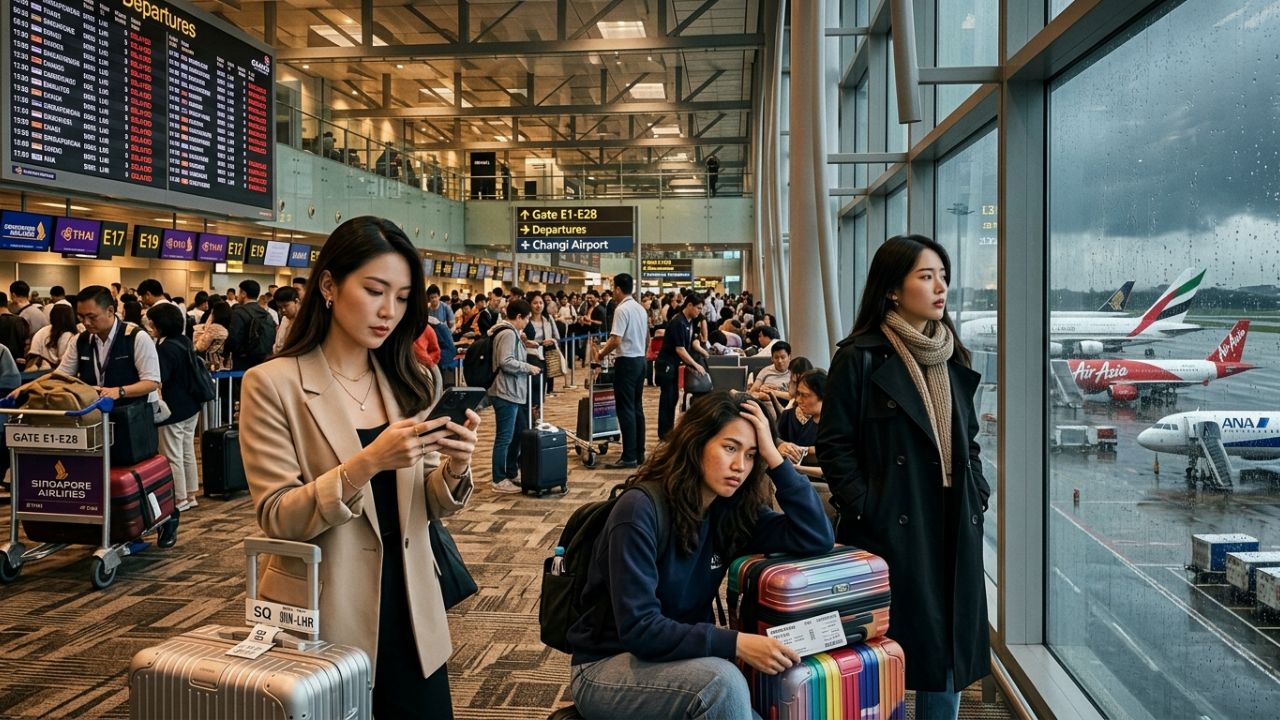
Image generated by AI
In a dramatic operational gridlock that has swept across the Asian and Middle Eastern aviation corridors, thousands of international and domestic travelers are facing extreme gridlock. On May 18, 2026, leading global and regional carriers—including Emirates, Singapore Airlines, AirAsia, China Eastern, and Hainan Airlines—grounded a total of 174 flights and triggered a staggering wave of 2,463 flight delays. This latest airline news update outlines the intense pressure on the Eastern hemisphere's primary transit nodes, causing extensive travel chaos and airport disruptions that have stranded passengers across primary hubs in Kuala Lumpur, Singapore, Dubai, Bangkok, Seoul, and across mainland China.
Subheading: Unprecedented Weather Fronts and Airspace Congestion Ground Critical Flights Across 21 Key Airports
Aviation data suggests that the massive operational slowdown was driven by a combination of severe convective weather systems moving across East Asia, high seasonal passenger volumes, and localized airspace restrictions. In compliance with strict international safety directives, airlines actively adjusted schedules to manage regional runways and air traffic control constraints. Because Asia's high-density intercontinental hubs share heavy scheduling connectivity, minor delays at primary transit nodes quickly cascade through regional networks, disrupting flight rotations for smaller communities.
The timing of these disruptions is particularly critical as carriers handle high traffic volumes. Major airlines like Emirates and Singapore Airlines manage massive passenger volumes at their main hubs in Dubai and Changi, making them vulnerable to crew allocation shortages and gate capacity bottlenecks when traffic staggers. Meanwhile, low-cost carriers face concentrated operational challenges, directly impacting essential travel links.
Detailed Section-Wise Breakdown of Asian Hub Disruptions
The scheduling bottleneck has affected multiple flight corridors across East Asia and the Gulf region, forcing passengers to navigate long queues, crowded terminals, and rapidly changing departure boards:
Gulf-Region Gateways Strained: Dubai and Sharjah Face Traffic Pressures
As the primary international gateway between East and West, Dubai International Airport (DXB) logged 122 delays and 2 cancellations, with Emirates alone accounting for 66 delayed flights. Regional partner FlyDubai reported 22 delays and 2 cancellations, while Sharjah International Airport (SHJ) registered 20 delays and 4 cancellations (with Air Arabia handling the bulk of the disruption load).
Southeast Asian Core Hubs Stranded: Malaysia, Singapore, and Thailand Operations Affected
Southeast Asia’s main transit gateways suffered heavy scheduling complications. Kuala Lumpur International Airport (KUL) reported 160 delays and 13 cancellations (heavily affecting AirAsia, Malaysia Airlines, and regional partner FIREFLY). Nearby, Singapore Changi Airport (SIN) logged 124 delays and 1 cancellation (disrupting Singapore Airlines, Scoot, Jetstar, and Cathay Pacific), while Bangkok’s Suvarnabhumi Airport (BKK) registered 125 delays and 1 cancellation (putting Thai Vietjet Air, Thai Airways, and Vietnam Airlines under severe operational pressure).
China’s Aviation Corridors Paralyzed: Heavy Delays in Shenzhen and Guangzhou
Mainland Chinese airports logged the highest absolute delays in the region due to severe convective weather fronts. Shenzhen Bao’an International (SZX) registered the highest airport delay total with 269 delayed flights and 18 cancellations, while Guangzhou Baiyun (CAN) reported 231 delays and 18 cancellations. Busiest eastern hubs like Shanghai Pudong (PVG) registered 238 delays and 10 cancellations, and Shanghai Hongqiao (SHA) logged 136 delays and 8 cancellations.
In the capital region, Beijing Daxing (PKX) recorded 182 delays and 11 cancellations, and Beijing Capital International (PEK) reported 140 delays and 16 cancellations. Other key regional stations—including Hangzhou Xiaoshan (HGH) with 170 delays and 6 cancellations, Kunming Changshui (KMG) with 116 delays and 12 cancellations, and Zhengzhou Xinzheng (CGO) with 95 delays and 19 cancellations—suffered severe scheduling cuts, leaving local travelers without immediate air links to the national network.
South Korea’s Gateway Facing Cascading Backlogs
Incheon International Airport (ICN) in Seoul registered 78 delays (with Asiana Airlines, Korean Air, Jin Air, Shandong Airlines, and Shenzhen Airlines among the affected carriers), though it managed to avoid outright flight cancellations.
Flight Details and Operational Performance Matrices
The following tables outline the detailed breakdown of the scheduling disruptions across domestic and international routes, highlighting the scope of the operational pressure:
Summary of Flight Disruptions by Major Airport
| Airport Name | Code | Country | Delayed Flights | Cancelled Flights | Operational Status |
|---|---|---|---|---|---|
| Shenzhen Bao'an International | SZX | China | 269 | 18 | Severe Disruptions |
| Shanghai Pudong International | PVG | China | 238 | 10 | High Terminal Pressure |
| Guangzhou Baiyun International | CAN | China | 231 | 18 | High Cancellations |
| Beijing Daxing International | PKX | China | 182 | 11 | Flow Control Delays |
| Hangzhou Xiaoshan International | HGH | China | 170 | 6 | Moderate Disruptions |
| Kuala Lumpur International | KUL | Malaysia | 160 | 13 | Major Southeast Asia Hub |
| Beijing Capital International | PEK | China | 140 | 16 | Heavy Hub Bottlenecks |
| Shanghai Hongqiao International | SHA | China | 136 | 8 | Flow Control Delays |
| Suvarnabhumi Airport Bangkok | BKK | Thailand | 125 | 1 | High Delay Volumes |
| Singapore Changi Airport | SIN | Singapore | 124 | 1 | Dense Regional Transfers |
| Dubai International Airport | DXB | UAE | 122 | 2 | Primary Gulf Hub Bottlenecks |
| Kunming Changshui International | KMG | China | 116 | 12 | Mountain Corridor Outages |
| Zhengzhou Xinzheng International | CGO | China | 95 | 19 | Peak Weather Shutdowns |
| Haikou Meilan International | HAK | China | 92 | 6 | Island Gateways Closed |
| Incheon International Airport | ICN | South Korea | 78 | 0 | Regional Backlogs Only |
| Zhuhai International Airport | ZUH | China | 76 | 9 | Regional Delays |
| Penang International Airport | PEN | Malaysia | 37 | 4 | Minor Outages |
| Jieyang Chaoshan International | SWA | China | 30 | 8 | Weather Restrictions |
| Sharjah International Airport | SHJ | UAE | 20 | 4 | Air Arabia Operations Affected |
| Hohhot Baita International | HET | China | 20 | 5 | Northern Corridor Delays |
| Sultan Mahmud International | TGG | Malaysia | 2 | 3 | High Percentage Cancellations |
| Total Disruptions Combined | - | - | 2,463 | 174 | Massive Regional Delays |
Individual Carrier Performance Breakdowns
| Airline Brand | Main Hubs | Delayed Flights | Cancelled Flights | Operational Impact |
|---|---|---|---|---|
| China Eastern | Shanghai, Beijing | 380 | 28 | Massive Flow Control Pressures |
| Hainan Airlines | Haikou, Beijing | 79 | 34 | Peak Cancellations Across Network |
| China Express Airlines | Chongqing | 74 | 18 | Regional Flight Groundings |
| Emirates | Dubai | 66 | 0 | Gulf Scheduling Bottlenecks |
| Malaysia Airlines | Kuala Lumpur | 55 | 0 | Southeast Asian Connections |
| AirAsia | Kuala Lumpur | 47 | 20 | Busiest Regional Low-Cost Outages |
| Thai Vietjet Air | Bangkok | 37 | 1 | High Thai Hub Backlogs |
| Singapore Airlines | Singapore | 35 | 0 | Changi Transit Disruptions |
| FlyDubai | Dubai | 22 | 2 | Gulf Regional Congestion |
| Asiana Airlines | Seoul | 20 | 0 | South Korean Corridor Delays |
| FIREFLY | Subang, Penang | 18 | 0 | Malaysian Regional Bottlenecks |
Passenger Impact and Terminal Realities
The emotional and financial toll of these airport disruptions extends far beyond simple scheduling inconveniences. Stranded passengers across Dubai, Singapore, Bangkok, and Kuala Lumpur have reported long lines at customer service counters, missed family milestones, postponed business meetings, and high travel anxiety. Because many international travelers utilize these primary airports as major transit gateways, these flight delays have resulted in numerous missed intercontinental connections, requiring airlines to coordinate extensive hotel re-accommodations and baggage re-routing.
Furthermore, passengers are facing unexpected out-of-pocket costs for meals and communications while waiting in crowded terminals. Depending on their origin airport, travelers experienced extended wait times, pushing many travelers to seek last-minute hotel stays or expensive airport dining options.
Industry Analysis: Root Causes of Asian Flight Disruptions
Aviation analysts explain that the widespread travel chaos is not solely a result of terminal gate capacity bottlenecks. Rather, carriers are dealing with complex geopolitical, weather, and operational challenges:
- Severe Convective Weather: Active monsoon and storm fronts across southern and eastern China have severely restricted regional flight paths.
- Airspace Congestion: Air traffic control (ATC) limits in high-density corridors like the Gulf region and East Asia require wider flight separation distances.
- Crew Duty-Hour Limits: Flight delays frequently push crew allocations past legal duty-hour restrictions, forcing subsequent flight cancellations.
- High Network Connectivity: Tight rotation schedules across Asia's major travel hubs mean that minor delays cascade quickly through regional networks.
Conclusion: Recovery Outlook and Stabilizing Operations
Despite the current turbulence, airport authorities and airline dispatch teams are working to stabilize flight schedules and restore passenger confidence. Departure boards continue to show updated times, and flight dispatchers are gradually returning delayed aircraft to their regular rotations. While terminals remain crowded, international aviation experts are optimistic that operational stability will steadily return to Asia's busy air corridors over the next 24 hours.
Key Takeaways
- Scale of Disruptions: Exactly 174 flights were cancelled and 2,463 flights delayed across 21 major Asian and Gulf airports on May 18, 2026.
- High-Risk Gateways: Shenzhen Bao’an (SZX) logged the highest airport delay total with 269 flights, while Zhengzhou (CGO) registered 19 cancellations.
- Most Impacted Carriers: China Eastern suffered the highest delays overall with 380 flights, while Hainan Airlines recorded 34 cancellations.
- Core Causes: Convective storm fronts, air traffic control restrictions, crew duty limits, and tight rotation schedules across key hubs.
- Advice for Travelers: Frequently check live flight status trackers, monitor official carrier applications, and keep essential documents in carry-on bags.
Related Travel Guides
- Ryanair Reports Record Passenger Traffic and Stronger Fares as Europe's Budget Travel Boom Shows No Signs of Slowing Down: New Aviation Updates
- British Airways Boeing 777 Emergency Slide Deploys at London Heathrow Airport, Delaying Washington Dulles Flight BA217 by 6 Hours: New Aviation Updates
- The 10 Best Tips to Claim Flight Compensation in Asia, According to Reddit
Disclaimer
This article is for informational and educational purposes only. It does not constitute legal, financial, or professional advice. While we strive to provide accurate and up-to-date information, travel policies, regulations, and conditions change rapidly. Always verify information with official sources before making travel decisions. Nomad Lawyer makes no representations about the accuracy, reliability, completeness, or suitability of the information provided. Readers should consult qualified professionals for advice specific to their circumstances. The views expressed in this article are those of the author and do not necessarily reflect the views of Nomad Lawyer.
Kunal K Choudhary
Co-Founder & Contributor
A passionate traveller and tech enthusiast. Kunal contributes to the vision and growth of Nomad Lawyer, bringing fresh perspectives and driving the community forward.
Learn more about our team →