
Aviation Updates: San Francisco International Airport Hit by Massive Travel Chaos as 213 Flight Delays and 3 Cancellations Strand Passengers on United Airlines, Alaska Airlines, Delta, American Airlines Routes to Los Angeles, New York, Chicago, London, Tokyo and Singapore
San Francisco International Airport (SFO) recorded a severe operational breakdown on June 25, 2026, with 213 flight delays and 3 cancellations impacting United Airlines, Alaska Airlines, Delta, American Airlines, and other major carriers across domestic and international routes to Los Angeles, New York, Chicago, London, Tokyo, and Singapore.

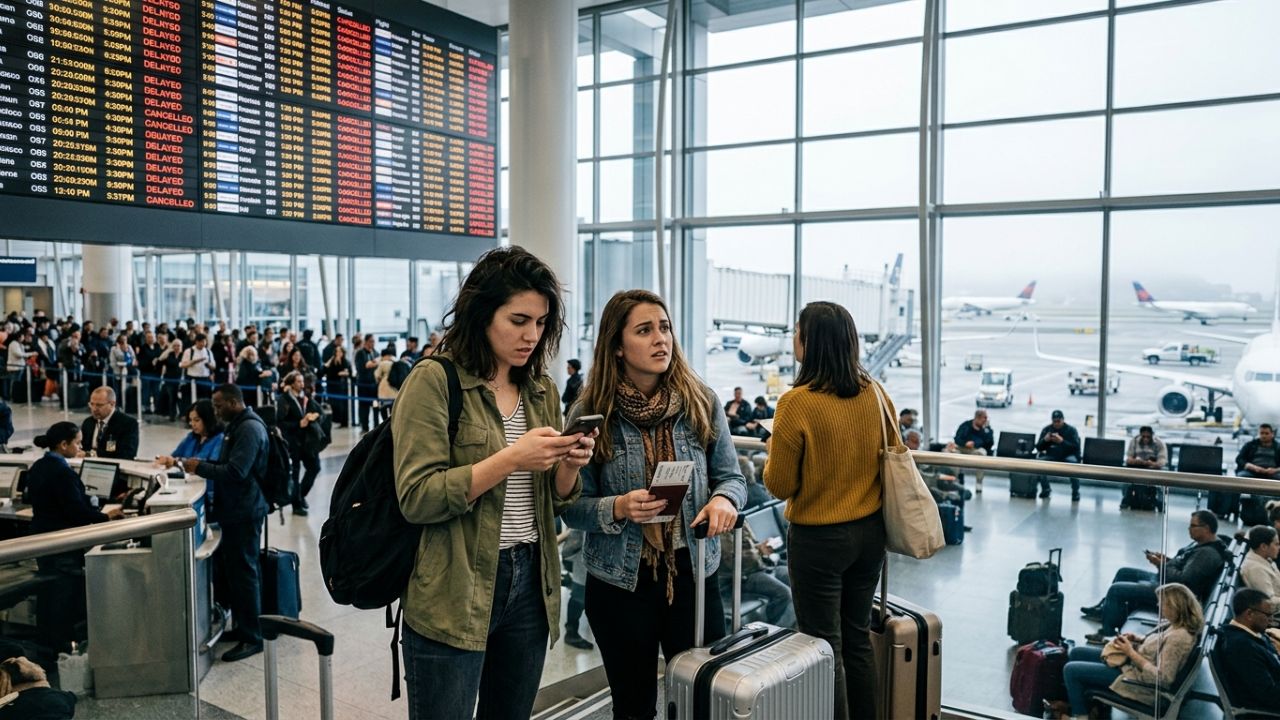
Image generated by AI
Aviation Updates: San Francisco International Airport Hit by Massive Travel Chaos as 213 Flight Delays and 3 Cancellations Strand Passengers on United Airlines, Alaska Airlines, Delta, American Airlines Routes to Los Angeles, New York, Chicago, London, Tokyo and Singapore
As the already-strained arteries of America's West Coast aviation network buckle under the weight of peak summer traffic, San Francisco International Airport is delivering thousands of passengers their worst travel day of the season — one defined by hours of uncertainty, cascading schedule failures, and the ever-present fog that has haunted this runway configuration for decades.
Confirmed airline news emerging from real-time tracking and FAA operational data reveals that San Francisco International Airport (SFO) suffered a sweeping and deeply disruptive operational breakdown on June 25, 2026, with an official total of 213 flight delays and 3 flight cancellations recorded across the airport's full scheduled service cycle. The disruption struck at the heart of one of the United States' most critical intercontinental aviation hubs, spreading travel chaos across domestic corridors connecting SFO to Los Angeles, New York, and Chicago, while simultaneously battering long-haul international services linking California to London, Tokyo, and Singapore.
Major carriers operating through San Francisco — including United Airlines, Alaska Airlines, Delta Air Lines, American Airlines, and additional domestic and international operators — found themselves unable to maintain scheduled departure windows as FAA traffic management initiatives, constrained runway capacity, and the airport's famously weather-sensitive operating environment combined to produce one of the most disruptive single-day airport disruptions recorded at SFO this summer season. For the hundreds of families, corporate travelers, and international tourists who had chosen June 25 to transit through San Francisco's terminals, a day that began with routine departure board checks rapidly devolved into a prolonged, exhausting confrontation with the realities of modern hub-airport congestion.
Expanded Overview: How 213 Delays Happened at America's Most Weather-Sensitive Hub
San Francisco International Airport occupies a unique and structurally vulnerable position within the United States national airspace system. Unlike the parallel runway configurations found at airports such as Dallas/Fort Worth or Chicago O'Hare — where aircraft can land simultaneously on adjacent runways in instrument meteorological conditions — SFO's runway geometry creates a critical operational limitation. The airport's two sets of parallel runways are positioned in such close proximity that when visibility drops or crosswind components exceed certain thresholds, the FAA is required to shift operations from simultaneous parallel approaches to dependent approaches — a configuration change that effectively halves the airport's arrival capacity and immediately begins generating delay backlogs that compound throughout the day.
This structural sensitivity to atmospheric conditions, combined with SFO's role as a primary gateway for transpacific aviation and a major domestic hub for United Airlines, means that operational disruptions at this airport do not stay contained within San Francisco's terminals. They propagate. Aircraft delayed into SFO from Tokyo or Singapore depart late for their next domestic rotation. Crews approaching duty-hour limits on inbound long-haul flights are unable to operate their scheduled outbound departures. Gate conflicts emerge as delayed arrivals occupy positions needed for the next wave of departures. Within hours, what began as a weather- or ATC-driven schedule compression at a single airport has become a continent-wide cascade of missed connections and revised itineraries.
The 213 delays recorded on June 25 represent exactly this kind of cascading systemic failure. The 3 cancellations, while modest in absolute number, reflect the point at which carriers determined that certain aircraft rotations could not be recovered within operationally acceptable parameters and made the difficult decision to ground those services entirely.
Section-Wise Breakdown: San Francisco International Airport Under Severe Operational Strain
San Francisco International Airport: The West Coast's Paralysed Gateway
SFO absorbed the entirety of the June 25 disruption — all 213 delays and all 3 cancellations were concentrated at this single airport, confirming that the breakdown was airport-specific rather than a network-wide event. The scale of the delay figure — 213 individual service disruptions recorded in a single operational cycle — places this event among the most significant single-day disruption episodes experienced at San Francisco this year.
The geographic reach of the impacted routes extended across virtually every segment of SFO's operational remit. Domestic corridors to Los Angeles — the airport's single busiest city pair — as well as high-frequency services to New York, Chicago, Seattle, and other major hubs experienced revised departure windows throughout the day. On the international side, the disruption struck the airport's most commercially vital routes: the transpacific services to Tokyo and Singapore that generate disproportionate revenue for the carriers operating them, and the transatlantic corridor to London that serves as a key gateway for both business travelers and European-bound leisure passengers.
For United Airlines, which operates San Francisco as one of its primary domestic and international hubs, the disruption carried particular operational weight. United's SFO hub functions as the primary gateway for the carrier's extensive Pacific network, and any schedule compression at SFO has immediate downstream consequences for onward connections at destinations across Asia and Oceania. Alaska Airlines, with a significant domestic presence at SFO, Delta Air Lines, and American Airlines all reported schedule disruptions as the operational pressure spread across gate assignments and ground handling resources throughout the terminal complex.
Flight Details and Verified Disruption Impact Matrix
The following data matrix reflects the official operational snapshot at San Francisco International Airport on June 25, 2026, sourced from FAA traffic management records and real-time flight tracking data.
Confirmed Disruption Data — San Francisco International Airport, June 25, 2026
| Airport | Cancelled Flights | Delayed Flights |
|---|---|---|
| San Francisco International Airport (SFO) | 3 | 213 |
Data reflects total confirmed flight disruptions at SFO on June 25, 2026. Affected carriers include United Airlines, Alaska Airlines, Delta Air Lines, American Airlines, and additional domestic and international operators. FAA Air Traffic Management initiatives were in effect during the disruption period.
The 213:3 delay-to-cancellation ratio is operationally significant. With fewer than 1.5% of the day's disrupted services resulting in outright cancellations, the data confirms that carriers chose to preserve operations through schedule slippage rather than ground aircraft. This approach keeps passengers moving — albeit at the cost of significant waiting time — while limiting the carrier's formal compensation obligations under Department of Transportation rules. For passengers, however, a delay of four or five hours can be functionally indistinguishable from a cancellation when downstream connections are missed and alternative seats are no longer available on the same day.
Passenger Impact: A Day of Cascading Consequences at SFO
The human experience of a 213-delay day at San Francisco International is one that thousands of travelers know from firsthand experience — and one that bears little resemblance to the sanitized narrative of "minor schedule adjustments" that airline communications often favor. Passengers booked on the first departure banks of the day encountered delays that pushed their flights into conflict with afternoon banking waves. Travelers connecting from transpacific arrivals — exhausted from 10-hour or longer inbound flights from Tokyo or Singapore — arrived at SFO to discover that their domestic connecting services had already departed, leaving them stranded in international arrivals without immediate rebooking options.
Business travelers on time-sensitive same-day itineraries between San Francisco and New York or Chicago — routes where SFO functions as the western terminus of critical corporate corridors — faced the collapse of meetings, conference appearances, and contractual commitments that a five-hour delay renders impossible to recover. Families traveling to London for summer holidays found themselves recalculating accommodation bookings and activity reservations as their transatlantic departure windows slid deep into the evening hours.
The financial exposure for affected passengers varied sharply by itinerary type. Travelers on flexible corporate fares had rebooking options. Passengers on restricted leisure tickets faced the prospect of booking new flights at walk-up prices or absorbing the full cost of a night's hotel accommodation in San Francisco while awaiting the next available departure. Travel insurance holders were better positioned, but even documented claims require time and administrative effort that exhausted travelers are ill-equipped to manage from a crowded departure terminal.
US Department of Transportation rules entitle passengers on domestic flights to refunds if their flight is cancelled and they choose not to travel. For significant delays, passengers have the right to request a refund rather than accept a rebooking. International passengers departing from the United States may have additional rights depending on the carrier's own policies and the destination country's passenger protection frameworks. Retaining all documentation of the disruption — including screenshots of delay notifications, boarding passes, and receipts for meals and accommodation — remains essential for any subsequent compensation claim.
Industry Analysis: Why SFO Remains America's Most Disruption-Prone Major Hub
San Francisco International Airport's chronic vulnerability to large-scale delay events is not a new phenomenon, and the June 25 disruption is best understood within a structural context that has persisted for decades. Several interlocking factors consistently position SFO as the US hub most likely to experience widespread airport disruptions during periods of adverse conditions.
The airport's runway geometry — which forces a switch from simultaneous to dependent parallel approaches in low-visibility conditions — is the foundational constraint. When Bay Area marine layer or fog reduces approach minima, SFO's arrival rate can fall from approximately 60 aircraft per hour to 30 — an instant 50% capacity reduction that generates immediate upstream demand for FAA ground delay programs at departure airports across the country.
FAA Air Traffic Management initiatives — including ground delay programs, ground stops, and miles-in-trail restrictions — are the regulatory mechanism through which this capacity reduction is managed. When the FAA implements a ground delay program at SFO, aircraft at departure airports across the US are held on the ground rather than being airborne when they cannot be landed safely. This is the correct safety intervention, but it creates exactly the kind of systemic delay accumulation that produced the 213-delay figure on June 25.
Peak summer demand saturation amplifies the baseline structural vulnerability. In summer 2026, US domestic and international travel demand is running at historically elevated levels, with SFO operating near maximum scheduled capacity. Any capacity reduction — whether weather-driven, ATC-initiated, or caused by temporary runway maintenance — now produces immediate and severe downstream consequences because there is no slack in the system to absorb even modest disruptions before they cascade.
Conclusion: Recovery Outlook and What SFO Travelers Must Prepare For
The 213-delay, 3-cancellation event at San Francisco International Airport on June 25, 2026 will require a 12–24 hour recovery window before the airport's schedule fully stabilizes and airline networks return to normal rotation patterns. The breadth of affected carriers and the geographic reach of impacted routes — spanning domestic US services and transpacific and transatlantic international operations — confirms that this was a genuinely systemic disruption rather than a localized operational blip.
For travelers currently in transit through San Francisco or planning imminent departures at SFO, the actionable priorities are clear: check flight status before departing for the airport, enable real-time push notifications from your carrier's app, carry essential medications and travel documents in hand luggage at all times, and have a clear understanding of your rebooking rights under the DOT's air travel consumer rules. Passengers who approach disruption events with documentation, flexibility, and a clear knowledge of their entitlements consistently achieve better outcomes than those who rely solely on the airline's proactive rebooking system.
For the broader US aviation industry, SFO's recurring susceptibility to large-scale delay cascades continues to highlight the case for runway infrastructure investment — specifically, the development of a configuration that would allow the airport to maintain simultaneous approaches in instrument meteorological conditions. Until that structural solution is realized, travel chaos at San Francisco during summer fog season will remain one of the most predictable events in American aviation.
Key Takeaways
- 213 Delays, 3 Cancellations: San Francisco International Airport (SFO) recorded a devastating 213 flight delays and 3 cancellations on June 25, 2026 — one of the most disruptive single-day events at the airport this summer season.
- Major Carriers Impacted: United Airlines, Alaska Airlines, Delta Air Lines, American Airlines, and additional domestic and international operators were all affected by the operational breakdown.
- Routes Hit: Disruptions extended across domestic services to Los Angeles, New York, and Chicago, alongside international operations to London, Tokyo, and Singapore.
- FAA Involvement: Federal Aviation Administration traffic management initiatives — including ground delay programs and arrival spacing requirements — were in active effect during the disruption period.
- Runway Geometry at the Core: SFO's unique parallel runway configuration, which reduces arrival capacity under low-visibility conditions, remains the foundational structural driver of the airport's chronic susceptibility to large-scale delay cascades.
- Passenger Action Required: Affected travelers are advised to monitor aviation updates via carrier apps, retain all disruption documentation for compensation claims, and contact their airline immediately to confirm rebooking arrangements on the next available service.
Related Travel Guides
- World's Largest Air Forces Ranked by F-35 Fighter Jets in 2026
- Breaking Airline News: Canadian Airports Battle Terrifying Travel Chaos as Air Canada and Jazz Violently Cancel 59 Flights and Delay 349 More
- The F-4 Phantom II: How a Navy Fighter Jet Became the Air Force's Most Trusted Workhorse
Disclaimer: This article is strictly for informational purposes only. All disruption data reflects the operational situation at San Francisco International Airport on June 25, 2026, sourced from FAA operational records and real-time flight tracking data. Airline schedules, rebooking availability, and route recovery timelines are subject to continuous, real-time revision. Passengers are urgently advised to verify their specific flight status directly via their carrier's official platform prior to departing for the airport.
Disclaimer
This article is for informational and educational purposes only. It does not constitute legal, financial, or professional advice. While we strive to provide accurate and up-to-date information, travel policies, regulations, and conditions change rapidly. Always verify information with official sources before making travel decisions. Nomad Lawyer makes no representations about the accuracy, reliability, completeness, or suitability of the information provided. Readers should consult qualified professionals for advice specific to their circumstances. The views expressed in this article are those of the author and do not necessarily reflect the views of Nomad Lawyer.
Preeti Gunjan
Contributor & Community Manager
A passionate traveller and community builder. Preeti helps grow the Nomad Lawyer community, fostering engagement and bringing the reader experience to life.
Learn more about our team →