
San Francisco Travel Guide 2026: Insider Neighborhoods, Forecast Spending, and Historic Gems

With visitor spending projected to reach an unprecedented record of $9.9 billion across 24.2 million travelers in 2026, a remarkable 60% of all tourist revenue in San Francisco flows directly into independent neighborhood businesses, dining spots, and cultural venues rather than hotel chains. Economic benchmark reports released by the San Francisco Travel Association reveal that following a robust 2025 performance—which welcomed 23.7 million visitors, generated $9.4 billion in economic impact, and supported 63,900 tourism jobs—the city's travel appeal is driven by distinct local neighborhoods rather than a single downtown strip.
Spanning a compact seven-by-seven-mile peninsula, the City by the Bay allows travelers to navigate from maritime shipyards and historic Chinese enclaves to sun-drenched Latin arts districts and windswept Pacific dunes within a single afternoon.
Six Essential Neighborhood Chapters: Beyond the Standard Postcard Circuit
To truly understand San Francisco, travelers must explore its six most expressive micro-districts:
1. Fisherman’s Wharf & San Francisco Maritime National Historical Park
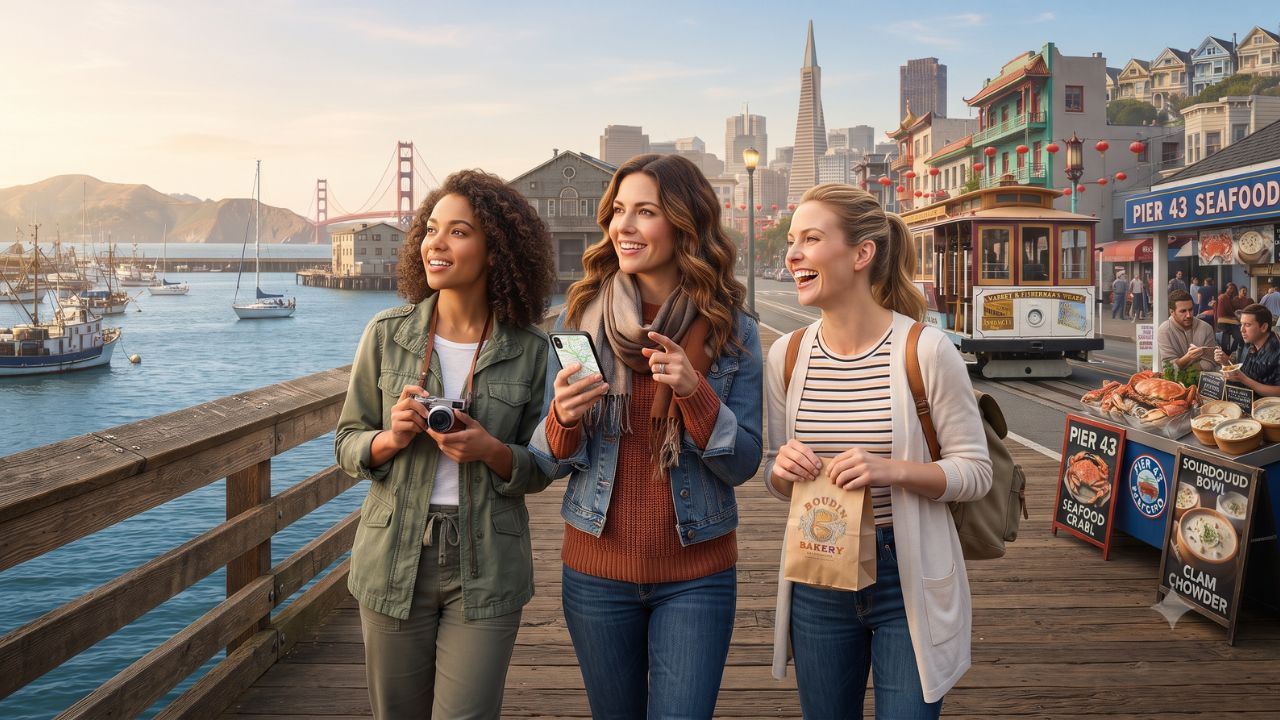
While popular for waterfront dining and sea lions, the true heart of the wharf resides in its maritime history. Visit the San Francisco Maritime National Historical Park Visitor Center inside the 1907 Haslett Warehouse (499 Jefferson Street), open daily from 10:00 AM to 5:00 PM, and the Maritime Museum (Wednesday–Sunday, 10:00 AM to 4:00 PM). Note that historic Hyde Street Pier remains temporarily closed for major restoration, with historic vessels moored at Mare Island. Sample traditional Dungeness crab and hot clam chowder served in freshly baked sourdough bread bowls along Jefferson Street before boarding a historic cable car.
2. Chinatown & Historic Portsmouth Square
Establishing a continuous cultural presence for more than a century, Chinatown is anchored by Portsmouth Square, the oldest public square in the city. Backed by a newly announced $73 million municipal revitalization project creating expanded community clubhouses and open event spaces, the square remains a vibrant gathering point for morning tai chi and lively xiangqi (Chinese chess) matches. Walk along Stockton Street to sample authentic Cantonese dim sum, herbal teas, egg tarts, and roasted meats.
3. Mission District & Mission Dolores Park
Fusing deep Latin American heritage with contemporary creativity, the Mission District centers around Dolores Park (Dolores and 19th Streets). Thousands gather here on weekend afternoons for panoramic skyline views. Explore the 18th-century adobe walls of Mission San Francisco de Asís (Mission Dolores), view colorful community murals along Balmy Alley and Clarion Alley, and enjoy authentic Mission-style burritos wrapped in steamed flour tortillas with grilled carne asada and fresh avocado.
4. Palace of Fine Arts & The Marina
Constructed as a temporary architectural centerpiece for the 1915 Panama-Pacific International Exposition, the Palace of Fine Arts remains the only major monumental structure preserved from the world's fair. Its classical Greco-Roman rotunda, curved colonnades, and swan-filled lagoon provide a peaceful walking retreat open daily from 5:00 AM to midnight, linking seamlessly into the Marina waterfront.
5. Twin Peaks Panoramic Viewpoint
Rising to 922 feet in elevation as the city’s second-highest summit behind Mount Davidson, the 64-acre park (including a 31.1-acre protected natural area) delivers 360-degree vistas across downtown skyscrapers, the Bay Bridge, and Alcatraz Island. Access the summit via the Portola Drive gate between 5:00 AM and midnight (the Burnett Avenue vehicle gate remains closed to car traffic).
6. Ocean Beach & Western Coastal Dunes
Stretching 3.5 miles along the Pacific Ocean, Ocean Beach offers wild maritime air, surf breaks, and historic landmarks like the 1925 Beach Chalet. Active ecological initiatives, including a major 2025 community sand-dune replanting program, are restoring native flora and stabilizing coastal dunes against winter tides.
What Makes San Francisco’s Urban Geography Distinct
San Francisco’s magic lies in its rapid transitions between microclimates and cultures.
Because the peninsula is hemmed between the cold Pacific Ocean and the warmer waters of San Francisco Bay, summer fog (Karl the Fog) frequently cloaks the western avenues of Ocean Beach in cool 13°C mist, while the Mission District just three miles east basks in clear 22°C sunshine. The city’s historic transit grid—including vintage F-line streetcars from Milan and Melbourne and three operational cable car lines—turns daily transit into an open-air historical experience.
Visitor Insider Tips for Exploring San Francisco 2026
Navigate the city smoothly with these local transit and sightseeing strategies:
- Purchase an SFMTA Visitor Passport: Avoid paying separate $5.70 single Muni bus fares or $9.00 single cable car tickets. Purchase an official SFMTA Transit Passport ($15 for 1-Day, $35 for 3-Day, or $47 for 7-Day) via the MuniMobile app for unlimited rides across all city buses, light rail, historic streetcars, and cable cars.
- Explore Presidio Tunnel Tops and Outpost Meadow: Don’t miss the newly expanded 1.5-acre Outpost Meadow within the Presidio’s 1,000-acre national park site, offering free picnic areas, scenic bay overlooks, and family nature labs that have welcomed over 5 million visitors since opening.
- Book Alcatraz Ferry Tickets Weeks Ahead: National Park Service concessions to Alcatraz Island sell out weeks in advance; secure morning departures to experience the award-winning Cellhouse audio tour (available in 11 languages) before afternoon crowds peak.
- Layer Clothing for Rapid Temperature Drops: Always carry a windproof jacket and light wool layer. Temperatures can drop by 10 degrees Celsius in twenty minutes as ocean sea breezes sweep through the Golden Gate strait.
- Dine Outside Peak Tourist Corridors: For authentic regional dining, step two blocks off main tourist thoroughfares. Choose family-owned dim sum tea houses along Clement Street in the Inner Richmond, or family bakeries on 24th Street in the Lower Mission.
Cultural and Environmental Context: Community Heritage and Coastal Stewardship
Managing 24.2 million annual visitors while preserving fragile urban ecosystems requires ongoing civic stewardship.
San Francisco continues to lead nationwide urban sustainability initiatives. From the ecological sand-dune stabilization projects along Ocean Beach to strict zero-waste composting mandates enforced across municipal parks and restaurants, the city actively protects its natural coastline.
Simultaneously, major public investments like the $73 million Portsmouth Square modernization ensure that historical immigrant enclaves preserve their cultural identity. By patronizing independent family merchants, heritage bakeries, and community arts non-profits, travelers directly support the living cultural fabric that makes San Francisco one of the world's most enduring travel destinations.
FAQ: Visiting San Francisco 2026
What is the best way to get around San Francisco without a car?
Use SFMTA Muni buses, historic streetcars, BART subway lines, and cable cars. A 1-Day or 3-Day Visitor Passport offers unlimited travel across the entire municipal system.
When is San Francisco’s warmest and sunniest weather?
September and October offer the warmest temperatures and clearest skies of the year, avoiding the heavy summer fog common in June and July.
Is Hyde Street Pier open for visitors in 2026?
Hyde Street Pier is currently closed for infrastructure repairs, though the San Francisco Maritime Museum and Visitor Center on Jefferson Street remain open.
How do I reach Twin Peaks using public transit?
Take the Muni 37 Corbett bus from the Castro neighborhood, get off at the Crestline Drive stop, and follow the marked pedestrian trail up to the observation summit.
From the chime of cable car bells in the morning mist to the Pacific sunset fading behind Ocean Beach, San Francisco proves that true discovery happens one neighborhood at a time.
Related Travel Guides
Disclaimer
This article is for informational and educational purposes only. It does not constitute legal, financial, or professional advice. While we strive to provide accurate and up-to-date information, travel policies, regulations, and conditions change rapidly. Always verify information with official sources before making travel decisions. Nomad Lawyer makes no representations about the accuracy, reliability, completeness, or suitability of the information provided. Readers should consult qualified professionals for advice specific to their circumstances. The views expressed in this article are those of the author and do not necessarily reflect the views of Nomad Lawyer.
Kunal K Choudhary
Co-Founder & Contributor
A passionate traveller and tech enthusiast. Kunal contributes to the vision and growth of Nomad Lawyer, bringing fresh perspectives and driving the community forward.
Learn more about our team →