
Ninh Binh Tourism Boom in Vietnam Puts Trang An’s UNESCO Landscape Under Mounting Visitor Pressure
Ninh Binh Tourism Boom in Vietnam Puts Trang An’s UNESCO Landscape Under Mounting Visitor Pressure

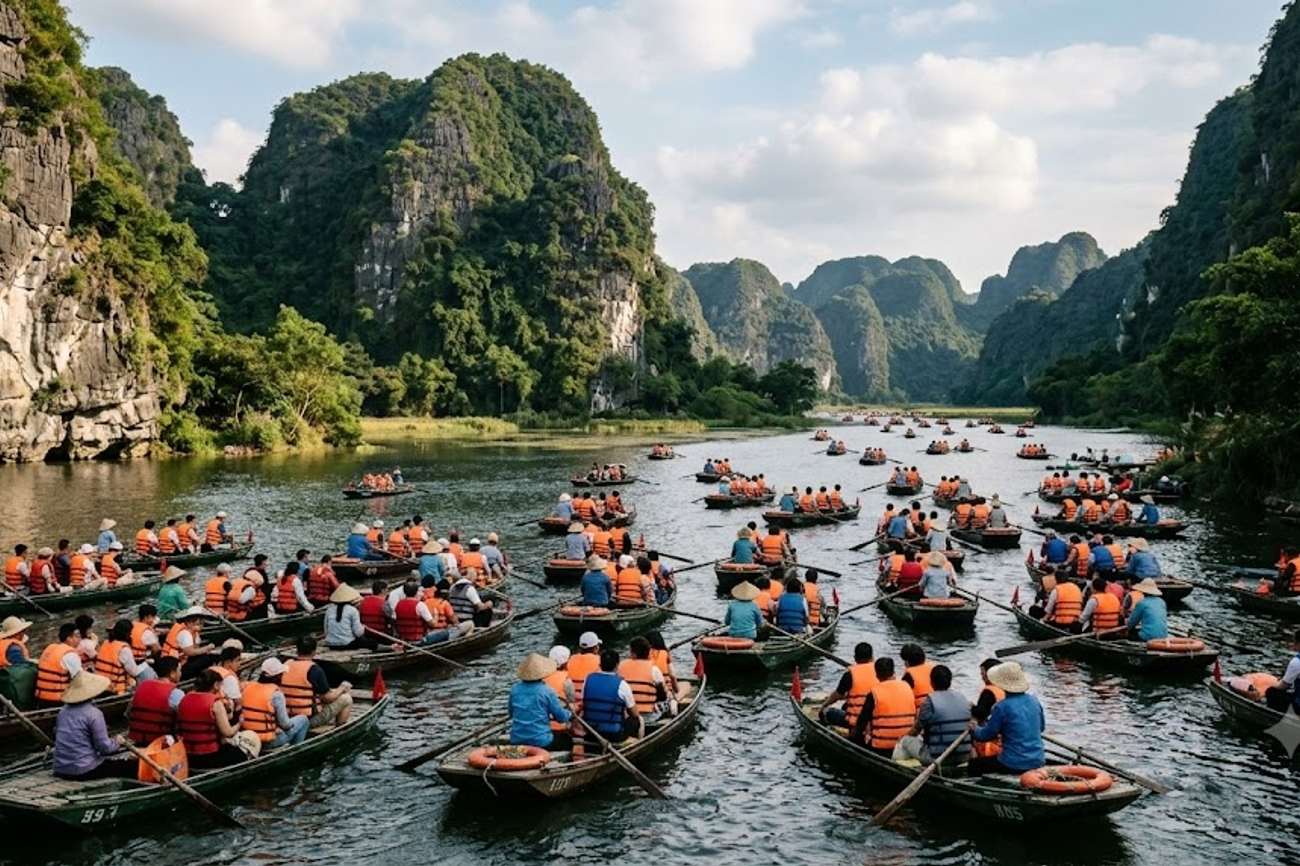
Image generated by AI
19.79 million visitors descended upon Ninh Binh in the first eight months of 2026 alone, representing a 24.13% year-on-year surge that pushes the region toward a critical infrastructure tipping point. This acceleration signals a shift in the destination's lifecycle; the primary challenge has evolved from the necessity of attracting global travelers to the urgent requirement of managing an overwhelming volume of arrivals. While the financial gains are staggering, the sheer scale of human movement threatens the integrity of one of Southeast Asia's most fragile ecological and cultural assets.
The Administrative Expansion of Ninh Binh
To understand the current trajectory, one must first address a significant shift in regional governance. In 2025, a major administrative reorganization occurred: the provinces of Ninh Binh, Ha Nam, and Nam Dinh were merged into a single, expanded Ninh Binh Province. This new entity spans approximately 3,942.62 square kilometers and supports a population of 4.41 million people.
This merger fundamentally alters how tourism data is interpreted. When comparing 2026 figures to those from 2023 or 2024, analysts are not looking at a like-for-like geographical area. The expanded provincial borders incorporate new coastal, religious, and rural attractions, which theoretically allows the government to divert tourist traffic away from the hyper-concentrated "hotspots" and distribute the economic benefit across a wider territory. However, the surge in numbers suggests that the primary draw remains the core heritage sites, regardless of the expanded administrative boundaries.
Tourism Growth and Revenue Metrics
The financial acceleration in the region has outpaced the actual growth in visitor volume, suggesting a rise in per-capita spending or a shift toward higher-value tourism products. Between 2023 and 2025, the region transitioned from a recovery phase into a period of aggressive expansion.
| Year | Total Visitors | Tourism Revenue |
|---|---|---|
| 2023 | 12.7 million | VND 10.43 trillion |
| 2024 | 15.29 million | VND 13.39 trillion |
| 2025 | 19.42 million | VND 21.28 trillion |
| 2026 (Jan–Aug) | 19.79 million | VND 20.61 trillion |
The 2025 data reveals a specific breakdown: of the 19.42 million arrivals, 17.17 million were domestic travelers and 2.22 million were international visitors. The revenue jump in 2025 was particularly sharp, increasing by nearly 37% compared to 2024, while visitor numbers grew by roughly 26.7%. By August 2026, the province had already surpassed its annual revenue target by 3.05%, underscoring the immense profitability of the region's current tourism model.
The Fragility of the Trang An Landscape Complex
At the heart of this growth is the Trang An Landscape Complex, a UNESCO World Heritage site that serves as a "destination within a destination." This is not a static museum but a living cultural landscape covering 6,226 hectares, further protected by a 6,026-hectare buffer zone. The area is home to approximately 14,000 residents and is characterized by a rare humid tropical tower-karst landscape featuring limestone cones, subterranean waterways, and caves.
The complexity of managing Trang An lies in its overlapping identities. It is simultaneously a geological wonder, an ecological sanctuary, and an archaeological site with evidence of human habitation dating back more than 30,000 years. Because the site integrates active agriculture and residential villages with protected forests and caves, the management equation is far more volatile than that of a sealed national park.
Expert Analysis: The Carrying Capacity Crisis
For travelers and investors, the most critical metric is not the total visitor count, but the "carrying capacity"—the maximum number of people a site can support without permanent environmental or cultural degradation. The data suggests that Ninh Binh has been operating above this threshold for over a decade.
As early as 2011, UNESCO-UNEP records indicated that Trang An was already seeing over one million visitors, with 30% coming from abroad. At that time, there were already 2,600 tourism boats operating—1,500 at Trang An and 1,000 at Tam Coc. Even then, the United Nations Environment Programme (UNEP) and UNESCO were warning that visitation exceeded expectations.
The direct consequence for the modern traveler is an impending shift toward strict regulation. When a site is labeled "fragile" by UNESCO, the inevitable result is the implementation of hard caps on daily entries, mandatory pre-booking systems, and the restriction of specific routes to prevent "over-tourism" in limestone caves. The 2021 UNESCO decision specifically called for the acceleration of sustainable-carrying-capacity studies and the creation of alternative itineraries.
The pricing pressure created by this scarcity will likely lead to a bifurcated experience: high-cost, regulated access to the core World Heritage zones, and a push toward the newer, less-regulated attractions in the expanded Ha Nam and Nam Dinh territories. For the nomad or slow traveler, this means the "undiscovered" era of Ninh Binh is officially over; the region is now a managed industrial-scale tourism hub.
Key Takeaways
- Hyper-Growth: Visitor numbers grew from 12.7 million in 2023 to nearly 19.8 million in just the first eight months of 2026.
- Administrative Shift: The 2025 merger of Ninh Binh, Ha Nam, and Nam Dinh provinces means current data covers a much larger landmass (3,942.62 sq km) than previous years.
- Revenue Outpacing Volume: Tourism revenue is growing faster than visitor counts, with 2026 revenue already exceeding annual targets by 3.05%.
- Ecological Risk: The Trang An complex is a fragile tower-karst landscape where UNESCO has repeatedly warned that visitation exceeds sustainable limits.
- Infrastructure Legacy: Issues with boat capacity and seasonality were identified as far back as 2011, suggesting that current pressures are a culmination of long-term mismanagement.
FAQ: Ninh Binh Tourism 2026
Is the Trang An Landscape Complex overcrowded? Yes. UNESCO has repeatedly noted that visitation exceeds previous estimates. Travelers should expect significant crowds, particularly during the peak season from February to April, and may encounter strict visitor limits at specific hotspots.
How has the provincial merger affected travel to Ninh Binh? The merger of Ninh Binh, Ha Nam, and Nam Dinh has expanded the region's tourism offerings. While the core heritage sites remain the main draw, the government is promoting coastal and rural attractions in the new territories to reduce pressure on Trang An.
What is the best time to visit to avoid crowds? Historically, one-third of all visitors arrive between February and April. To avoid the highest density of tourists and the pressure on boat capacity, travelers should plan visits outside of this window and avoid national holidays.
Are there limits on how many people can enter the heritage sites? While specific daily caps vary, UNESCO has called for strict limits to protect the site's "Outstanding Universal Value." Visitors should expect increasing regulations and the potential for mandatory bookings at major attractions.
The tension between VND 20 trillion in revenue and the preservation of 30,000-year-old history is the new defining conflict of Northern Vietnam.
Tags: Trang An Landscape Complex, Ninh Binh Province, UNESCO World Heritage Vietnam, Vietnam Tourism 2026, Tam Coc Boat Tours
Related Travel Guides
- Johannesburg Joins Cape Town and Other Regions in Skyrocketing South Africa Tourism with a Surge in Tourist Arrivals During the Third Quarter of 2026
- Cancún, Tulum and Riviera Maya Gain New Tourism Momentum as Mexico Investment Pipeline Expands Across Seven Hundred Seventy Three Projects
- Taiwan Strengthens American Tourism Connections Through New York, Chicago and Los Angeles Events
Disclaimer
This article is for informational and educational purposes only. It does not constitute legal, financial, or professional advice. While we strive to provide accurate and up-to-date information, travel policies, regulations, and conditions change rapidly. Always verify information with official sources before making travel decisions. Nomad Lawyer makes no representations about the accuracy, reliability, completeness, or suitability of the information provided. Readers should consult qualified professionals for advice specific to their circumstances. The views expressed in this article are those of the author and do not necessarily reflect the views of Nomad Lawyer.
Preeti Gunjan
Contributor & Community Manager
A passionate traveller and community builder. Preeti helps grow the Nomad Lawyer community, fostering engagement and bringing the reader experience to life.
Learn more about our team →