
Cancún, Tulum and Riviera Maya Gain New Tourism Momentum as Mexico Investment Pipeline Expands Across Seven Hundred Seventy Three Projects
Cancún, Tulum and Riviera Maya Gain New Tourism Momentum as Mexico Investment Pipeline Expands Across Seven Hundred Seventy Three Projects

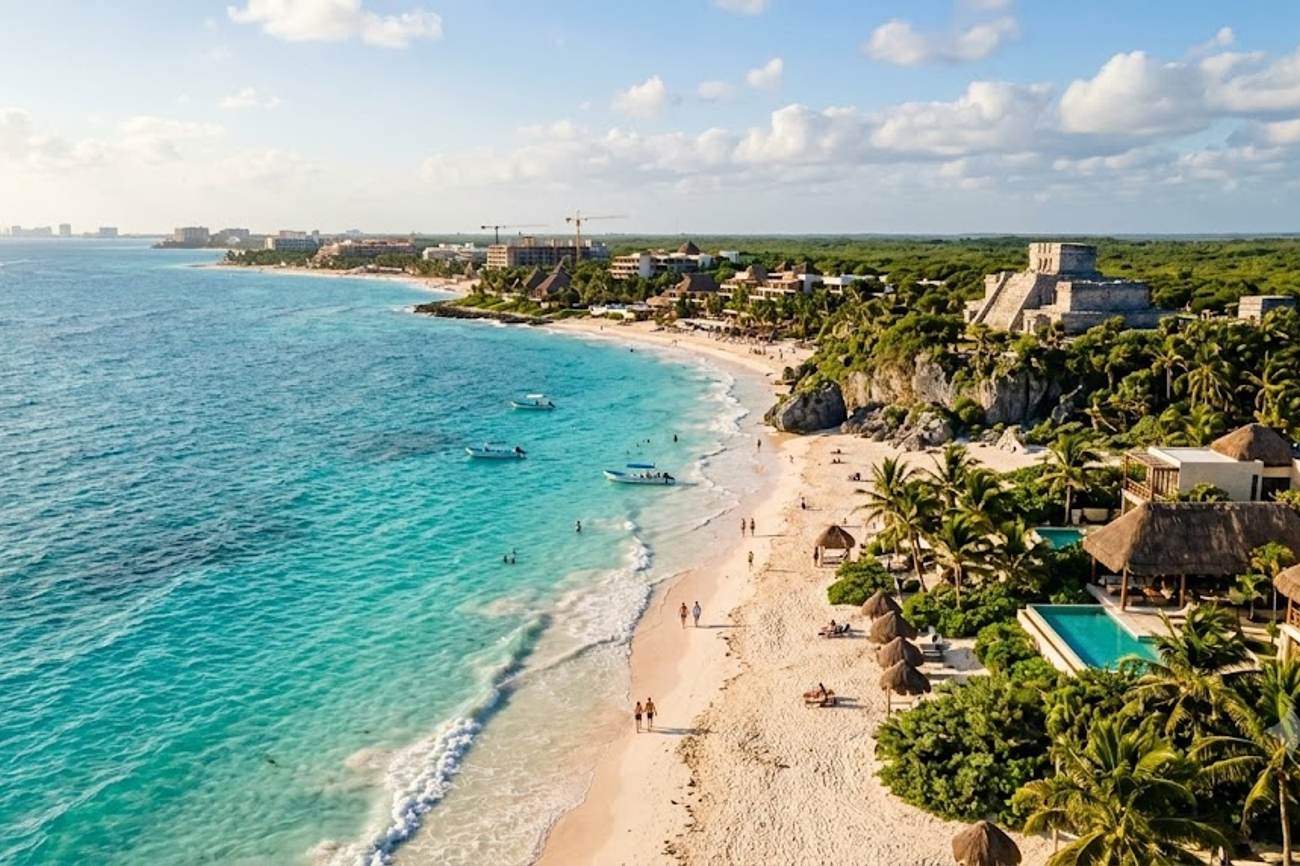
Image generated by AI
[Mexico City, June 2026] — Mexico is aggressively expanding its tourism infrastructure with a massive investment pipeline of 773 projects valued at more than US$42.452 billion spanning all 32 states. This surge in development is centered heavily on the Caribbean coast, with the state of Quintana Roo claiming the largest portion of programmed capital to fuel growth in Cancún, Tulum, and the Riviera Maya.
The expansion is being tracked through two primary financial metrics: immediate Foreign Direct Investment (FDI) and the broader project portfolio managed by the Secretaría de Turismo (SECTUR). While recorded tourism FDI for the first half (H1) of 2026 reached US$1.3004 billion, the long-term project pipeline represents a significantly larger scale of planned development, showing a 16% increase in investment value and a 10% increase in the number of projects compared to the same period in 2025.
The Capital Surge: FDI vs. Project Pipeline
The Mexican tourism economy is currently operating on two distinct financial tracks. The first is the actual flow of foreign capital already recorded. Between January and June 2026, tourism-related FDI totaled US$1.3004 billion. This represents 3.7% of the total US$34.9675 billion in FDI that entered the entire Mexican economy during H1 2026.
A sharp acceleration occurred in the second quarter (Q2) of 2026, where tourism FDI hit US$589 million—a 49% spike over Q2 2025 figures.
The second track is the SECTUR Tourism Investment Portfolio, which serves as a roadmap for future development. This portfolio is vastly larger than the immediate FDI, containing 773 projects across every state in the republic. This pipeline is not a measure of money already spent, but of programmed investment totaling over US$42.452 billion.
Who Is Affected: Regional and Sectoral Breakdown
The investment is not distributed evenly across the country. A small group of coastal states is absorbing the majority of the capital, while specific types of accommodation are dominating the spending.
Regional Investment Concentration (Programmed Portfolio):
- Quintana Roo: 20% (Primary focus: Cancún, Riviera Maya, Tulum)
- Nayarit: 19% (Primary focus: Pacific coast)
- Jalisco: 12% (Primary focus: Puerto Vallarta)
- Baja California Sur: 9% (Primary focus: Los Cabos)
Combined, these four states account for 60% of all programmed tourism investment in Mexico.
Sectoral FDI Allocation (H1 2026): The vast majority of foreign capital is flowing into the hospitality sector rather than transportation or services.
| Tourism Activity | H1 2026 FDI Value |
|---|---|
| Furnished apartments/houses with hotel services | US$1.0634 billion |
| Hotels with integrated services | US$163.5 million |
| Scheduled domestic air transport | US$32 million |
| Combined Total | 96.8% of Tourism FDI |
Project Type Distribution: While "Sun-and-Beach" remains the dominant draw, the pipeline shows a diversifying strategy to attract different traveler profiles.
- Sun and Beach: 28% of projects
- Cultural Tourism: 20% of projects
- Business Tourism: 15% of projects
- Ecotourism: 11% of projects
What This Means for Travelers
For the average traveler or digital nomad, this investment surge translates to a rapid shift in the available lodging and transport landscape.
1. Explosion of "Hotel-Lite" Accommodations With over US$1.06 billion flowing specifically into furnished apartments and houses with hotel services, travelers will see a massive increase in hybrid stays. This means more high-end condos and serviced apartments that offer the flexibility of an Airbnb with the amenities and security of a luxury hotel.
2. New Luxury Hubs in Quintana Roo The concentration of 20% of all national investment in Quintana Roo is already manifesting in tangible assets. A prime example is the new St. Regis Costa Mujeres, a US$250 million complex that has recently begun operations. This project alone is creating between 250 and 350 direct jobs, signaling a trend toward "ultra-luxury" enclaves moving away from the crowded center of Cancún.
3. Diversification Beyond the Beach While the coast still wins, the fact that 46% of new projects are dedicated to cultural, business, or eco-tourism suggests that travelers will soon have more high-quality infrastructure in Mexico's interior and rural regions, potentially easing the overcrowding of the "Big Four" coastal states.
4. Domestic Flight Stability While accommodation dominates, the US$32 million investment in scheduled domestic air transport indicates a continued effort to improve connectivity between major hubs and emerging tourism zones, which may lead to more route options for those traveling between the Pacific and Caribbean coasts.
The Roadmap to 2027
The trajectory of Mexico's tourism economy is leaning heavily into the "premiumization" of its offerings. By focusing nearly 97% of its current FDI on high-end accommodation and integrated hotel services, Mexico is positioning itself to capture a higher spend per visitor.
The immediate future will see the completion of the 773 projects currently in the SECTUR pipeline. As these move from the "programmed" stage to the "operational" stage, the supply of hotel rooms in Nayarit and Jalisco is expected to rise sharply, mirroring the growth already seen in the Riviera Maya.
Regulatory bodies and the Mexican Ministry of Tourism are now tasked with ensuring that this US$42.452 billion pipeline does not lead to over-saturation or environmental degradation, particularly in the fragile ecosystems of the Yucatan Peninsula and Baja California Sur.
FAQ: Mexico Tourism Investment 2026
Where is most of the new tourism money going? The state of Quintana Roo leads with 20% of programmed investment, followed closely by Nayarit (19%). Most of the actual foreign cash is being spent on furnished apartments and luxury hotels rather than airlines or tour operators.
Will there be more flight options within Mexico? Yes, though the investment is smaller than in hotels. US$32 million was specifically allocated to scheduled domestic air transport in the first half of 2026 to improve regional connectivity.
Is Mexico only investing in beach resorts? No. While "Sun-and-Beach" projects make up 28% of the pipeline, there is significant growth in cultural (20%), business (15%), and ecotourism (11%) projects across all 32 states.
What is the difference between FDI and the Project Portfolio? FDI (US$1.3004 billion) is money that has already been invested. The Project Portfolio (US$42.452 billion) represents the total estimated value of planned projects that are currently in the pipeline.
Mexico is betting billions that the world will continue to flock to its shores, shifting from simple resorts to a massive, diversified hospitality empire.
#QuintanaRoo2026 #SECTUR #MexicoTourismInvestment #CancunTulumRivieraMaya #MexicoFDI2026 #CostaMujeres
Related Travel Guides
Disclaimer
This article is for informational and educational purposes only. It does not constitute legal, financial, or professional advice. While we strive to provide accurate and up-to-date information, travel policies, regulations, and conditions change rapidly. Always verify information with official sources before making travel decisions. Nomad Lawyer makes no representations about the accuracy, reliability, completeness, or suitability of the information provided. Readers should consult qualified professionals for advice specific to their circumstances. The views expressed in this article are those of the author and do not necessarily reflect the views of Nomad Lawyer.
Naina Thakur
Contributor & Travel Specialist
Travel enthusiast and legal writer covering visa regulations, responsible tourism, and cultural journeys across global destinations.
Learn more about our team →