
Aviation Updates: Travel Chaos Engulfs Miami International Airport as American Airlines Leads 114 Flight Delays
Miami International Airport records 114 delays and 8 cancellations, generating severe airport disruptions across major North and South American aviation corridors.

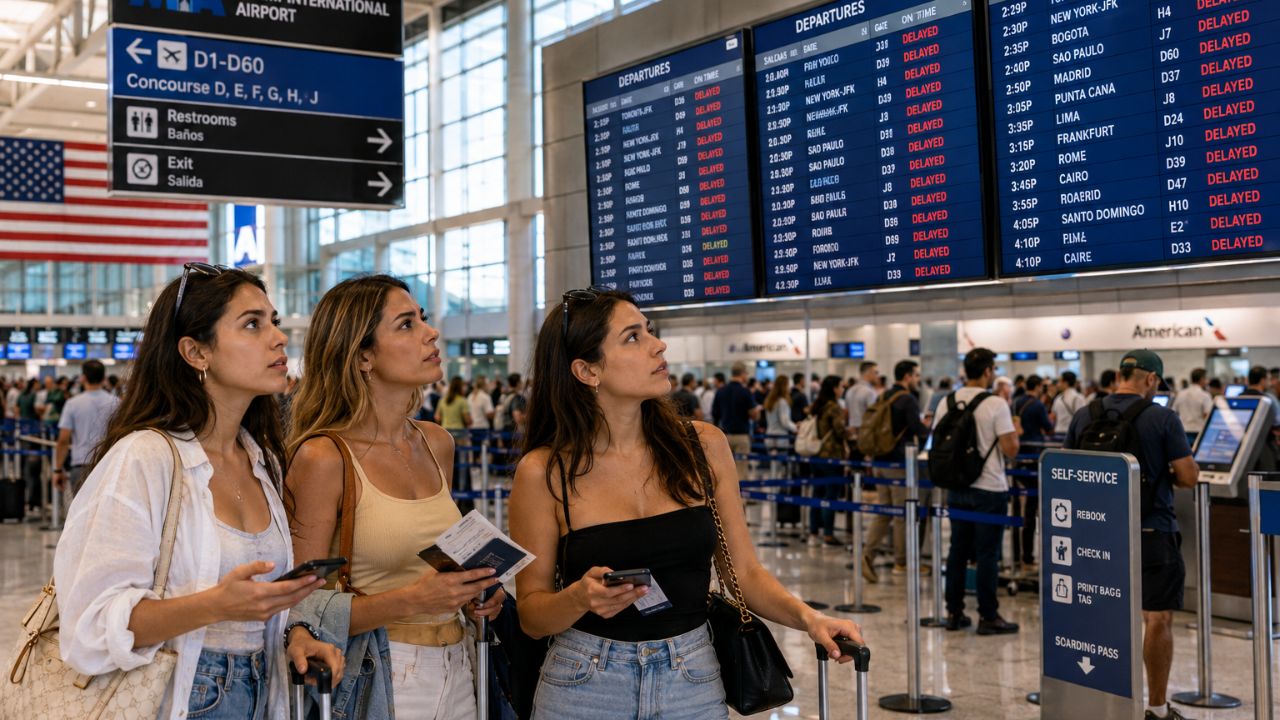
Image generated by AI
Aviation Updates: Travel Chaos Engulfs Miami International Airport as American Airlines Leads 114 Flight Delays
A massive wave of scheduling strain heavily fractures connectivity across the Western Hemisphere, devastating flight schedules for thousands of passengers transiting through Florida's premier aviation gateway.
Image generated by AI
Intense operational strain is currently generating severe airport disruptions at Miami International Airport, forcing thousands of global travelers into a highly unpredictable state of travel chaos. According to the latest airline news and confirmed operational telemetry, the massive Florida hub recorded a staggering 114 flight delays alongside 8 targeted flight cancellations during its latest operational cycle. Because Miami functions as the primary aviation bridge connecting the USA with Latin America, the Caribbean, and Europe, this high-volume gridlock has instantly cascaded across multiple global corridors. Leading domestic and international carriers, including American Airlines, Air Canada, Delta Air Lines, Qatar Airways, LATAM, and Avianca, are all battling severe scheduling instability. Flights operating between the United States and Canada, Venezuela, Colombia, Brazil, the Caribbean Islands, Spain, and Italy are absorbing the absolute brunt of the disruption, stranding passengers in terminals and devastating complex multi-hub itineraries.
Expanded Overview: The Western Hemisphere Transfer Point
When a high-density, globally connected hub like Miami experiences massive operational pressure, the friction is rarely isolated. The current disruption pattern reflects a system straining under massive traffic volumes, incredibly tight aircraft turnaround schedules, and rolling knock-on delays feeding in from other crippled hubs.
The data confirms that while the airport is suffering heavily, it has not experienced a complete systemic failure. The heavy imbalance between massive delays (114) and relatively low cancellations (8) indicates that airline operations teams are desperately prioritizing continuity of service. However, this strategy ultimately sacrifices scheduling precision, forcing aircraft to operate hours behind schedule to prevent outright route abandonments. As these severely delayed wide-body aircraft finally depart Miami, they carry this operational rot to downstream destinations across the globe.
Section-Wise Breakdown: Domestic Network Disruption
The inbound delay metrics definitively prove that Miami is actively absorbing massive disruptions from highly congested US domestic hubs.
The primary domestic feeders into the Miami network are showing significant operational friction. Flights arriving from Dallas–Fort Worth recorded 4 delays, Chicago O’Hare suffered 3 delays, while Boston Logan, Baltimore/Washington, and Nashville each contributed 2 inbound delays. Furthermore, massive domestic nodes including JFK, LaGuardia, DCA, ATL, SEA, PHX, MCO, and RDU all transmitted isolated delays directly into the Miami arrivals board. Outbound domestic routes were equally paralyzed, with passengers attempting to access Atlanta, Dallas, Chicago, New York, Seattle, Tampa, and Washington trapped in rolling delay cycles throughout the day.
Section-Wise Breakdown: Caribbean and Latin American Gridlock
Because Miami is the undisputed gateway to the south, the international disruption is incredibly severe. Inbound flights from South America have been severely damaged; Simon Bolivar International Airport (Caracas) absorbed 2 brutal cancellations (representing 100% of its affected flights), while El Dorado International Airport (Bogotá) and Toronto Pearson each reported outright cancellations paired with delays.
Outbound operations were similarly devastated. The Caribbean leisure network absorbed heavy damage, with multi-hour delays paralyzing routes to Punta Cana, Santo Domingo, Nassau, Barbados, Tortola, St Vincent, and Exuma. Central American routes bounding for San José, Managua, Guatemala City, San Pedro Sula, and Liberia recorded repeated delays, while deep South American flights to Buenos Aires, Rio de Janeiro, Brasília, and Lima suffered heavy, sustained friction. Furthermore, intercontinental routes to Europe and the Middle East saw minor but concerning delays from Madrid Barajas, Rome Fiumicino, Doha Hamad International, and São Paulo Guarulhos.
Flight Details: Miami Airline Disruption Matrix
The specific operational telemetry detailing this massive hub congestion event has been consolidated into the mandatory matrix below, outlining the specific delay and cancellation distribution across major operators.
Miami International Airport Airline Disruption Matrix
| Airline | Delayed Flights | Cancelled Flights |
|---|---|---|
| American Airlines | 57 | 0 |
| Southwest Airlines | 9 | 0 |
| Envoy Air | 4 | 4 |
| Air Canada | 1 | 4 |
| Delta Air Lines | 4 | 0 |
| Frontier Airlines | 4 | 0 |
| Qatar Airways | 1–3 | 0 |
| LATAM | 1–3 | 0 |
| Avianca | 1–3 | 0 |
| Iberia Express | 1–3 | 0 |
| GOL | 1–3 | 0 |
| Volaris | 1–3 | 0 |
| Cathay Pacific | 1–3 | 0 |
| Ethiopian Airlines | 1–3 | 0 |
(Note: American Airlines absorbed the absolute highest delay volume, while Air Canada and Envoy Air experienced the most severe service loss via cancellations).
Passenger Impact: Navigating the Chaos
For the thousands of travelers attempting to transit through Miami today, immediate precautionary action is vital. Because Miami operates as a massive connection point, international passengers—specifically those utilizing the heavily disrupted Caracas, Bogotá, and Air Canada routes—must prioritize aggressive rebooking to prevent being stranded overnight.
Aviation authorities strongly advise travelers connecting through Miami to Caribbean or Latin American destinations to expect severe rebooking scenarios. Gate changes are occurring rapidly due to departure bank congestion, meaning passengers must arrive significantly earlier than usual to navigate extended ground processing. Travelers on domestic transfers from hubs like Dallas, Chicago, and New York must proactively build massive buffer times into their layover planning to absorb the inevitable cascading delays.
Industry Analysis: The Hub Concentration Risk
Aviation strategists analyzing these aviation updates point to American Airlines' performance as a textbook example of hub concentration risk. By operating the vast majority of flights out of Miami, American absorbed 57 delays—representing half of the entire airport's delayed volume. When a mega-carrier's schedule slips due to tight rotation times or localized weather friction, the entire hub’s infrastructure (gates, baggage handling, and air traffic control sequencing) immediately bottlenecks. While international carriers like Qatar, Cathay Pacific, and LATAM experienced only low-level delays (1-3 flights), their disruption is a direct secondary effect of the broader airfield congestion generated by domestic volume.
Conclusion: A System Under Pressure
Ultimately, the latest data proves that Miami International Airport is currently operating under massive, multi-network pressure. While the relatively low number of outright cancellations prevents a total systemic collapse, the 114 rolling delays heavily degrade operational reliability across the Western Hemisphere. As the airport absorbs delays from major domestic hubs and transmits that friction outward to the Caribbean, South America, and Europe, passengers must maintain extreme itinerary flexibility. Travelers are strongly urged to rely entirely on real-time application updates and aggressively pursue rebooking options as airline scheduling teams fight to stabilize the gridlocked network.
Key Takeaways
- Total Disruption: Miami International Airport recorded 114 flight delays and 8 flight cancellations.
- Most Affected Airline: American Airlines recorded the highest disruption volume with 57 delayed flights.
- Severe Service Loss: Air Canada and Envoy Air absorbed the heaviest cancellation burdens (4 cancellations each).
- Caribbean & LATAM Hit: Outbound routes to Punta Cana, Santo Domingo, Buenos Aires, and Lima suffered massive delay clustering.
- Global Spread: The disruption impacted international operations spanning Canada, Venezuela, Colombia, Brazil, Italy, and Spain.
FAQ: Miami International Airport Flight Delays 2026
Which airlines experienced the most delays at Miami International Airport? American Airlines recorded the highest delay volume with 57 flights, followed by Southwest Airlines with 9 delayed flights.
Which routes had the most flight cancellations at Miami? Simon Bolivar International Airport (Caracas) recorded 2 cancellations (representing 100% of its affected flights). Envoy Air and Air Canada each recorded 4 cancellations on their respective networks.
Which international regions were affected by the Miami airport delays? The delays were incredibly widespread, severely impacting outbound flights to the Caribbean (Punta Cana, Nassau), Central America (San José, Guatemala City), South America (Bogotá, Buenos Aires, Lima), and extending into Europe and the Middle East (Madrid, Rome, Doha).
Related Travel Guides
Newark Liberty Airport Delays United Delta Lufthansa Travel Chaos 2026
Helsinki-Vantaa Airport Delays Finnair CityJet Travel Chaos 2026
Miami International Airport MIA Travel Disruption Survival Guide 2026
Disclaimer: This article is strictly for informational purposes. Delay statistics (114 delays) and cancellation figures (8 cancellations) involving American Airlines, Air Canada, Envoy Air, and other carriers are based on real-time data sourced from FlightAware at the time of publication. Flight schedules are highly dynamic and subject to continuous modification to maintain operational safety. Passengers must verify their exact flight status directly with their airline before arriving at the airport.
Disclaimer
This article is for informational and educational purposes only. It does not constitute legal, financial, or professional advice. While we strive to provide accurate and up-to-date information, travel policies, regulations, and conditions change rapidly. Always verify information with official sources before making travel decisions. Nomad Lawyer makes no representations about the accuracy, reliability, completeness, or suitability of the information provided. Readers should consult qualified professionals for advice specific to their circumstances. The views expressed in this article are those of the author and do not necessarily reflect the views of Nomad Lawyer.
Kunal K Choudhary
Co-Founder & Contributor
A passionate traveller and tech enthusiast. Kunal contributes to the vision and growth of Nomad Lawyer, bringing fresh perspectives and driving the community forward.
Learn more about our team →