
Miami Airport Faces Global Flight Disruptions Following Amazon Cargo Plane Crash

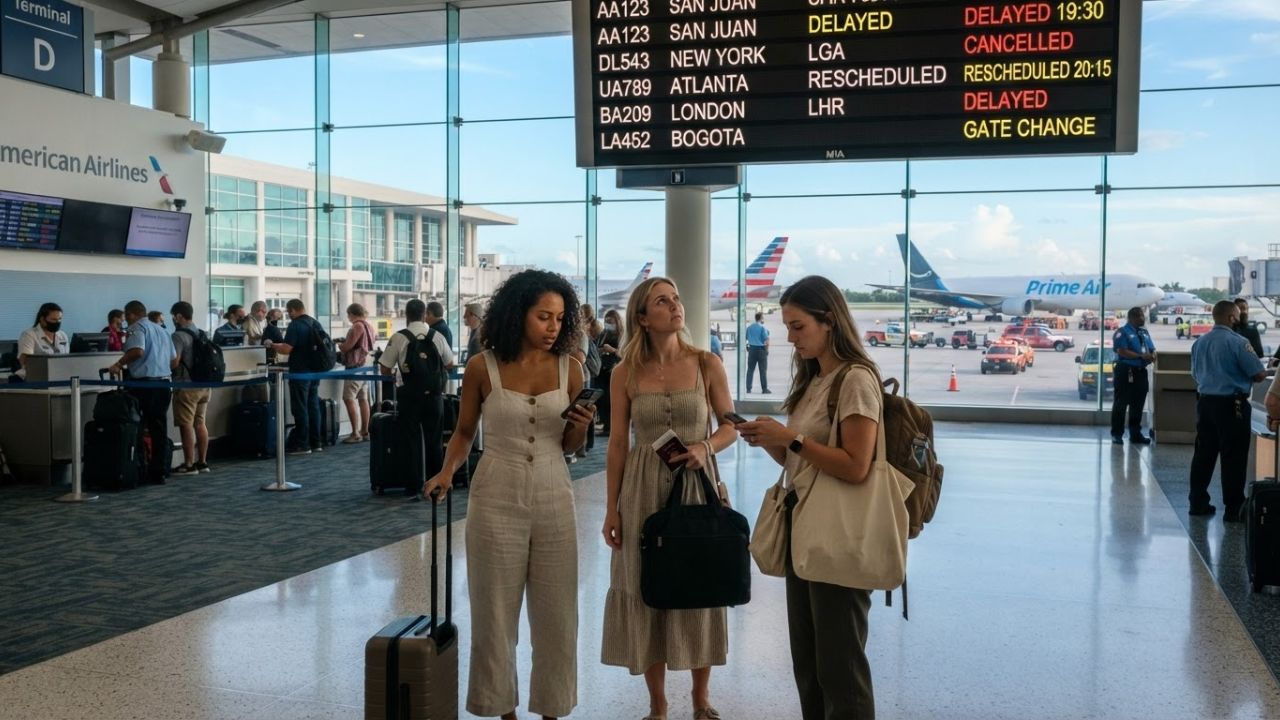
A fatal runway overrun involving an Amazon Prime Air Boeing 767-300 freighter operated by 21 Air arriving from San Juan has triggered severe global travel disruptions across Miami International Airport, resulting in more than 160 cancellations and roughly 325 flight delays. As federal investigators from the National Transportation Safety Board and the Federal Aviation Administration lead a comprehensive probe, American Airlines has issued fee waivers to assist thousands of passengers stranded across transcontinental, Latin American, and Caribbean connecting corridors.
The accident prompted an immediate ground stop, halting departures and holding inbound airliners while emergency rescue teams secured the active airfield. Because Miami International Airport (MIA) operates as America’s premier aviation gateway to Latin America and the Caribbean, the temporary reduction in runway capacity rapidly reverberated across domestic and intercontinental flight schedules.
The Local Trend Revealed: Operational Gridlock at America's Gateway to the Americas
The emergency response and ongoing federal probe by the National Transportation Safety Board (NTSB) and the Federal Aviation Administration (FAA) severely curtailed airfield movements:
- Accident Specifics: An Amazon Prime Air Boeing 767-300 freighter, operated by cargo charter carrier 21 Air on an inbound flight from San Juan, Puerto Rico, overshot the runway during landing. Emergency services responded immediately to extinguish a resulting blaze and secure the perimeter, initiating an active federal investigation into aircraft mechanical performance, runway friction, weather data, and flight crew operational parameters.
- Volume of Flight Disruption: Airport operational logs recorded more than 160 flight cancellations alongside approximately 325 flight delays, causing widespread gate holdbacks and missed aircraft rotations throughout MIA’s concourses.
- Domestic Connecting Networks Constrained:
- Intra-Florida Feeder Flights: Regional commuter links serving Orlando, Tampa, and Fort Lauderdale experienced schedule compressions.
- Northeast Corridors: High-frequency business and leisure rotations to New York (JFK and LGA), Boston Logan, and Washington, D.C. faced cascading delays.
- Midwest and Southern Hubs: Heavy transit links connecting through Chicago, Dallas/Fort Worth, and Atlanta absorbed delayed arrivals.
- West Coast Services: Transcontinental routes connecting Los Angeles, San Francisco, and Seattle suffered delayed turnaround aircraft.
- Intercontinental Transfer Friction: As a vital hub connecting North America with the Caribbean, Central America, South America, and Europe, long-haul international passengers encountered overnight gate delays and missed connections to transatlantic and trans-equatorial sectors.
Airline Recovery Operations and Passenger Relief Measures
With Miami serving as the primary southern international fortress hub for American Airlines, commercial carriers enacted urgent mitigation procedures:
- American Airlines Fee Waivers: American Airlines instituted flexible rebooking policies and travel fee waivers for ticketed passengers scheduled through MIA, permitting travelers to change departure dates or reroute through alternative connection hubs without paying fare penalties.
- Terminal Passenger Congestion: Passengers inside MIA experienced heavy customer service queues, long ticketing lines, and extended overnight terminal waits as hotel room inventories around Blue Lagoon and Le Jeune Road filled to capacity.
- Cargo Flow Realignment: In addition to passenger schedules, express freight operations experienced temporary backlogs as logistics providers rerouted urgent cargo through alternative South Florida and Southeast air facilities.
Cultural & Environmental Value: Sustaining Miami’s Tourism and Port Logistics
Miami International Airport serves as the foundational economic engine for South Florida’s hospitality and maritime cruise sectors:
- Protecting Regional Hospitality Morale: Airport frontline workers, baggage handlers, and local transportation operators face heightened stress during airfield emergencies. Respectful communication and adherence to airport guidance help frontline teams maintain airport safety.
- Preserving Multimodal Cruise Connections: Millions of travelers transit through MIA directly to PortMiami, the world’s busiest cruise port. The sudden disruption forced cruise operators to coordinate emergency transport for passengers arriving late for embarkation aboard departing Caribbean voyages.
- Environmental Runway Rehabilitation: Airfield emergency operations deploy specialized containment barriers to prevent aviation fuel and firefighting foam runoff from entering surrounding Biscayne Bay watershed canals, safeguarding sensitive coastal marine ecosystems.
Visitor Insider Tips: Navigating South Florida During Miami Airport Disruptions
- Leverage the Brightline Train to Alternate Airports: When flights out of MIA are grounded or canceled, explore departures from Fort Lauderdale-Hollywood International Airport (FLL) or Palm Beach International Airport (PBI). Take the Miami Metrorail Orange Line to MiamiCentral Station in downtown Miami, then board the high-speed Brightline train to reach Fort Lauderdale in 30 minutes or West Palm Beach in 70 minutes.
- Activate In-App Carrier Waivers Promptly: Do not wait in terminal customer service lines. Access the American Airlines or partner carrier mobile app immediately to claim available fee waivers and select alternative flights via Charlotte (CLT), Atlanta (ATL), or Orlando (MCO).
- Cruise Passenger Safeguards: If traveling to catch a cruise departure from PortMiami, contact your cruise line immediately upon facing a flight delay. Major cruise lines operate emergency concierge desks that can arrange delayed boarding at the first scheduled port of call if you miss sail-away.
- Explore Miami’s Airport-Adjacent Cultural Neighborhoods: If delayed overnight near MIA, experience authentic local culture rather than staying inside the terminal: take a short rideshare to Little Havana’s Calle Ocho for authentic Cuban pressed sandwiches, cafecito, and live son cubano music at Ball & Chain, or sample fresh ceviche in neighboring Doral.
- Monitor Live FAA Ground Advisories: Keep real-time track of airport operational status via the FAA’s Air Traffic Control System Command Center website (nasstatus.faa.gov) to check ground stops, departure delay averages, and runway reopenings before heading to the airport.
Aviation Outlook for Miami International Airport
While the NTSB and FAA advance their technical investigation into the Boeing 767-300 runway overrun, Miami International Airport is progressively restoring normal departure banks. The incident emphasizes the critical role of coordinated crisis communication and multi-airport regional transit in maintaining international connectivity across the Americas.
Related Travel Guides
Disclaimer
This article is for informational and educational purposes only. It does not constitute legal, financial, or professional advice. While we strive to provide accurate and up-to-date information, travel policies, regulations, and conditions change rapidly. Always verify information with official sources before making travel decisions. Nomad Lawyer makes no representations about the accuracy, reliability, completeness, or suitability of the information provided. Readers should consult qualified professionals for advice specific to their circumstances. The views expressed in this article are those of the author and do not necessarily reflect the views of Nomad Lawyer.
Raushan Kumar
Founder & Lead Developer
Full-stack developer with 11+ years of experience and a passionate traveller. Raushan built Nomad Lawyer from the ground up with a vision to create the best travel and law experience on the web.
Learn more about our team →