
Submerged Ruins and Black Roses: Halfeti Emerges as Türkiye’s Premier Cultural Frontier
Explore Halfeti, Türkiye, featuring the sunken ruins of Old Halfeti, the rare black rose, and Rumkale fortress. Discover travel routes from Istanbul.

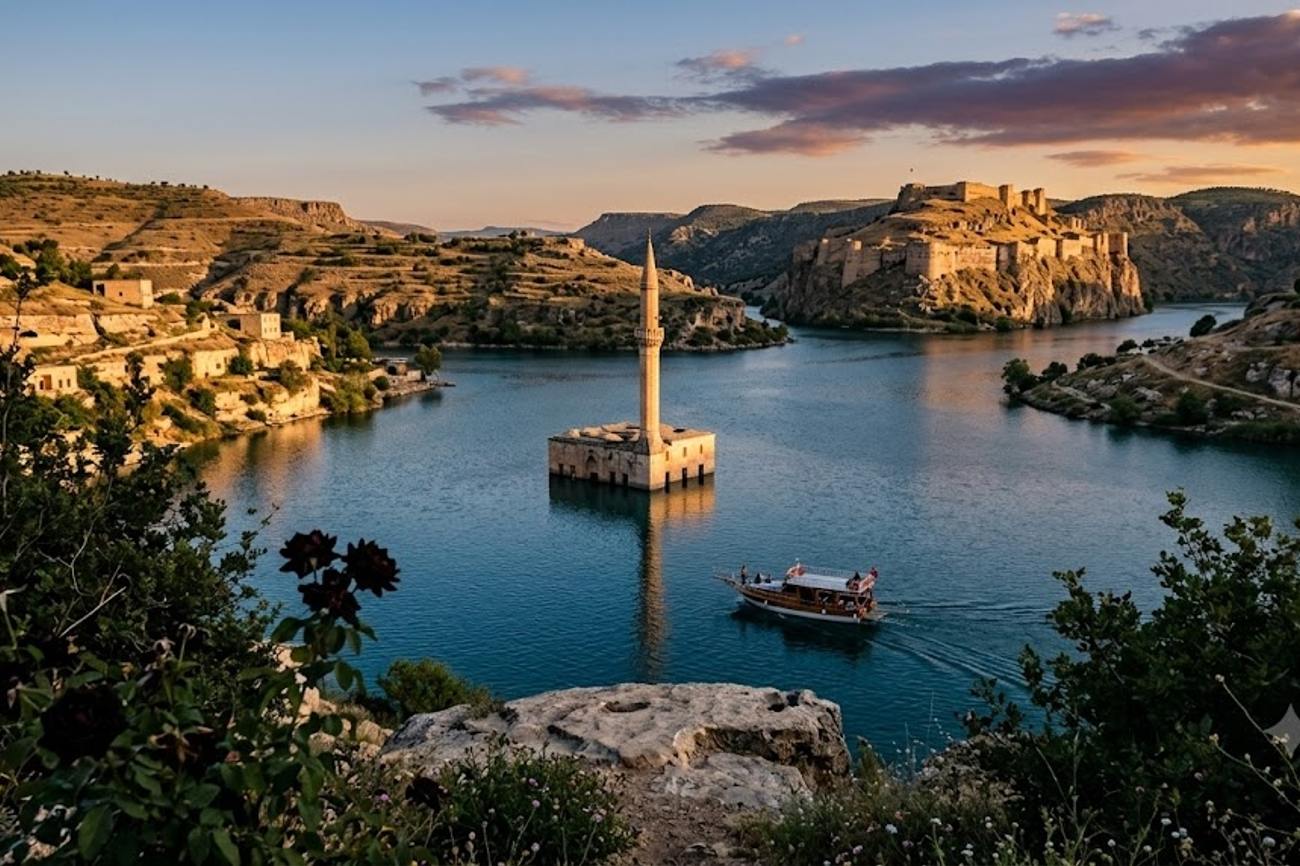
Image generated by AI
[Şanlıurfa, September 7, 2026] — Halfeti, a secluded settlement nestled along the banks of the Euphrates River in Şanlıurfa Province, is seeing a resurgence in international interest as travelers pivot toward "slow tourism" and immersive cultural heritage. The town is distinguished by a hauntingly beautiful geography where the rising waters of the Euphrates have swallowed entire neighborhoods, leaving only the tops of minarets and stone walls visible above the surface.
While traditional Turkish tourism often centers on the coastal resorts of Antalya or the urban density of Istanbul, Halfeti provides a starkly different narrative. It is a destination defined by the intersection of human history and environmental change, where visitors can engage with the deep cultural identity of southeastern Anatolia through boat excursions, archaeological exploration, and botanical rarities.
Exploring the Sunken Heritage of Old Halfeti
The centerpiece of the local experience is the exploration of Old Halfeti. Due to the construction of dams on the Euphrates, much of the original town was submerged, creating a unique aquatic archaeological site. Boat tours are the primary method for navigating this area, allowing passengers to glide over what were once bustling streets and residential quarters.
One of the most poignant landmarks remaining is the Grand Mosque, known locally as Ulu Cami. Constructed between 1804 and 1807, the mosque serves as a testament to Ottoman architectural precision. Its persistence amidst the encroaching waters has made it a symbol of the town's resilience and a primary draw for historians and photographers.
Beyond the architecture, Halfeti holds a botanical monopoly on the karagül, or black rose. This rare flower, which develops its characteristic deep, dark hue only within the specific soil and climatic conditions of Halfeti, cannot be naturally cultivated elsewhere. For horticulturalists and luxury travelers, the black rose represents the enigmatic spirit of the region.
Rumkale and the Convergence of Ancient Civilizations
Venturing further along the Euphrates via boat leads to Rumkale, a formidable fortress perched on a rocky peninsula. This site is not merely a military ruin but a chronological map of the civilizations that have contested and controlled the Euphrates valley over millennia.
Archaeological evidence and historical records indicate that Rumkale was influenced by a succession of major powers, including:
- The Urartians
- The Babylonians
- The Sumerians
- The Seljuks
- The Ottomans
The fortress's strategic position allowed these empires to monitor river traffic and secure the frontier of southeastern Anatolia. For the modern traveler, the site offers a visceral sense of scale, combining dramatic cliffs with the remnants of ancient fortifications.
Navigating the Journey from Istanbul to Halfeti
Reaching this remote corner of Türkiye from Istanbul is an expedition in itself, often transforming the transit into a multi-city cultural tour. There are several logistical paths available depending on the traveler's priority for speed or exploration.
One comprehensive overland route utilizes a combination of rail and road:
- Rail Segment: Departure from Yenikapi via the Marmaray service toward Pendik.
- High-Speed Link: Transition to a high-speed train heading toward Sivas.
- Regional Transit: A bus connection from Sivas to Gaziantep.
- Final Leg: A taxi journey covering approximately 57 miles to reach Halfeti.
This specific itinerary encourages a stopover in Sivas, a city in central Anatolia renowned for its Seljuk and Ottoman landmarks. Travelers frequently visit the Double Minaret Madrasa, the Sivas Grand Mosque, and the UNESCO-recognized Divriği Great Mosque and Darüşşifa.
Gastronomy and Art in Gaziantep
For many, the gateway to Halfeti is the city of Gaziantep. This urban center is globally recognized as a culinary powerhouse and is a member of UNESCO’s Creative Cities Network for Gastronomy. Integrating a stop in Gaziantep allows visitors to experience the region's world-famous flavors and traditional cooking techniques before entering the quietude of the river valley.
In addition to its food scene, Gaziantep hosts the Zeugma Mosaic Museum. This institution houses some of the most intricate and well-preserved ancient mosaics in existence, providing a sophisticated artistic contrast to the rugged ruins of Rumkale.
Overland Transit and the Changing Anatolian Landscape
For those avoiding air travel, long-distance bus routes from Istanbul to Gaziantep offer a panoramic view of Türkiye’s shifting geography. While time-consuming, this method reveals the transition from the metropolitan energy of the Marmara region to the rural, wide-open plains of the southeast. This slow-travel approach allows for a deeper connection with local communities and a better understanding of the diverse lifestyles present across the Anatolian plateau.
Infrastructure Upgrades and the Mersin-Gaziantep Rail Link
The accessibility of southeastern Türkiye is poised for a significant upgrade. Officials are preparing to test a new 312-kilometer high-speed railway designed to connect Mersin and Gaziantep. This project is expected to drastically alter regional logistics.
| Route Segment | Current Travel Time (Approx.) | Projected High-Speed Time |
|---|---|---|
| Mersin to Gaziantep | 6.5 Hours | 2 Hours 15 Minutes |
This reduction in travel time is expected to increase tourist throughput to Halfeti, making the "forgotten" town more accessible to short-term visitors and weekend travelers from other Turkish provinces.
Why This Matters: The Shift Toward Experiential Travel
For the modern traveler, the appeal of Halfeti lies in its "Information Gain"—it offers an experience that cannot be replicated in a museum or a standard city tour. The physical sensation of boating over a submerged city creates a psychological connection to the concept of loss and adaptation.
From a logistical standpoint, the integration of high-speed rail and gastronomic hubs like Gaziantep means that Halfeti is no longer a destination for the "hardcore" adventurer only, but is becoming viable for the luxury and cultural tourist. The transition from Istanbul's urbanity to Halfeti's silence provides a complete narrative of the Turkish experience, blending the ultra-modern with the ancient.
Related Travel Guides
Disclaimer
This article is for informational and educational purposes only. It does not constitute legal, financial, or professional advice. While we strive to provide accurate and up-to-date information, travel policies, regulations, and conditions change rapidly. Always verify information with official sources before making travel decisions. Nomad Lawyer makes no representations about the accuracy, reliability, completeness, or suitability of the information provided. Readers should consult qualified professionals for advice specific to their circumstances. The views expressed in this article are those of the author and do not necessarily reflect the views of Nomad Lawyer.
Preeti Gunjan
Contributor & Community Manager
A passionate traveller and community builder. Preeti helps grow the Nomad Lawyer community, fostering engagement and bringing the reader experience to life.
Learn more about our team →