
European Aviation Crisis: 2,618 Flights Delayed as London and Amsterdam Hubs Face Severe Disruptions
Massive flight disruptions hit Europe with 2,618 delays across 12 major airports. Gatwick and Schiphol hardest hit. See affected airlines and passenger rights.

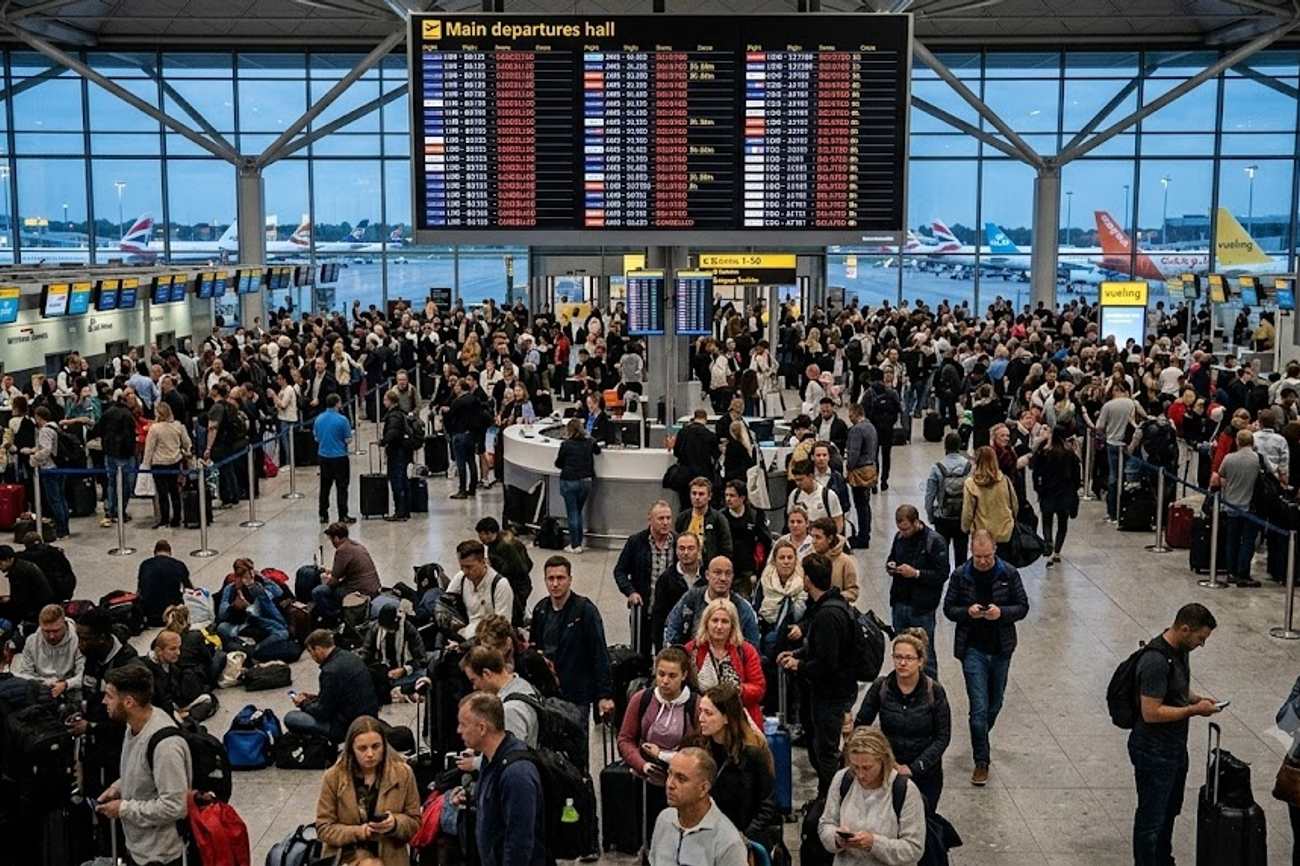
Image generated by AI
[London, September 4, 2026] — A systemic collapse in scheduling and operational efficiency has paralyzed air travel across Europe, resulting in 2,618 delays and 105 cancellations within a single reporting window. The disruptions span seven countries—Ireland, the United Kingdom, France, Switzerland, Germany, Norway, and the Netherlands—striking the continent's most critical aviation arteries including Dublin, Edinburgh, Paris, London, Geneva, Munich, Frankfurt, Oslo, and Amsterdam.
The scale of the instability is most evident among the region's largest carriers. easyJet, Lufthansa, KLM, British Airways, Air France, and Ryanair have all reported significant setbacks. easyJet emerged as the hardest-hit carrier in terms of total cancellations, recording 42 scrubbed flights, while KLM followed with 24.
London Gatwick and Amsterdam Schiphol Lead Disruption Totals
The crisis is centered heavily on two of Europe's busiest gateways. London Gatwick recorded the highest volume of instability with 437 delays and 27 cancellations. The impact at Gatwick was skewed heavily toward easyJet, which accounted for 214 of those delays and 25 of the cancellations. Norwegian Air Sweden also faced setbacks at the hub, recording 17 delays and one cancellation. Data indicates a severe imbalance in reliability at Gatwick; departing flights suffered a 45% delay rate, while arriving flights saw an even higher delay rate of 55%. Both directions maintained a 3% cancellation rate.
Closely following is Amsterdam Schiphol, which logged 424 delays and 20 cancellations. The majority of these disruptions were linked to KLM, which saw 192 delays and 15 cancellations. easyJet contributed 48 delays and four cancellations to the Schiphol total, while Delta Air Lines recorded 10 delays and a single cancellation. Schiphol's operational metrics were slightly more stable than Gatwick's, with departing flights seeing a 31% delay rate and arriving flights at 30%.
Major Hubs Face Escalating Scheduling Failures
Beyond the primary hotspots, other Tier-1 airports reported significant volatility:
- London Heathrow: This hub recorded 295 delays and 9 cancellations. British Airways bore the brunt of the impact with 153 delays and three cancellations. Other affected carriers included American Airlines (two delays, three cancellations) and KLM (five delays, two cancellations). Delay rates were nearly symmetrical, with 25% for departures and 24% for arrivals.
- Frankfurt: Reporting 288 delays and 8 cancellations, Frankfurt saw Lufthansa struggle with 122 delays and four cancellations. Condor recorded 52 delays and two cancellations, while Air Dolomiti and American Airlines each suffered one cancellation. Departure delays peaked at 31%, while arrivals were lower at 18%.
- Charles de Gaulle: The Paris hub recorded 287 delays and 8 cancellations. Air France reported 98 delays and two cancellations, while easyJet logged 37 delays and five cancellations. KLM recorded two delays and one cancellation. The delay rate stood at 24% for departures and 20% for arrivals.
- Munich: Lufthansa dominated the disruption figures here with 86 delays and four cancellations out of a total of 179 delays and 6 cancellations. easyJet added five delays and two cancellations. Departure delays hit 21%, while arrivals were 16%.
Regional Disruptions in Dublin and Paris Orly
The instability extended into regional hubs, though the figures were lower than the primary gateways. Dublin Airport recorded 173 delays and 3 cancellations. Ryanair was the primary contributor with 77 delays, followed by Aer Lingus with 30. Emerald Airlines reported one cancellation, and departing flights from Dublin faced a 20% delay rate.
At Paris Orly, 172 delays and 4 cancellations were recorded. Transavia France was the sole driver of the cancellations, accounting for all four, and recorded 84 of the delays. Departing flights at Orly faced a 31% delay rate, while arrivals were slightly lower at 28%.
Airline Performance Breakdown
The following data summarizes the total impact across the affected European airports:
| Airline | Total Delays | Total Cancellations | Primary Hub Impact |
|---|---|---|---|
| easyJet | 429 | 42 | London Gatwick (214 delays / 25 cancels) |
| Lufthansa | 217 | 8 | Frankfurt (122 delays / 4 cancels) |
| KLM | 204 | 24 | Amsterdam Schiphol (192 delays / 15 cancels) |
| British Airways | 163 | 3 | London Heathrow (153 delays / 3 cancels) |
| Air France | 105 | 2 | Charles de Gaulle (98 delays / 2 cancels) |
| Ryanair | 89 | 0 | Dublin (77 delays) |
Operational Triggers and the Domino Effect
Industry observers point to a combination of systemic operational failures as the catalyst for these disruptions. The volatility is typically driven by aircraft availability, crew scheduling conflicts, and urgent maintenance requirements. Furthermore, airport capacity constraints and air traffic management restrictions often exacerbate existing delays.
Aviation logistics rely on tight rotations; when a single aircraft or crew member falls behind schedule, it creates a "knock-on" effect. This ripple effect means that a delay in the morning at one hub can lead to cancellations in the evening across multiple other cities. This is particularly evident at high-density airports like London Heathrow and Amsterdam Schiphol, where a small scheduling error can compromise dozens of subsequent flights.
Why This Matters: The Traveler's Perspective
For the modern traveler, these statistics translate into a high-risk environment where a "confirmed" ticket no longer guarantees timely arrival. The high delay rates—particularly the 55% arrival delay rate at Gatwick—suggest that passengers are not just losing time but are risking missed connections and hotel bookings.
From a logistical standpoint, the concentration of delays within specific airlines (like easyJet and KLM) indicates that passengers using these carriers are at a significantly higher risk of disruption than those on others. Travelers should be aware that when a hub like Schiphol or Heathrow reaches a certain threshold of delays, the likelihood of a "cascading failure" increases, meaning a delay in the first leg of a journey almost certainly guarantees a disrupted second leg.
To mitigate these risks, passengers are advised to:
- Verify flight status via the airline app immediately before departing for the airport.
- Confirm if the airline has automatically rebooked a cancelled flight.
- Maintain a detailed log of receipts for food and accommodation to claim eligible expenses under passenger rights regulations.
- Verify the status of connecting flights independently, as automated systems may not update in real-time during a crisis.
- Confirm baggage transfers manually if a flight is changed to a different aircraft or route.
Related Travel Guides
Disclaimer
This article is for informational and educational purposes only. It does not constitute legal, financial, or professional advice. While we strive to provide accurate and up-to-date information, travel policies, regulations, and conditions change rapidly. Always verify information with official sources before making travel decisions. Nomad Lawyer makes no representations about the accuracy, reliability, completeness, or suitability of the information provided. Readers should consult qualified professionals for advice specific to their circumstances. The views expressed in this article are those of the author and do not necessarily reflect the views of Nomad Lawyer.
Preeti Gunjan
Contributor & Community Manager
A passionate traveller and community builder. Preeti helps grow the Nomad Lawyer community, fostering engagement and bringing the reader experience to life.
Learn more about our team →