
Travel Chaos at Dubai Airport: Over 100 Flight Delays Disrupt Emirates, SpiceJet, and Global Routes
A severe travel setback at Dubai International Airport triggers massive airport disruptions, leaving Emirates and FlyDubai struggling with widespread delays across multi-continental routes.

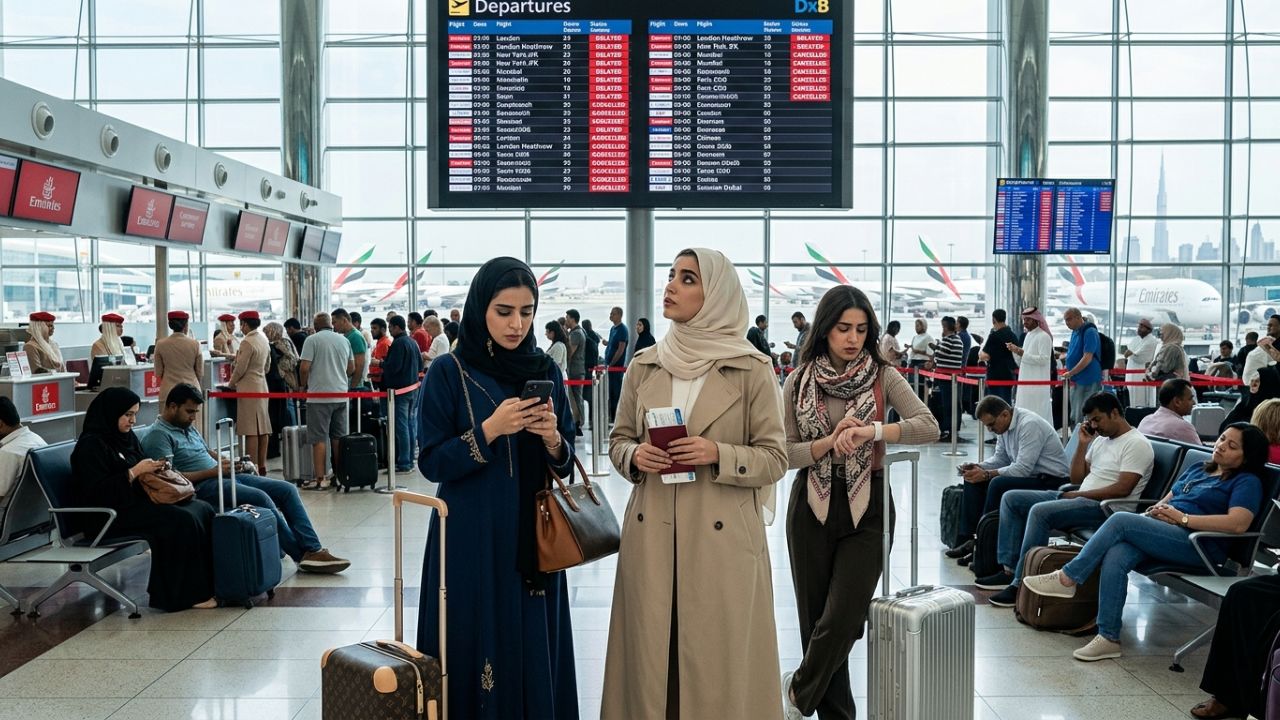
Image generated by AI
Travel Chaos at Dubai Airport: Over 100 Flight Delays Disrupt Emirates, SpiceJet, and Global Routes
A massive travel setback at one of the world's busiest aviation hubs triggers severe operational strain, crippling connections across Europe, Asia, Africa, and the Americas.
A profound operational setback has aggressively struck Dubai International Airport, plunging thousands of frantic passengers and major global airlines into sudden travel chaos. As one of the absolute busiest aviation hubs on the planet, any disruption in Dubai immediately reverberates worldwide. Today, severe airport disruptions have grounded one flight and triggered well over 100 severe delays. This sprawling logistical nightmare has heavily impacted dominant flag carriers and low-cost operators alike, including SpiceJet, Flynas, EgyptAir, Royal Jordanian, and the hub's primary operator, Emirates.
As a direct result of these operational failures, travelers are currently enduring agonizing schedule changes, rapidly expanding waiting times, and entirely severed onward connections. The massive disruption is violently tearing through major travel corridors linking the United Arab Emirates, Tunisia, the UK, Italy, Israel, the US, and destinations far beyond these key markets. While overall airport operations technically continue, the sheer volume of delayed services brutally highlights the immense scale of this airline news event.
Aviation Updates: The Scale of the Disruption
The rapidly deteriorating situation at Dubai International Airport serves as a stark reminder of the incredible fragility of modern global aviation networks. A hub of Dubai's magnitude acts as the central circulatory system for East-West global transit. When flight cancellations or widespread delays infect this system, the consequences are immediate and severe.
Currently, airlines are desperately working to minimize the disruption and assist deeply affected passengers, but the backlog of delayed departures is immense. The situation clearly underscores how rapidly localized operational bottlenecks at a major international gateway can ripple violently across regional short-haul and ultra-long-haul networks, destroying travel itineraries across multiple continents simultaneously.
Section-Wise Breakdown: A Global Footprint
The geographical footprint of this disruption is staggering, extending across a massive network of international and regional cities tightly linked to the emirate.
European and Transatlantic Corridors
Western and Northern connectivity is heavily compromised. Passengers traveling to and from Brussels, Düsseldorf, Munich, Birmingham, London, Amsterdam, Copenhagen, Paris, Frankfurt, Geneva, and Zurich are facing severe rolling delays. Further south, critical routes involving Barcelona, Madrid, Athens, Santorini, Milan, Bologna, Rome, Naples, Bucharest, Tirana, and Sofia are similarly choked. Transatlantic operations targeting Boston and Los Angeles have not escaped the massive travel chaos, with connections severely threatened.
The Middle East and Africa
Regional connectivity within the Middle East and Africa is suffering immense strain. Disruptions are battering flights linked to Tunis, Johannesburg, Dakar, Bosaso, Cairo, Tel Aviv, Antalya, Istanbul, Belgrade, Manama, Dammam, Riyadh, Amman, Beirut, Erbil, and Damascus. As these regional flights feed into larger long-haul operations, the delays are multiplying aggressively.
South Asia and the Asia-Pacific
Eastern corridors are bearing a massive brunt of the operational failure. Major South Asian hubs including Mumbai, Karachi, Lahore, Colombo, Chattogram, Dhaka, Delhi, Bengaluru, Thiruvananthapuram, Kolkata, and Chennai are heavily impacted. Furthermore, vital Asia-Pacific and Oceanic links to Singapore, Guangzhou, Hangzhou, Clark, Manila, Bangkok, Bali, Melbourne, Shenzhen, Shanghai, and Auckland are struggling to maintain scheduled integrity alongside Central Asian routes to Almaty, Tashkent, Minsk, and Moscow.
Flight Details and Operational Data
According to verified operational data directly from Dubai International Airport, the raw number of flight cancellations remained surprisingly low, but the staggering volume of delayed flights crippled network efficiency.
SpiceJet recorded the sole cancelled flight, which severely represented 10% of its scheduled operations during this reporting period. However, the true story lies in the massive delay metrics. The hub's primary airline, Emirates, suffered a brutal 61 delayed flights, while its low-cost sister airline FlyDubai absorbed 21 delays.
Confirmed Airline Disruption Matrix
| Airline | Cancelled Flights (#) | Delayed Flights (#) |
|---|---|---|
| SpiceJet | 1 | 2 |
| Air India | 0 | 1 |
| Air India Express | 0 | 2 |
| Bangladesh Biman | 0 | 1 |
| Daallo Airlines | 0 | 1 |
| FlyDubai | 0 | 21 |
| Fly Jinnah | 0 | 2 |
| Fly Cham | 0 | 2 |
| IndiGo | 0 | 2 |
| Flynas | 0 | 1 |
| Egypt Air | 0 | 3 |
| Royal Jordanian | 0 | 1 |
| Air Sial | 0 | 1 |
| Turkish Airlines | 0 | 2 |
| Emirates | 0 | 61 |
| US-Bangla Airlines | 0 | 2 |
| Airblue | 0 | 3 |
Data reflects verified operational interruptions. The single cancellation heavily affected connectivity between Dubai and key destinations across India, while the broader delay disruption extended globally.
Passenger Impact: Stranded in Transit
For the traveling public actively navigating Dubai International Airport today, the conditions are incredibly frustrating. A hub built entirely on the concept of rapid, seamless global connections is currently trapping passengers in transit purgatory.
The high volume of delayed departures and arrivals means that precisely timed connections to Europe, Asia, and the Americas are violently failing. Passengers are facing agonizingly extended waiting times inside the terminals. International travelers are particularly vulnerable; a single delay arriving from Mumbai or Cairo can brutally sever a crucial long-haul connection to London or Los Angeles, forcing exhausted passengers into unexpected overnight hotel stays and entirely ruining holiday or business itineraries.
Industry Analysis: The Mechanics of Hub Congestion
Aviation analysts monitoring the Dubai crisis point to the inherent vulnerabilities of the mega-hub operational model. Dubai International operates at an incredibly high density, with tightly packed runway sequencing and rapid turnaround requirements. When an unforeseen operational challenge arises—whether driven by air traffic congestion, weather anomalies, or cascading late arrivals from other disrupted regions—the system quickly loses its buffer. Because massive wide-body operators like Emirates require precise aircraft rotations to function profitably, a delay of just 45 minutes can completely disrupt crew duty-time limits and gate availability, extending the initial disruption into a multi-day recovery effort.
Conclusion: A Complex Recovery
The travel setback at Dubai International Airport clearly illustrates how even a highly limited number of flight cancellations can generate catastrophic operational challenges when paired with over 100 delays. As passengers traveling across the UAE, Tunisia, the UK, Italy, Israel, the US, and beyond continue to experience severe itinerary destruction, airlines are frantically executing recovery efforts. Travelers are strongly advised to relentlessly monitor flight updates, proactively review airline rebooking restrictions, and maintain extreme flexibility, as full network normalization will require significant time to achieve.
Key Takeaways
- Massive Delays: Dubai International Airport is suffering severe operational disruptions with over 100 delayed flights and 1 cancellation.
- Emirates Hit Hardest: The primary hub carrier, Emirates, recorded an absolutely staggering 61 delays, severely impacting global connectivity.
- Global Footprint: Disruptions have paralyzed routes linking Dubai to major cities across Europe, the Middle East, Africa, South Asia, the Asia-Pacific, and the Americas.
- SpiceJet Cancellation: SpiceJet absorbed the only cancellation, heavily impacting 10% of its operational schedule for the period.
- Cascading Connection Failures: The sheer volume of delays is violently severing tightly timed onward connections for thousands of international transit passengers.
- Passenger Vigilance Required: Travelers must strictly monitor real-time updates directly from their airlines and prepare for potential rebooking scenarios.
Related Travel Guides
Los Angeles Airport Flight Cancellations Disrupt Global Networks
Travel Chaos Sweeps Italy: 647 Flight Delays and Cancellations Disrupt Rome, Milan, Venice, and Pisa
Disclaimer
This article is for informational and educational purposes only. It does not constitute legal, financial, or professional advice. While we strive to provide accurate and up-to-date information, travel policies, regulations, and conditions change rapidly. Always verify information with official sources before making travel decisions. Nomad Lawyer makes no representations about the accuracy, reliability, completeness, or suitability of the information provided. Readers should consult qualified professionals for advice specific to their circumstances. The views expressed in this article are those of the author and do not necessarily reflect the views of Nomad Lawyer.
Preeti Gunjan
Contributor & Community Manager
A passionate traveller and community builder. Preeti helps grow the Nomad Lawyer community, fostering engagement and bringing the reader experience to life.
Learn more about our team →