
Travel Chaos Sweeps Italy: 647 Flight Delays and Cancellations Disrupt Rome, Milan, Venice, and Pisa
Severe airport disruptions across four of Italy's busiest gateways trigger widespread travel chaos, heavily impacting ITA Airways, Ryanair, easyJet, Lufthansa, and Wizz Air.

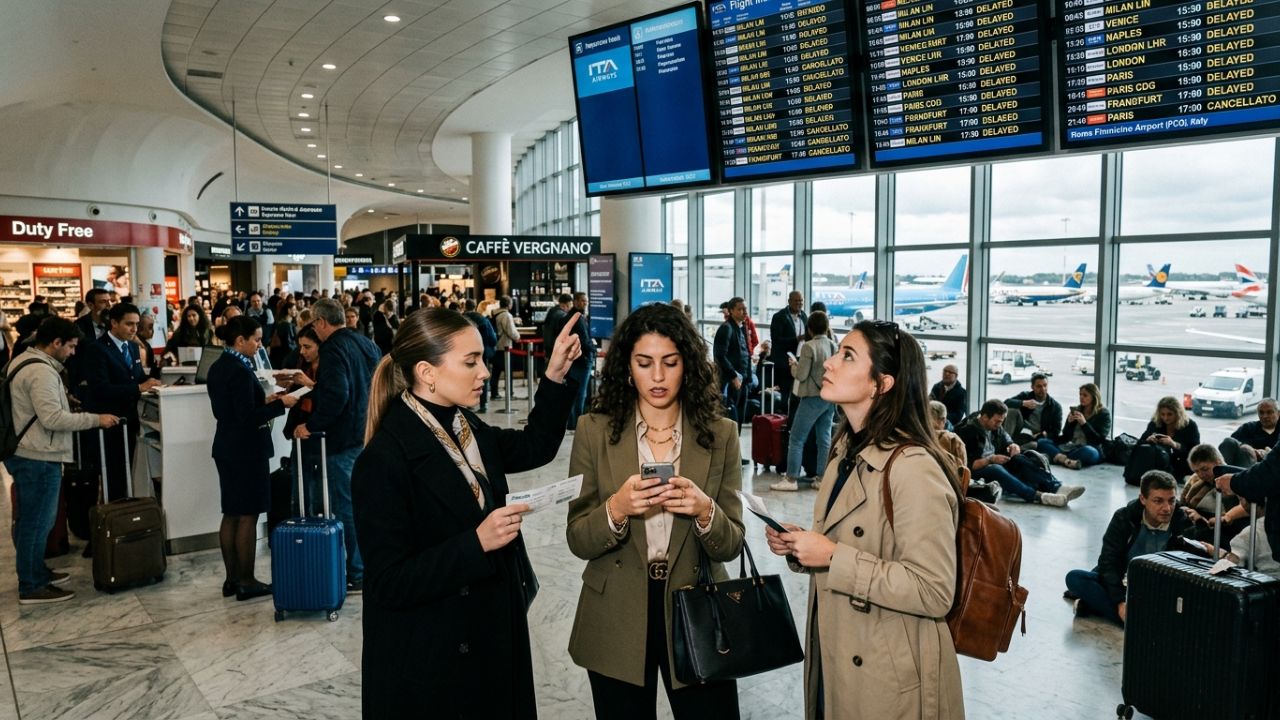
Image generated by AI
Travel Chaos Sweeps Italy: 647 Flight Delays and Cancellations Disrupt Rome, Milan, Venice, and Pisa
Unprecedented operational disruptions across four major Italian aviation gateways leave thousands of domestic and international travelers scrambling to salvage their summer itineraries.
Massive travel chaos is actively unfolding across the Italian peninsula as an intense wave of operational instability violently shatters flight schedules at four of the country’s most critical aviation hubs. Travelers heading to or departing from Rome, Milan, Venice, and Pisa are currently enduring severe airport disruptions, with official operational data confirming a staggering 647 flight delays and 22 cancellations. This sprawling logistical nightmare is aggressively impacting massive European operators including ITA Airways, Ryanair, easyJet, Lufthansa, and Wizz Air. As peak summer travel demand collides with localized operational bottlenecks, the escalating crisis is generating a highly complex ripple effect throughout both domestic and international travel corridors.
Aviation Updates: The Scale of Italy's Operational Crisis
The rapidly deteriorating situation across Italy's primary international gateways highlights the profound fragility of European aviation networks during high-density travel periods. Whether it’s a meticulously planned family vacation, a critical corporate business meeting, or the highly anticipated beginning of a European backpacking adventure, these brutal, unexpected changes in departure times are completely destroying travel itineraries.
For thousands of frantic passengers caught in the crossfire of this massive airline news event, the reality on the ground is grim. The sheer volume of delayed and canceled flights means that immediate rebooking options are virtually non-existent. The crisis heavily underscores the absolute necessity for all passengers to rigorously verify real-time flight information before ever setting foot inside an airport terminal.
Section-Wise Breakdown: Major Hubs Paralyzed
The current operational collapse is not isolated to a single runway; it is a multi-city catastrophe heavily distributed across Italy’s most vital economic and tourism centers.
Rome Fiumicino: The Epicenter of the Disruption
As Italy’s absolute largest aviation hub and a dominant European international gateway, Leonardo da Vinci International Airport (Rome Fiumicino) is currently bearing the brutal brunt of the operational collapse. Serving tens of millions of passengers annually, the airport connects Italy directly with highly lucrative markets across North America, Asia, the Middle East, and Africa. Even minor operational hiccups at a hub of this massive scale instantly create violent ripple effects throughout global airline networks. Today, Fiumicino handled the largest and most painful share of the interruptions, crippling both domestic feeders and long-haul international departures.
Milan Malpensa: Northern Gateway Compromised
In Northern Italy, the primary international gateway of Malpensa International Airport is visibly struggling beneath the weight of intense operational pressure. Malpensa serves as the absolute critical hub for high-yield business and leisure travelers accessing Milan and the broader Lombardy region. Because Malpensa heavily relies on tightly interconnected airline schedules across the continent, these extensive delays are aggressively extending far beyond the airport itself, heavily impacting connecting flights across Europe.
Venice Marco Polo: Tourism Corridors Choked
The travel misery heavily extends to the iconic canals and historic streets of Venice. Marco Polo International Airport, which plays an absolutely vital role in supporting the immense tourism economy throughout the Veneto region, is severely compromised. During these peak travel periods when thousands of international visitors flood the region daily, the inability to reliably process inbound and outbound flights is creating dangerous terminal congestion and severe passenger anxiety.
Pisa International: Regional Access Disrupted
While handling a smaller volume of total flights compared to the massive primary hubs, Galileo Galilei International Airport in Pisa is still reporting a highly noticeable and painful impact. Pisa serves as the critical entry point for travelers heavily exploring Tuscany and nearby regional destinations. For tourists relying heavily on tightly scheduled rail connections or pre-booked organized tours across central Italy, these sudden schedule failures are completely derailing entire holiday itineraries.
Flight Details and Operational Data
The sheer scale of this crisis is heavily reflected in the precise operational metrics recorded across the four gateways. Major legacy carriers like Lufthansa and ITA Airways, alongside ultra-low-cost giants like Ryanair, easyJet, and Wizz Air, are taking massive hits to their daily performance.
Airport-wise Operational Summary
| Airport Facility | Verified Delays | Verified Cancellations |
|---|---|---|
| Leonardo da Vinci International Airport (Rome Fiumicino) | 309 | 7 |
| Malpensa International Airport (Milan) | 181 | 8 |
| Marco Polo International Airport (Venice) | 114 | 3 |
| Galileo Galilei International Airport (Pisa) | 43 | 4 |
| Total Disruptions | 647 | 22 |
Data accurately reflects the verified operational interruptions impacting both domestic and international services.
Passenger Impact: Stranded and Scrambling
For the traveling public actively navigating these four Italian airports, the conditions are nothing short of miserable. The brutal combination of 647 delays and 22 flight cancellations has severely compromised itineraries across the continent.
Passengers are facing agonizingly extended waiting times, violently missed onward connections, and completely unpredictable departure updates. International travelers are particularly vulnerable; a single delay in Rome or Milan can brutally sever a crucial long-haul connection to North America or Asia, forcing passengers into overnight airport stays. During these peak travel windows, the sheer volume of displaced passengers means airline customer service lines are completely overwhelmed, driving unexpected hotel costs, lost tour deposits, and ruined holiday plans.
Industry Analysis: The Mechanics of the Meltdown
Aviation analysts monitoring the Italian crisis point to a heavily strained European operational ecosystem. While Italy’s aviation infrastructure is closely coordinated through the Italian Civil Aviation Authority (ENAC), the entire system is highly susceptible to localized bottlenecks. High-density summer scheduling, tightly packed runway sequencing, and cascading aircraft rotation imbalances mean that a delay at one major hub instantly infects the others. When an ITA Airways or Ryanair aircraft arrives significantly behind schedule in Milan, its subsequent turnaround time in Rome or Venice is completely annihilated. This creates an inescapable domino effect, directly leading to mandatory crew duty-time expirations and forcing unavoidable cancellations.
Conclusion: Navigating the Recovery
As Italy's major airports brutally struggle beneath the weight of this massive operational strain, the immediate outlook remains incredibly challenging. While ENAC and individual airlines are frantically attempting to stabilize their schedules, residual delays are mathematically guaranteed to continue throughout the remainder of the day due to wildly imbalanced aircraft rotations. Full network normalization will likely bleed heavily into subsequent operational cycles. Passengers are strongly urged to invoke their protections under the European Union’s passenger rights framework (Regulation EC 261/2004) for potential compensation, and must maintain extreme vigilance regarding real-time flight statuses.
Key Takeaways
- Massive Disruptions: Italy is suffering a massive operational meltdown with 647 flight delays and 22 cancellations across four major hubs.
- Rome Fiumicino Hit Hardest: The capital's primary gateway recorded the highest disruption with 309 delays and 7 cancellations.
- Milan, Venice, and Pisa Impacted: Malpensa (181 delays, 8 cancellations), Marco Polo (114 delays, 3 cancellations), and Galileo Galilei (43 delays, 4 cancellations) all reported severe operational failures.
- Major Airlines Bleeding: ITA Airways, Ryanair, easyJet, Lufthansa, and Wizz Air are heavily impacted.
- Cascading Failures: Tightly packed schedules and aircraft rotation imbalances are entirely driving the chaos across domestic and international routes.
- Passenger Action Required: Travelers must relentlessly verify flight statuses, utilize online check-in, and understand their EC 261/2004 compensation rights.
Related Travel Guides
Los Angeles Airport Flight Cancellations Disrupt Global Networks
Middle East Flight Cancellations Disrupt Flyadeal, Yemenia, and Qatar Airways
Disclaimer
This article is for informational and educational purposes only. It does not constitute legal, financial, or professional advice. While we strive to provide accurate and up-to-date information, travel policies, regulations, and conditions change rapidly. Always verify information with official sources before making travel decisions. Nomad Lawyer makes no representations about the accuracy, reliability, completeness, or suitability of the information provided. Readers should consult qualified professionals for advice specific to their circumstances. The views expressed in this article are those of the author and do not necessarily reflect the views of Nomad Lawyer.
Preeti Gunjan
Contributor & Community Manager
A passionate traveller and community builder. Preeti helps grow the Nomad Lawyer community, fostering engagement and bringing the reader experience to life.
Learn more about our team →