
Travel Chaos Erupts at LAX: 162 Flight Delays and Cancellations Disrupt American, Southwest, and Global Networks
Massive airport disruptions at Los Angeles International Airport leave thousands stranded as global airlines face severe flight cancellations and rolling delays across multiple continents.

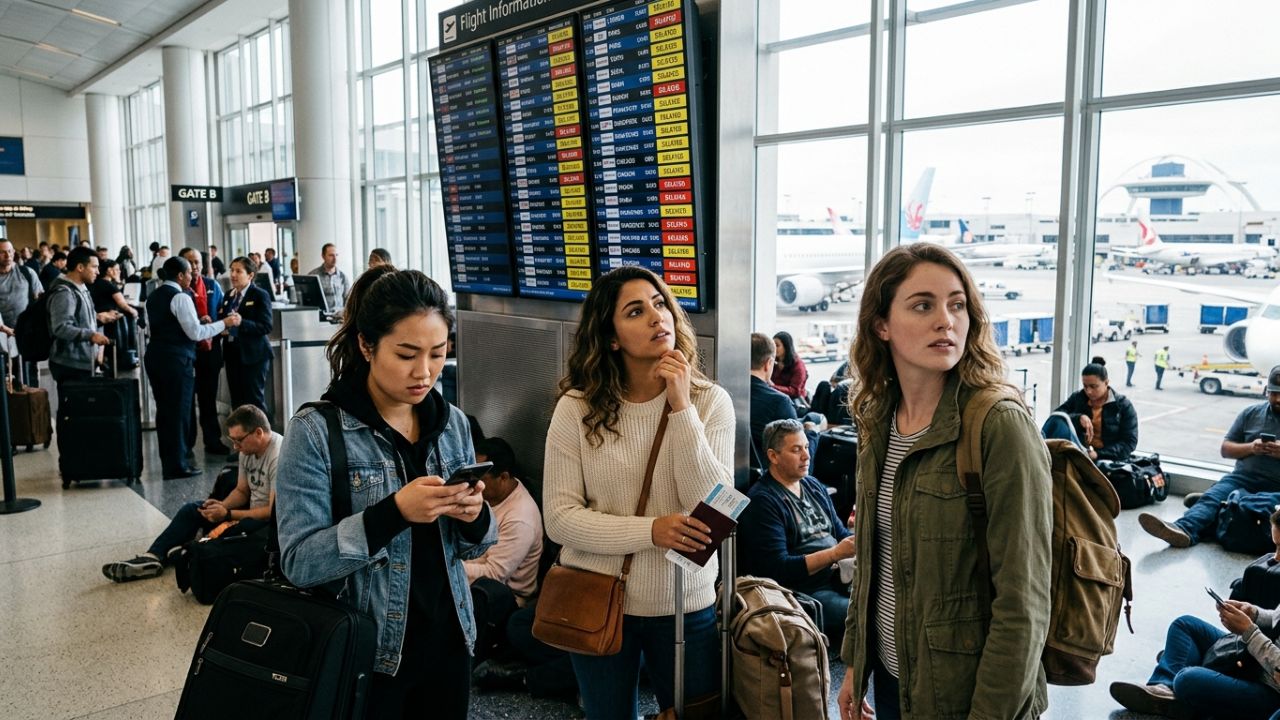
Image generated by AI
Travel Chaos Erupts at LAX: 162 Flight Delays and Cancellations Disrupt American, Southwest, and Global Networks
Severe airport disruptions at Los Angeles International Airport trigger widespread operational meltdowns, heavily impacting global transit corridors from Europe to the Asia-Pacific.
Massive travel chaos is actively unfolding at Los Angeles International Airport (LAX) as intense operational strain completely shatters flight schedules across multiple continents. Legacy operators and low-cost carriers alike—including American Airlines, Southwest, United, Delta, Air Canada, and Frontier—are currently scrambling to recover as the massive West Coast hub records a staggering 162 delays and 5 cancellations. These severe airport disruptions are aggressively spreading across routes spanning the USA, Canada, France, Germany, the UK, Japan, China, Hong Kong, Australia, and the Middle East. The escalating crisis is generating a highly complex ripple effect throughout global aviation networks, leaving thousands of desperate passengers stranded during peak operational windows.
Aviation Updates: The Scale of LAX's Operational Meltdown
The rapidly deteriorating situation at Los Angeles International Airport highlights a massive, system-wide imbalance in global flight coordination. Delays from heavily congested origin airports and complex destination flows are dangerously converging at one of the busiest and most critical international gateways in the United States.
Aircraft rotation imbalances, severe gate availability constraints, tight runway sequencing, and intense air traffic congestion are simultaneously crippling the airport's efficiency. Consequently, inbound and outbound flights are drastically failing to maintain their published schedules. For thousands of travelers caught in the crossfire of this airline news event, the reality on the ground is grim: agonizingly extended waiting times, violently missed connections, and completely unpredictable departure updates that change by the minute. Both domestic and international passengers are enduring profound schedule instability that shows little sign of immediate relief.
Section-Wise Breakdown: A Multi-Continental Crisis
The current operational collapse at LAX is not simply a localized event; it is a sprawling, multi-regional catastrophe heavily distributed across a vast network of global airports and sovereign airspaces.
North American Network Strain
Significant disruption is aggressively pouring in from dominant North American mega-hubs. Critical connecting nodes including Montréal-Trudeau (YUL), Toronto Pearson (YYZ), Atlanta (ATL), Dallas–Fort Worth (DFW), Chicago O’Hare (ORD), Seattle–Tacoma (SEA), Denver (DEN), Boston Logan (BOS), Las Vegas (LAS), Phoenix Sky Harbor (PHX), and San Francisco (SFO) are collectively injecting massive delay inflow directly into Los Angeles. Because these hubs form the absolute backbone of US and Canadian air traffic, any localized bottleneck propagates instantly into the LAX arrival queues.
European Transatlantic Bottlenecks
The travel chaos heavily extends across the Atlantic. European hubs including Paris Charles de Gaulle (CDG), Frankfurt Airport (FRA), London Heathrow (LHR), and Rome Fiumicino (FCO) are actively contributing immense long-haul delay pressure. Because scheduling flexibility on these massive intercontinental routes is critically low, a single delayed transatlantic arrival forcefully disrupts subsequent domestic turnarounds in Los Angeles.
Asia-Pacific and Hawaiian Congestion
Across the Pacific, transpacific congestion is drastically exacerbating the crisis. Major Asian and Oceanic gateways including Tokyo Narita (NRT), Hong Kong (HKG), Taiwan Taoyuan (TPE), Seoul Incheon (ICN), Beijing Capital (PEK), Shanghai Pudong (PVG), Xiamen (XMN), Chengdu Tianfu (TFU), Auckland (AKL), and Brisbane (BNE) are tightly locked into the delay cycle. Furthermore, intense high-frequency tourism traffic from Hawaiian airports—such as Honolulu (HNL), Kahului (OGG), Kona (KOA), and Lihue (LIH)—is suffering repeated scheduling failures.
Latin American and Caribbean Disruptions
Southern routes are equally compromised. Critical leisure and transit hubs including Cancun (CUN), Playa de Oro (ZLO), Grand Cayman (GCM), Puerto Vallarta (PVR), and Los Cabos (SJD) are visibly struggling to maintain fluid operations, leaving thousands of vacationers severely impacted by unexpected flight cancellations and lengthy tarmac delays.
Flight Details and Airline-Wide Impact
The sheer scale of this crisis is heavily reflected in the broad spectrum of global airlines currently bleeding operational capacity. Major US carriers are taking the hardest hits, while international operators face brutal turnaround delays.
Operational Disruption Matrix
| Airline Carrier | Disruption Status | Regional Focus |
|---|---|---|
| American Airlines | 33 Delays | Domestic & International Hub Operations |
| Southwest Airlines | 32 Delays | High-Frequency Domestic Routing |
| United Airlines | 15 Delays | Transcontinental & Global Connectivity |
| Alaska Airlines | 13 Delays | West Coast & Pacific Operations |
| Frontier Airlines | 9 Delays, 2 Cancellations | Ultra-Low-Cost Domestic |
| JetBlue | 6 Delays | Transcontinental |
| Delta Air Lines | 4 Delays | Global Network |
| Volaris | Multiple Cancellations | Latin American Cross-Border |
Additional widespread disruptions are severely impacting regional operators such as SkyWest, Breeze Airways, and Hawaiian Airlines, alongside heavy delays for massive international flag carriers including Air Canada, Air France, Lufthansa, Condor, Swiss, Qatar Airways, Emirates, All Nippon Airways (ANA), Japan Airlines (JAL), Cathay Pacific, EVA Air, Starlux, Sichuan Airlines, XiamenAir, China Airlines, and ZIPAIR.
Passenger Impact: Stranded and Scrambling
For the traveling public actively navigating Los Angeles International Airport today, the conditions are nothing short of miserable. The brutal combination of 162 delays and 5 cancellations has severely compromised domestic and international itineraries.
International passengers are facing extreme anxiety due to the incredibly tight coordination required between intercontinental flight banks. A single delay can brutally sever a crucial connection, forcing passengers into overnight airport stays. Domestic travelers are equally trapped, watching helplessly as cascading delays annihilate their onward connections at secondary US hubs like Dallas, Chicago, or Atlanta. During these peak travel windows, the sheer volume of displaced passengers means that immediate rebooking options are virtually non-existent, driving unexpected hotel costs and ruined holiday or business plans.
Industry Analysis: The Mechanics of the Meltdown
Aviation analysts monitoring the LAX crisis point to a heavily strained operational ecosystem. The simultaneous convergence of delays from North America, Europe, and the Asia-Pacific creates an inescapable cascading effect. When an aircraft arrives significantly behind schedule from Frankfurt or Tokyo, the delayed offloading immediately compromises gate availability for an inbound domestic flight from Chicago or Dallas. This directly impacts subsequent crew scheduling, leading to mandatory duty-time expirations and forcing unavoidable flight cancellations. It is a stark reminder of how perilously fragile modern hub-and-spoke aviation networks are when multi-layered operational stress attacks a centralized chokepoint.
Conclusion: A Slow and Painful Recovery
As Los Angeles International Airport brutally struggles beneath the weight of intense multi-regional pressure, the immediate operational outlook remains incredibly bleak. While airlines are frantically attempting to stabilize their schedules, residual delays are mathematically guaranteed to continue throughout the remainder of the day due to wildly imbalanced aircraft rotations. Full network normalization will likely bleed heavily into subsequent operational cycles, entirely dependent on how rapidly global inbound and outbound flows can be safely restored.
Key Takeaways
- Massive Disruptions: LAX is suffering a massive operational meltdown with 162 flight delays and 5 cancellations.
- Heavy Carrier Impact: American Airlines (33 delays) and Southwest Airlines (32 delays) are the most severely impacted domestic carriers.
- Global Reach: The crisis spans multiple continents, heavily disrupting routes connected to Europe, Asia-Pacific, Latin America, and major North American hubs.
- Cascading Failures: A vicious cycle of gate constraints, air traffic congestion, and aircraft rotation imbalances is entirely driving the chaos.
- Passenger Crisis: Travelers face agonizing wait times, completely severed connections, and severely limited rebooking options.
- Slow Recovery: Operational normalization is expected to take significant time, bleeding into future scheduling cycles.
Related Travel Guides
Middle East Flight Cancellations Disrupt Flyadeal, Yemenia, and Qatar Airways
Boston Logan Airport Near-Miss Sparks Runway Incursion Investigation
Disclaimer
This article is for informational and educational purposes only. It does not constitute legal, financial, or professional advice. While we strive to provide accurate and up-to-date information, travel policies, regulations, and conditions change rapidly. Always verify information with official sources before making travel decisions. Nomad Lawyer makes no representations about the accuracy, reliability, completeness, or suitability of the information provided. Readers should consult qualified professionals for advice specific to their circumstances. The views expressed in this article are those of the author and do not necessarily reflect the views of Nomad Lawyer.
Preeti Gunjan
Contributor & Community Manager
A passionate traveller and community builder. Preeti helps grow the Nomad Lawyer community, fostering engagement and bringing the reader experience to life.
Learn more about our team →