
Bucharest Flat Tourist Tax Hits Italy, Germany, and UK Travellers Hardest as Romania Joins European Levy Trend in 2026
Bucharest introduces a flat 10 Romanian leu nightly tourist tax affecting all visitors, with Italy, Germany, and UK travellers projected to bear the greatest collective impact.

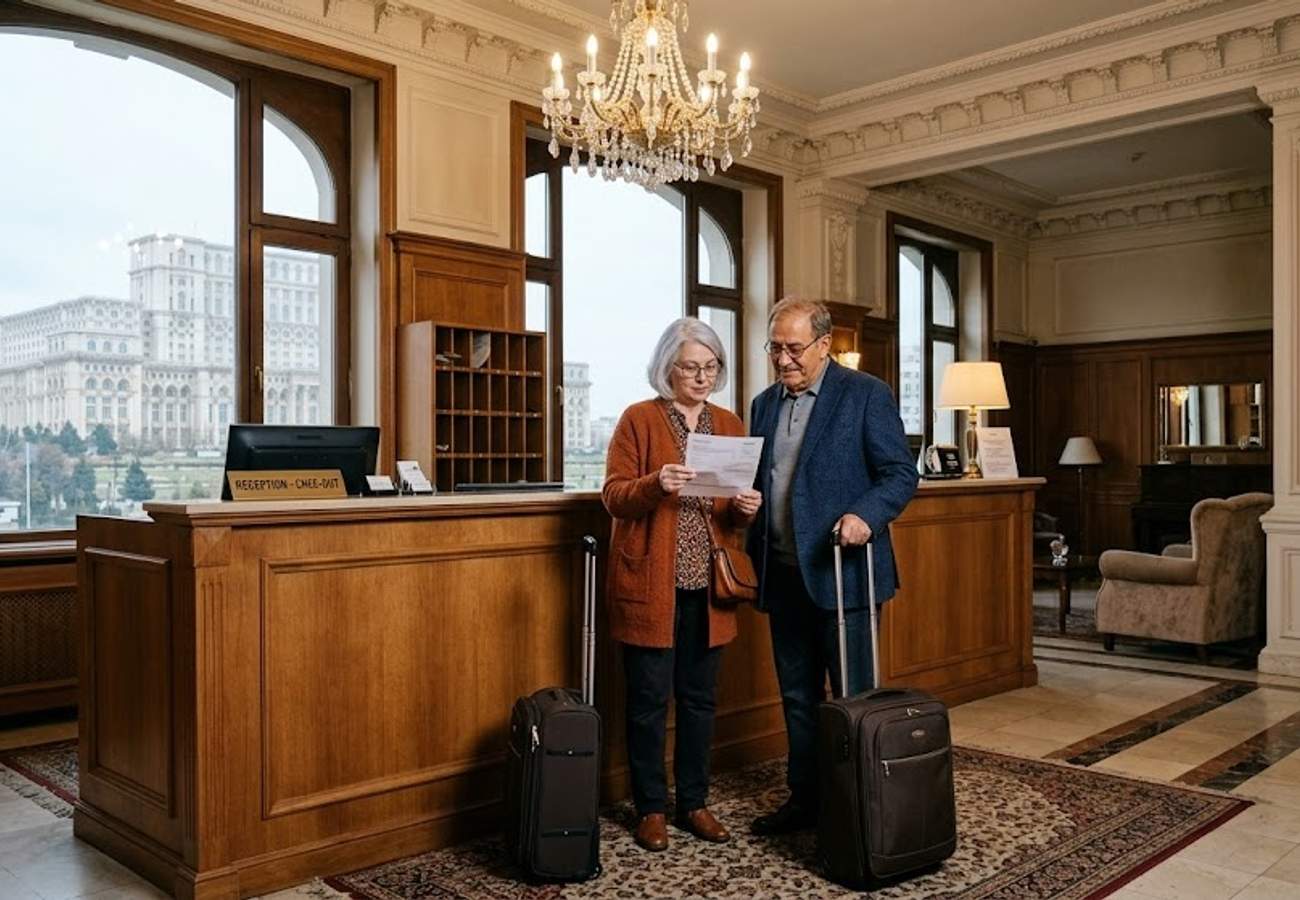
Image generated by AI
[Bucharest, July 31, 2026] — A flat 10 Romanian leu (approximately €2) per-night tourist tax now applies to every visitor staying in registered accommodation across Bucharest, and travellers from Italy, Germany, and the United Kingdom are projected to shoulder the largest collective share of the new levy. The charge is universal — nationality, hotel category, and room price do not alter what a guest pays — but because these three nations send the highest volumes of European visitors to Romania, their citizens will contribute the most total revenue under the policy.
Bucharest Implements Flat-Rate Overnight Levy
Romania's capital has formally introduced a mandatory overnight accommodation charge that applies to all visitors staying in officially registered properties within city limits. The levy is set at a fixed rate of 10 Romanian leu per night — roughly €2 — and is not tied to accommodation type, property classification, or nightly room rates.
Unlike several major European destinations where tourism taxes scale upward with hotel category or luxury tier, Bucharest has opted for a single-rate model. A guest in an economy hostel, a private holiday rental, a boutique three-star property, or a five-star luxury hotel all pay the identical amount per night.
The simplified structure is intended to ensure consistent application across the hospitality sector while reducing administrative complexity for accommodation providers and booking platforms. By eliminating tiered calculations, the city aims to streamline compliance and create predictable costs for visitors regardless of their budget or travel style.
Italy, Germany, and UK Travellers Face Greatest Collective Impact
The tax itself does not discriminate by nationality. Every traveller occupying eligible accommodation in Bucharest pays the same 10 Romanian leu per night, regardless of country of residence or citizenship. Visitors from every European nation — as well as those from other regions globally — are equally subject to the charge.
However, the practical financial impact is distributed unevenly because visitor volumes from different countries vary significantly. According to official tourism data published by Romania Insider, Italy represents Romania's largest European inbound tourism market. German visitors constitute the country's second-largest European source market, while travellers from the United Kingdom occupy the third position.
Because these three countries collectively contribute a substantial proportion of Bucharest's international accommodation demand, their citizens are expected to account for a considerable share of the total tourism tax revenue collected. The disproportionate impact is driven entirely by visitor numbers rather than differentiated taxation — every traveller pays exactly the same per-night amount.
How the Bucharest Tourist Tax Is Collected
The collection mechanism has been designed to integrate into existing accommodation payment systems with minimal disruption.
For travellers booking through major online platforms such as Airbnb and Booking.com, the tourist tax may be automatically incorporated into the accommodation invoice during the reservation process where applicable. In other cases, the charge may be collected directly by accommodation providers at check-in or checkout, depending on the property's operational procedures.
This integrated approach is intended to minimise inconvenience for visitors while simplifying compliance for hotels, guesthouses, apartments, and short-term rental operators. By incorporating the charge into existing payment workflows, the levy can be administered without requiring separate transactions for most guests.
Bucharest's Uniform Model Contrasts With Tiered European Systems
Across Europe, accommodation taxes vary considerably between destinations. Many major tourism centres operate tiered taxation systems in which higher-end hotels attract larger tourism levies than budget accommodation. In several cities, the tax is calculated according to hotel classification, room price, or overall accommodation value.
Bucharest has departed from this approach by adopting a uniform flat-rate structure. Under this model, visitors staying in budget hostels, serviced apartments, boutique hotels, holiday rentals, or luxury five-star properties all contribute the identical 10 Romanian leu per night.
This system provides greater predictability for visitors while ensuring that accommodation providers apply identical taxation regardless of property category. The flat-rate design also eliminates the need for properties to classify or reclassify their offerings for tax purposes, reducing a layer of administrative overhead.
Non-Compliance Carries Steep Financial Penalties
Romanian authorities have introduced financial penalties to enforce full compliance with the new regulation. Visitors who deliberately avoid or bypass the mandatory tourism levy may face local fines reaching as much as 1,500 Romanian leu — approximately €294.
These penalties significantly exceed the value of the nightly tourist tax itself, signalling the importance authorities place on proper compliance. The fine represents roughly 150 times the per-night charge, making evasion financially irrational for any visitor.
Accommodation providers and booking platforms are expected to play a central role in ensuring that visitors are informed of their payment obligations before or during their stay. Properties that fail to collect or remit the tax may also face scrutiny under the regulation.
Romania Aligns With Broader European Tourism Levy Trend
The introduction of the Bucharest tourist tax reflects a wider pattern across Europe, where numerous destinations have implemented accommodation levies to generate additional revenue supporting tourism infrastructure, public services, and destination management.
By maintaining a modest flat-rate charge, Bucharest has sought to introduce supplementary funding without creating substantial financial barriers for visitors. For the majority of international tourists, the additional cost represents only a small fraction of overall travel expenditure. Nevertheless, because Italy, Germany, and the United Kingdom consistently contribute large visitor numbers, travellers from these countries will collectively shoulder a considerable share of the total revenue generated.
The standardised collection process — combined with automatic integration through accommodation providers and online booking platforms — is expected to reduce administrative burdens while improving transparency for visitors. As European tourism continues to evolve, accommodation taxes are increasingly becoming a standard feature of destination management strategies across the continent.
What This Means for Travellers and the European Tourism Landscape
For the traveller, this means a small but permanent addition to the cost of any overnight stay in Bucharest — €2 per night, collected either at booking or at the property. While the amount is modest compared to daily travel spending, it is non-negotiable and backed by a fine of up to 1,500 Romanian leu for those who attempt to bypass it. Visitors booking through platforms like Airbnb or Booking.com may never notice the charge, as it can be embedded directly in the reservation total. Those booking directly with smaller properties should expect to pay at check-in or checkout.
From a policy standpoint, Bucharest's flat-rate model creates an interesting contrast with cities like Paris, Amsterdam, and Barcelona, where taxes scale with accommodation quality. The uniform approach eliminates any incentive for visitors to downgrade their declared accommodation category to reduce tax liability — a loophole that tiered systems can inadvertently create. It also means that budget travellers pay the same nominal amount as luxury visitors, which raises questions about proportional burden: €2 per night represents a larger percentage of a hostel guest's daily budget than a five-star hotel guest's.
For Italy, Germany, and UK travellers specifically, the practical effect is cumulative. A family of four staying five nights in Bucharest will pay 200 Romanian leu (approximately €40) in tourist tax — a modest but real addition to trip costs. Travel agencies and tour operators serving these markets may need to update pricing displays and booking confirmations to reflect the levy transparently.
The broader signal is clear: the era of tax-free accommodation in major European cities is effectively over. Bucharest's entry into the levy space means that travellers planning multi-city European itineraries in 2026 should budget for accommodation taxes at nearly every stop. Romania's adoption of a flat, low-rate model may even serve as a template for other emerging European destinations seeking tourism revenue without the administrative complexity of tiered systems.
As European capitals continue refining how they fund tourism infrastructure, Bucharest's €2-per-night experiment will be closely watched by both travellers and policymakers across the continent.
Related Travel Guides
Disclaimer
This article is for informational and educational purposes only. It does not constitute legal, financial, or professional advice. While we strive to provide accurate and up-to-date information, travel policies, regulations, and conditions change rapidly. Always verify information with official sources before making travel decisions. Nomad Lawyer makes no representations about the accuracy, reliability, completeness, or suitability of the information provided. Readers should consult qualified professionals for advice specific to their circumstances. The views expressed in this article are those of the author and do not necessarily reflect the views of Nomad Lawyer.
Kunal K Choudhary
Co-Founder & Contributor
A passionate traveller and tech enthusiast. Kunal contributes to the vision and growth of Nomad Lawyer, bringing fresh perspectives and driving the community forward.
Learn more about our team →