
Aviation Updates: British Airways A380 Superjumbo Forced into Sudden Birmingham Diversion Amidst London Travel Chaos
As catastrophic logistical bottlenecks severely paralyze massive transit grids, severe thunderstorms force a massive British Airways A380 to abruptly divert to Birmingham, exposing the extreme fragility of London airspace.

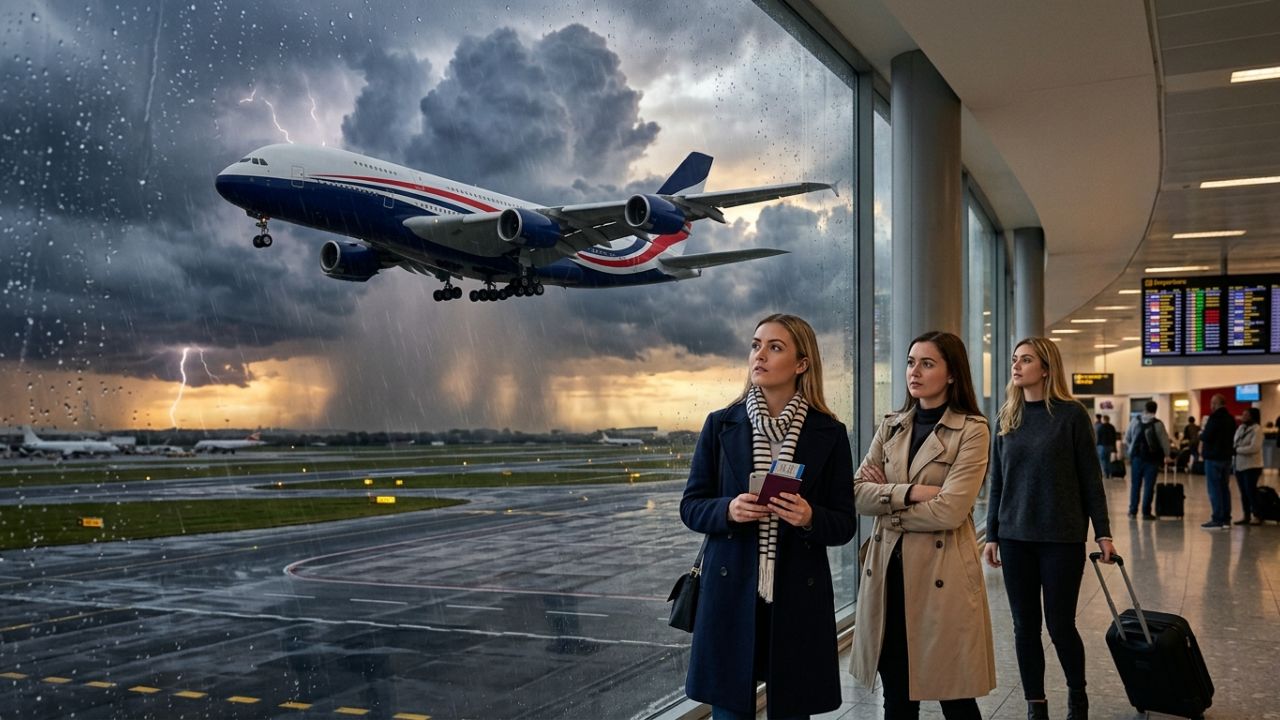
Image generated by AI
Aviation Updates: British Airways A380 Superjumbo Forced into Sudden Birmingham Diversion Amidst London Travel Chaos
As extreme operational friction and suddenly compounding infrastructure bottlenecks continue to terrorize standard travel itineraries, a massive transatlantic wide-body jet was violently forced out of London airspace, brutally exposing the sheer fragility of high-capacity airport flows under meteorological stress.
Image generated by AI
As high-impact airline news platforms rapidly issue continuous, grim aviation updates regarding the intense fragility of aging European transit grids, a massive operational anomaly has struck the United Kingdom’s busiest aviation corridor. Amidst widespread rolling travel chaos, severe airport disruptions, and devastatingly frequent flight cancellations plaguing massively overcrowded primary hubs, a flagship British Airways transatlantic service was forced into an abrupt, highly disruptive emergency diversion on Saturday evening. British Airways Flight BA284, operating a massive Airbus A380 superjumbo directly from San Francisco International Airport, was violently denied entry into London Heathrow airspace due to intense, highly localized convective storm activity across southern England. The massive double-deck aircraft was instead forced into a sudden, heavily publicized diversion to Birmingham Airport. This incredibly rare wide-body displacement matters right now because it brilliantly exposes exactly how fast high-capacity airport flow completely disintegrates under weather stress, cascading system-wide congestion across the entire London air corridor and impacting thousands of exhausted passengers in real time.
Expanded Overview: The Transatlantic Flow Chain Collapse
To fully comprehend the sheer scale of this severe network disruption, aviation analysts must closely examine how incredibly fragile long-haul arrival sequencing becomes when massive mega-hubs reach absolute saturation.
After executing a flawless, completely on-time departure from San Francisco and spending nearly 11 hours airborne over the Atlantic, the British Airways A380 brutally entered UK airspace under highly unstable meteorological conditions. Instead of executing a standard, highly synchronized descent directly into Heathrow, the massive aircraft was violently pushed into extended holding patterns far north near Manchester. This agonizing holding phase served as a massive, glaring signal of severe upstream congestion and rapidly collapsing landing capacity directly within London airspace. After enduring extended airborne delay management and critically calculating safe fuel depletion levels, the exhausted flight crew executed a massive operational deviation, aborting the Heathrow approach and diverting the flagship service to Birmingham Airport.
Section-Wise Breakdown: The Hidden Weather Trigger
Southern England was violently experiencing severe convective storm activity at the exact time of the diversion, heavily forcing air traffic controllers to aggressively implement massive spacing buffers to prevent mid-air collisions.
The Capacity Crisis: When Heathrow landing capacity rapidly tightens, massive inbound aircraft are violently pushed into high-altitude holding stacks across northern and central UK airspace. The absolute key impacts of this specific storm cell included severely reduced runway throughput at Heathrow, extended holding patterns over the Manchester region, massive diversion pressure on all inbound transatlantic flights, and incredibly expensive increased fuel burn.
The Dual Narrative: Interestingly, aviation tracking signals and highly panicked early eyewitness accounts suggested multiple possible causes for the sudden diversion. While air traffic congestion definitively caused the massive holding pattern, unconfirmed reports of a possible medical emergency onboard also surfaced. As is standard during real-time aviation disruptions, British Airways and UK aviation authorities withheld immediate official confirmation, highlighting the intense dual-pressure conditions flight crews face when balancing passenger safety against rapidly deteriorating airport flow management. What remains absolutely clear is that the aircraft was violently denied a Heathrow landing window during its crucial descent phase.
Flight Details: British Airways BA284 Diversion Matrix
To ensure international travelers and commercial aviation analysts can accurately track the incredibly precise operational telemetry of this massive regional disruption, the verified flight data has been consolidated into the exact, mandatory matrix below.
| Operational Metric | Verified Flight Data |
|---|---|
| Operating Carrier | British Airways |
| Flight Number | BA284 |
| Aircraft Type | Airbus A380 (Superjumbo) |
| Scheduled Route | San Francisco to London Heathrow |
| Diversion Location | Birmingham Airport |
| Holding Pattern Area | Manchester Region |
| Primary Disruption Cause | Severe Southern England Storm Cells |
| Repositioning Duration | 28–30 Minutes to Heathrow |
Industry Analysis: The Birmingham Safety Valve
The highly calculated choice to land a massive Airbus A380 at Birmingham Airport was explicitly strategic rather than incidental.
Under standard operating conditions, Birmingham’s wide-body operations are typically dominated by carriers like Emirates on Dubai services. The incredibly rare, highly unexpected arrival of a British Airways A380 highlights exactly how severe disruption can temporarily, violently override standard network design logic. Birmingham functions as an absolute pressure release point when Heathrow violently reaches saturation because it offers massive long runway capacity explicitly suitable for A380 operations, significantly lower airspace congestion, and full ground handling capabilities positioned safely outside the volatile London storm corridors.
This massive diversion heavily demanded incredibly rapid airport readiness, as A380 operations require highly specialized, high-capacity ground support systems. The decision expertly ensured the absolute continuity of passenger safety, avoiding unnecessary fuel depletion while proving that secondary UK airports are increasingly, desperately essential to maintaining long-haul network stability during massive disruption events.
Passenger Impact: The 28-Minute Dash
For the exhausted luxury travelers trapped onboard BA284, the sheer experience of an unexpected diversion inevitably created massive, highly frustrating anxiety.
Passengers endured agonizing extended airborne holding time, the massive confusion of an unexpected landing at an alternate airport, and intense ground transfer uncertainty. However, the operational recovery was highly robust. After executing a safe, uneventful landing at Birmingham and receiving critical ground-level intervention, the massive A380 eventually completed a highly unusual, rapid 28-to-30-minute short repositioning hop directly back to Heathrow, finally restoring the original schedule flow.
For the wider global network, the ripple effect was heavily felt. The massive diversion forced aggressively adjusted arrival sequencing at Heathrow, caused minor cascading delays for connecting flights, and forced a highly complex aircraft rotation recalibration for the British Airways long-haul fleet.
Conclusion: Normalizing the Exceptional Diversion
Ultimately, the sudden, highly dramatic diversion of the British Airways A380 from San Francisco reveals vastly more than a simple one-off operational adjustment. It violently highlights the incredibly fragile equilibrium of modern aviation networks operating under severe meteorological stress. As global storm cells intensify and massive mega-hubs like Heathrow operate perpetually near absolute maximum capacity, these massive wide-body diversions will undeniably become increasingly normalized rather than exceptional. The absolute key challenge ahead for the global aviation industry is not just managing these massive aircraft safely, but rapidly closing the "transparency gap"—communicating diversion decisions clearly and instantly to exhausted passengers trapped inside an incredibly fragile, interconnected global transit system.
Key Takeaways
- Massive Wide-Body Diversion: British Airways Flight BA284, a massive Airbus A380, was forced to abort its London arrival and violently divert to Birmingham Airport.
- The Weather Trigger: Severe convective thunderstorms across southern England violently reduced arrival sequencing efficiency at Heathrow.
- Holding Over Manchester: After nearly 11 hours flying from San Francisco, the aircraft was forced into extended holding patterns near Manchester due to upstream London congestion.
- The Repositioning Hop: After safely landing at Birmingham, the A380 executed a highly unusual, incredibly short 28-minute repositioning flight directly to Heathrow.
- The Transparency Gap: Unconfirmed rumors of a medical emergency heavily highlighted the massive communication lag that occurs during real-time aviation disruptions.
FAQ: British Airways Flight BA284 Diversion
Where did British Airways Flight BA284 divert to? The massive Airbus A380, originally scheduled to land at London Heathrow from San Francisco, was forced to divert to Birmingham Airport.
Why was the British Airways A380 diverted from London? Severe thunderstorms over southern England drastically reduced Heathrow's landing capacity, forcing air traffic control to push the aircraft into extended holding patterns before diverting.
How long did it take the A380 to fly from Birmingham to Heathrow? After the weather cleared, the A380 completed a highly unusual, short 28-minute repositioning flight from Birmingham back to Heathrow.
Why was Birmingham Airport chosen for the diversion? Birmingham offers the massive runway length required for A380 operations, full wide-body ground handling, and was located safely outside the primary London storm cells.
Related Travel Guides
Qatar Airways Canberra Melbourne Doha Travel Chaos 2026
Vietnam Long Thanh Airport 100m Southeast Asia Travel Chaos 2026
Europe Regional Tourism and Transit Survival Guide 2026
Disclaimer: This article is strictly for informational and aviation tracking purposes. The specific flight telemetry (BA284, Airbus A380, San Francisco to Heathrow via Birmingham) and disruption causes are based on verified public flight tracking data available at the time of publication. European airspace conditions, specific airline recovery schedules, and air traffic control diversion protocols are highly dynamic and subject to immediate modification by the operating carriers and government authorities. Passengers planning international travel through major hubs like London Heathrow should explicitly verify their exact flight itineraries, strictly monitor their airlines for sudden flight cancellations or weather diversions, and secure comprehensive travel insurance prior to departure.
Disclaimer
This article is for informational and educational purposes only. It does not constitute legal, financial, or professional advice. While we strive to provide accurate and up-to-date information, travel policies, regulations, and conditions change rapidly. Always verify information with official sources before making travel decisions. Nomad Lawyer makes no representations about the accuracy, reliability, completeness, or suitability of the information provided. Readers should consult qualified professionals for advice specific to their circumstances. The views expressed in this article are those of the author and do not necessarily reflect the views of Nomad Lawyer.
Kunal K Choudhary
Co-Founder & Contributor
A passionate traveller and tech enthusiast. Kunal contributes to the vision and growth of Nomad Lawyer, bringing fresh perspectives and driving the community forward.
Learn more about our team →