
Trans-Tasman Aviation Chaos: 900 Flights Grounded as Severe Winter Storms Batter Australian and New Zealand Hubs
A volatile winter storm system has plunged the Trans-Tasman aviation network into absolute chaos, forcing airlines to delay or cancel 900 flights.

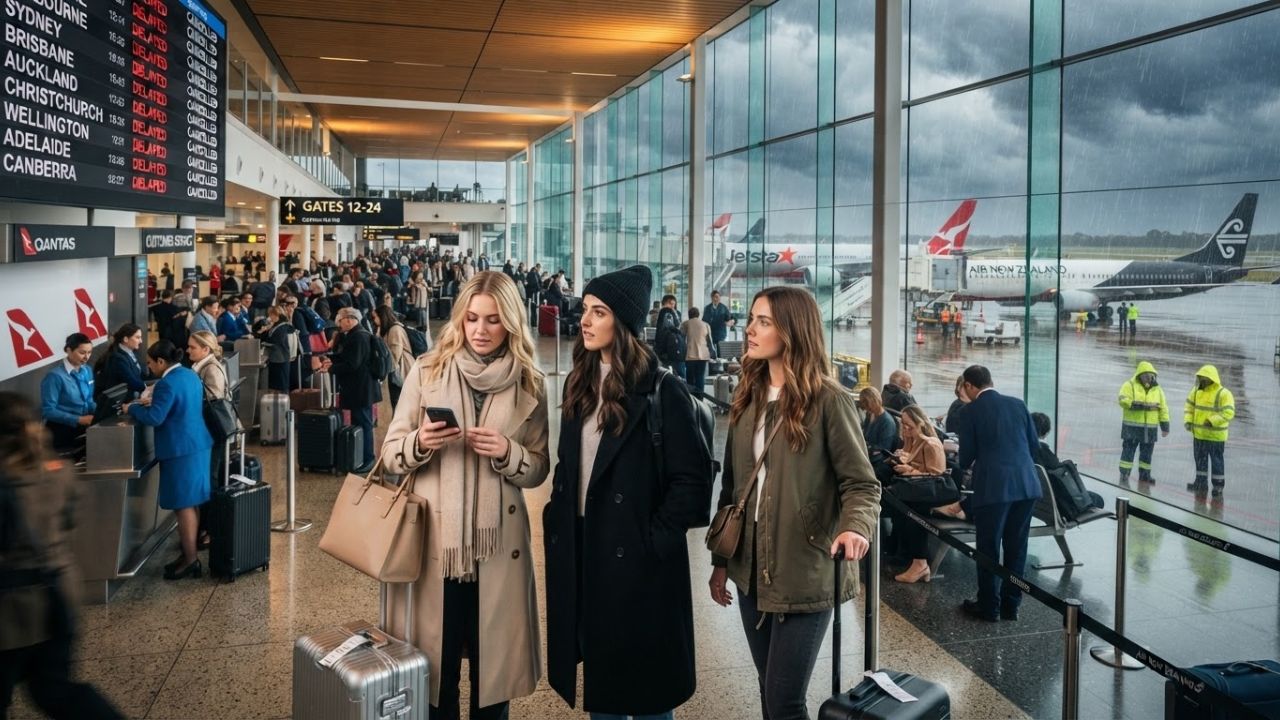
Image generated by AI
[Sydney, July 3] — An unprecedented winter storm system sweeping across southeastern Australia has paralyzed regional air travel, stranding thousands of passengers across the Trans-Tasman corridor. Severe atmospheric volatility—marked by gale-force winds, torrential rain, and over 50,000 lightning strikes—triggered a statewide “Code Blue” emergency response in South Australia. The extreme weather immediately compromised runway operations, resulting in a staggering 839 delays and 61 cancellations across the region.
Major commercial carriers are currently battling massive scheduling logjams as they attempt to clear rapidly compounding backlogs. Flight tracking data indicates that interconnected aircraft routing has caused the initial localized bottlenecks to spread instantly across the Tasman Sea. Terminal congestion remains critically high as airlines actively manage disrupted flight schedules while prioritizing passenger safety amid ongoing weather warnings.
Melbourne Tullamarine and Sydney Suffer Highest Disruptions
Melbourne Tullamarine (MEL) absorbed the heaviest operational blow, logging 266 delayed flights and 21 cancellations as alpine cold fronts and damaging wind warnings severely reduced runway throughput. Australia’s primary international gateway, Sydney (SYD), experienced immense knock-on effects despite facing milder immediate weather conditions. Sydney recorded 218 delays and 20 cancellations as its interconnected flight scheduling collapsed under the pressure of incoming domestic delays.
Brisbane (BNE), located further north and physically shielded from the storm’s core, nevertheless became heavily gridlocked, recording 150 delays and one cancellation. Adelaide International (ADL) sat directly at the storm's entry point, enduring 33mm of rainfall in under 24 hours. Operating under severe gale warnings, the facility processed 89 delays and four cancellations. Regional entry points also felt the squeeze, with Canberra International (CBR) experiencing 20 delays and seven cancellations, while Mildura (MQL) reported eight delays and two cancellations.
New Zealand Hubs Absorb Cascading Delays
The operational failure quickly bridged the Tasman Sea, severely compromising New Zealand's primary aviation hubs. Auckland (AKL) recorded 42 delays and two canceled flights. Further south, Christchurch International (CHC) saw 31 delays and one cancellation, while Wellington International (WLG) noted 15 delays and three cancellations. Industry sources indicate these disruptions were predominantly driven by delayed inbound aircraft arriving late from the paralyzed Australian mainland hubs.
Virgin Australia, Jetstar, and Qantas Networks Compromised
Low-cost carriers operating tightly scheduled, high-utilization fleets faced intense pressure trying to maintain network integrity. Virgin Australia led the region in absolute delays, holding back 138 flights and canceling seven along the highly congested eastern seaboard corridor. Jetstar similarly saw its regional network heavily compromised, reporting 133 delays and four cancellations.
Qantas bore the highest absolute volume of groundings, logging 10 cancellations alongside 118 delays. The carrier's regional subsidiary, QantasLink, struggled to service smaller, vulnerable flight paths, posting 71 delays and seven cancellations. Meanwhile, Air New Zealand managed to suppress total cancellations to five, but could not escape the regional crosswinds, enduring 49 delays across its domestic and Trans-Tasman routes.
Emergency Rebooking Protocols for Stranded Travelers
With airlines managing hundreds of delays simultaneously, terminal customer service queues are completely overwhelmed, and traditional phone lines are experiencing extreme wait times. Industry experts strongly advise passengers not to travel to the airport if their flight has been flagged as canceled. Instead, travelers must monitor live digital channels and utilize the self-service portals on official airline smartphone apps to confirm alternative flight allocations or request immediate travel credits.
Because these massive delays are formally categorized under severe, act-of-God weather events—explicitly highlighted by South Australia’s official Code Blue activation—commercial airlines may not be legally liable for providing out-of-pocket accommodation or meal compensation. Consequently, affected passengers are urged to keep all itemized receipts to lodge formal claims through their independent travel insurance providers. Maintaining patience and leveraging digital self-service tools remains the most effective strategy for securing alternative transport during this historic winter aviation crisis.
Trans-Tasman Disruption Data
| Hub / Airline | Delays | Cancellations |
|---|---|---|
| Melbourne Tullamarine (MEL) | 266 | 21 |
| Sydney (SYD) | 218 | 20 |
| Brisbane (BNE) | 150 | 1 |
| Adelaide Int’l (ADL) | 89 | 4 |
| Auckland (AKL) | 42 | 2 |
| Virgin Australia | 138 | 7 |
| Jetstar | 133 | 4 |
| Qantas | 118 | 10 |
| QantasLink | 71 | 7 |
| Air New Zealand | 49 | 5 |
Why This Matters
Our analysis of the flight data indicates a critical structural vulnerability within the Trans-Tasman aviation corridor. The sheer velocity at which an extreme weather event in South Australia collapsed runway operations in Auckland demonstrates that airlines are operating with zero buffer capacity. When carriers run high-utilization fleets to maximize profitability, a localized disruption—such as the "Code Blue" storm front—instantly infects the entire network. The disproportionately high delay-to-cancellation ratio (839 delays versus 61 cancellations) proves that Qantas and Virgin Australia are intentionally choosing to absorb massive operational friction to avoid outright flight groundings. While this strategy keeps passengers moving eventually, it traps aircraft on the tarmac, exhausts crew duty limits, and guarantees severe downstream congestion across the entire oceanic region.
Industry Outlook
Market trends suggest that Trans-Tasman flight operations will remain highly volatile over the next 48 hours as aircraft and flight crews remain severely out of position. Because this weather system is formally categorized as an act-of-God event, airlines are generally exempt from providing out-of-pocket accommodation or meal vouchers, forcing stranded passengers to rely heavily on independent travel insurance policies. Travelers are strongly advised to abandon overwhelmed terminal customer service desks and exclusively utilize digital rebooking windows via official airline smartphone applications. Moving forward, regional carriers must urgently reassess their winter scheduling density, as increasingly extreme weather patterns routinely threaten to break their tightly integrated hub-and-spoke network models.
Related Travel Guides
- Global Air Travel Demand Drops 2.2% in May
- Emirates Expands African Footprint with Third Daily Flight to Nairobi
- Canadian Aviation Gridlock: 880 Flights Disrupted
- US Airspace Gridlock: 4,500 Flights Delayed as Weather and ATC Shortages Ground Operations
- Toronto Pearson Gridlock: 243 Flights Disrupted
Disclaimer
This article is for informational and educational purposes only. It does not constitute legal, financial, or professional advice. While we strive to provide accurate and up-to-date information, travel policies, regulations, and conditions change rapidly. Always verify information with official sources before making travel decisions. Nomad Lawyer makes no representations about the accuracy, reliability, completeness, or suitability of the information provided. Readers should consult qualified professionals for advice specific to their circumstances. The views expressed in this article are those of the author and do not necessarily reflect the views of Nomad Lawyer.
Kunal K Choudhary
Co-Founder & Contributor
A passionate traveller and tech enthusiast. Kunal contributes to the vision and growth of Nomad Lawyer, bringing fresh perspectives and driving the community forward.
Learn more about our team →