
Canada Flight Delays: Air Canada, WestJet & Porter Cancellations
Canada's major airports face disruptions as Calgary, Montreal, Toronto, and Vancouver record 179 cancellations and 403 delays. Check flight status.

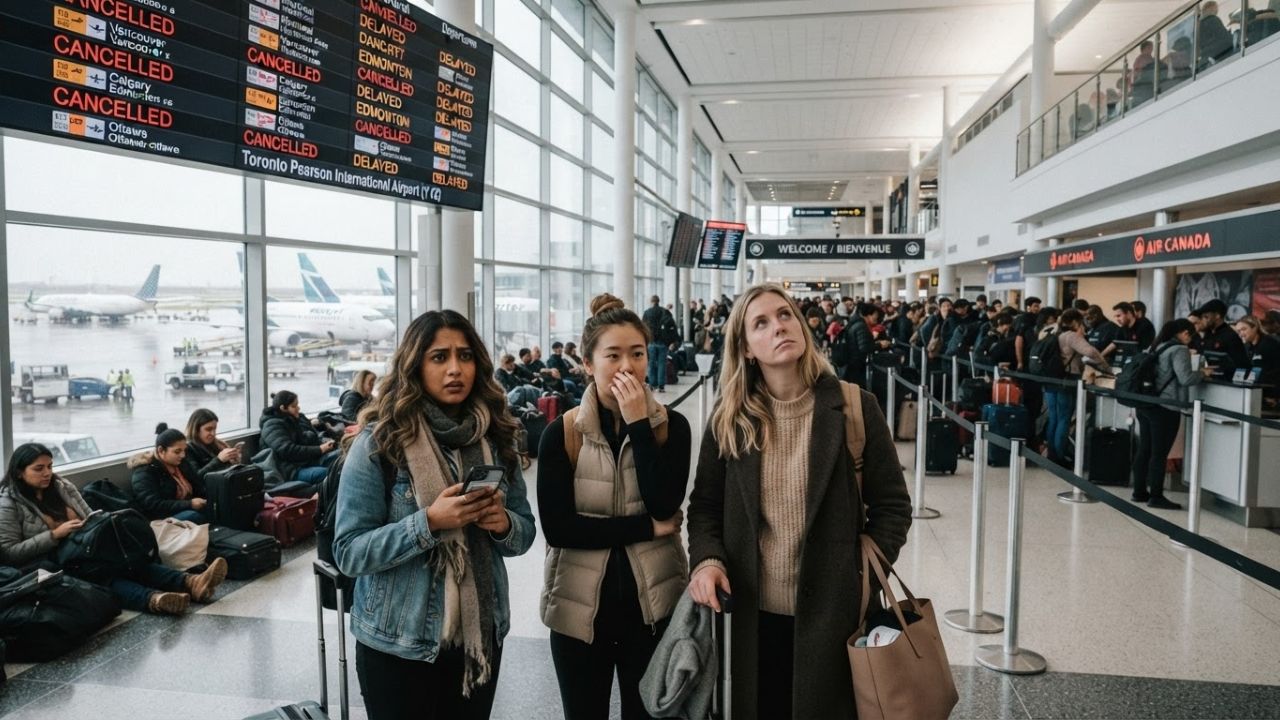
Image generated by AI
Canada experienced widespread Canada flight cancellations today as its major aviation hubs faced mounting delays and groundings. A total of 179 flights were cancelled and 403 delayed across cities including Calgary, Montreal, Toronto, Vancouver, and Winnipeg.
According to FlightAware flight tracking telemetry on July 3, 2026, the operational backlogs affected major carriers including Air Canada, Jazz (ACA), Porter Airlines, WestJet, Air Canada Rouge, Air Transat, United Airlines, American Airlines, and Lufthansa.
Aviation officials are monitoring the situation to restore normal aircraft rotations. Passengers are advised to verify flight statuses before departing for terminal gates.
Heatwave and Pearson Airport Runway Closure Cripple Canadian Aviation Network
The widespread operational issues across the Canadian aviation network stem from a combination of infrastructure limitations and environmental challenges. A partial runway closure at Toronto Pearson International Airport (YYZ) has severely reduced the landing and takeoff capacity of Canada's most critical transit hub. This capacity drop has caused flight backlogs that are rippling out to other airports across the country.
At the same time, an intense summer heat wave and high humidity are placing additional physical stress on airport equipment and personnel. According to the International Air Transport Association (IATA), summer travel surges can push airport infrastructure to its absolute limit, leaving no margin for operational issues. High temperatures reduce air density, which limits the lift capacity of departing aircraft. This weather event requires carriers to carefully monitor weight restrictions, occasionally forcing them to reduce cargo loads or passenger counts to maintain safety standards.
In addition, ground handling crews must take mandatory heat breaks to prevent heat stroke, which slows baggage loading and refueling operations. These delays accumulate throughout the day, leaving airlines with very little time to recover schedules before crews exceed their legal duty hours. Combined with ongoing staffing shortages, these factors have left the Canadian aviation network highly vulnerable to systemic delays.
Major Hubs Suffer Highest Disruption Rates at Toronto Pearson, Montreal-Trudeau, and Vancouver
According to flight tracking telemetry, Toronto Pearson International Airport (YYZ) reported the highest volume of disruptions in the country. The airport logged 112 delays and 56 cancellations. These cancellations primarily impacted flights operated by Air Canada and Jazz (ACA). However, passengers flying on Air Canada Rouge, Porter Airlines, Air Transat, WestJet, American Airlines, Endeavor Air, and Lufthansa also faced major schedule changes.
Montreal-Trudeau International Airport (YUL) experienced similar operational strain, reporting 70 delays and 33 cancellations. The largest portion of these cancellations affected Air Canada and Jazz (ACA) operations. Additional delays disrupted services for Air Transat, PAL Airlines, Lufthansa, Porter Airlines, and Royal Air Maroc.
On the West Coast, airlines at Vancouver International Airport (YVR) reported 53 delays and 15 cancellations. Air Canada recorded the highest number of disruptions at this gateway. Other carriers experiencing schedule changes included Jazz (ACA), United Airlines, American Airlines, Porter Airlines, Air Canada Rouge, SkyWest Airlines, Pacific Coastal Airlines, Fiji Airways, and Horizon Air.
Regional Travel Corridors Blocked in Ottawa, Toronto City Centre, and Calgary
At Ottawa Macdonald-Cartier International Airport (YOW), airlines logged 40 delays and 19 cancellations. Jazz (ACA) and Porter Airlines accounted for the majority of these disruptions. Passengers flying on Air Canada, PAL Airlines, Air Canada Rouge, Republic Airways, and WestJet also experienced delays.
Toronto City Centre Airport (YTZ) recorded 39 delays and 28 cancellations. Because of the airport's layout and operator profile, almost all disruptions involved Jazz (ACA) and Porter Airlines.
Further west, Calgary International Airport (YYC) reported 37 delays and 6 cancellations. Air Canada recorded the highest number of cancellations at the Alberta hub. Delays also affected WestJet, WestJet Encore, United Airlines, Porter Airlines, Cargojet, Air Canada Rouge, Condor, Discover Airlines, and Flair Airlines.
Other airports across Canada recorded smaller but still significant disruptions. Edmonton International Airport (YEG) registered 22 delays and 8 cancellations, with Air Canada and Air Canada Rouge experiencing the most issues. Québec City Jean Lesage International Airport (YQB) recorded 20 delays and 7 cancellations, affecting Pascan Aviation, Central Mountain Air, PAL Airlines, Air Inuit, Air Liaison, and Jazz (ACA). Winnipeg Richardson International Airport (YWG) saw 7 delays and 3 cancellations, while Regina International Airport (YQR) experienced 3 delays and 4 cancellations.
Carrier Operations Disrupted for Air Canada, Jazz, and Porter Airlines
Air Canada recorded the highest volume of cancellations and delays across the country. The airline logged 90 delays and 86 cancellations, affecting routes through Toronto, Montreal, Vancouver, Calgary, Ottawa, Edmonton, Quebec City, Regina, and Winnipeg.
Jazz (ACA), which operates regional feeder services on behalf of Air Canada, reported 60 delays and 69 cancellations. These disruptions were concentrated at regional hubs, including Toronto City Centre, Ottawa, Montreal, and Toronto Pearson.
Porter Airlines experienced 64 delays and 9 cancellations. The airline's disruptions were centered around Toronto City Centre, Ottawa, Edmonton, Toronto Pearson, and Vancouver.
WestJet reported 23 delays, primarily affecting flights operating through Calgary and Toronto Pearson, as well as minor disruptions in Ottawa.
Air Canada Rouge recorded 15 delays and 11 cancellations, with its schedule heavily impacted in Toronto Pearson, Vancouver, Ottawa, and Edmonton.
Air Transat logged 19 delays. The disruptions primarily affected flights departing from Montreal-Trudeau and Toronto Pearson.
Flight Disruption Summary Tables
Airport Flight Disruptions
| Airport Name | Airport Code | Delayed Flights | Cancelled Flights |
|---|---|---|---|
| Toronto Pearson International Airport | YYZ | 112 | 56 |
| Montreal-Trudeau International Airport | YUL | 70 | 33 |
| Vancouver International Airport | YVR | 53 | 15 |
| Ottawa Macdonald-Cartier International Airport | YOW | 40 | 19 |
| Toronto City Centre Airport | YTZ | 39 | 28 |
| Calgary International Airport | YYC | 37 | 6 |
| Edmonton International Airport | YEG | 22 | 8 |
| Québec City Jean Lesage International Airport | YQB | 20 | 7 |
| Winnipeg Richardson International Airport | YWG | 7 | 3 |
| Regina International Airport | YQR | 3 | 4 |
Airline Flight Disruptions
| Carrier | Delayed Flights | Cancelled Flights |
|---|---|---|
| Air Canada | 90 | 86 |
| Porter Airlines | 64 | 9 |
| Jazz (ACA) | 60 | 69 |
| WestJet | 23 | 0 |
| Air Transat | 19 | 0 |
| Air Canada Rouge | 15 | 11 |
Systemic Impact on Transborder Flights and Regional Connections
The operational delays in Canada have also begun to affect transborder flights connecting with the United States. Feeder services to American hubs are facing delays as late-arriving aircraft from Canada miss their scheduled departure windows. Industry observers report that international connections are also experiencing delays as airlines delay departures to accommodate transfer passengers arriving from delayed domestic flights.
These delays have highlighted the interdependence of regional and national transportation routes. When a major gateway like Montreal-Trudeau or Toronto Pearson experiences disruptions, the entire country's flight schedules are affected. Passengers on regional routes face long delays or outright cancellations as airlines focus their resources on maintaining high-volume mainline services.
Why This Matters
The high concentration of cancellations among regional carriers like Jazz (ACA) reveals how airlines manage system capacity during crisis events. When a major hub like Toronto Pearson (YYZ) faces runway closures and weather-related constraints, air traffic control reduces the number of landing slots. In response, airlines prioritize mainline flights, which carry more passengers over longer distances, while canceling short-haul regional flights. This strategy shields international routes but disproportionately impacts travelers in smaller regional markets who rely on connecting flights.
Additionally, the combination of extreme heat and a partial runway closure demonstrates the vulnerability of modern aviation infrastructure. High ambient temperatures reduce air density, which limits aircraft climb performance and increases takeoff distance. When combined with a reduced runway footprint, the operational margin of error disappears. This forcing mechanism requires airlines to reduce fuel or passenger loads, often resulting in proactive cancellations to avoid gridlock.
Ultimately, these disruptions highlight the fragility of tightly integrated crew and fleet rosters. When scheduling delays exceed crew duty limits, airlines cannot easily find replacement crew members due to ongoing staffing shortages. This creates a backlog where delayed flights from the morning cascade into cancellations by the evening, showing that modern airline networks have minimal capacity to absorb even minor disruptions.
Actionable Advice for Affected Passengers in Canada
- Verify Flight Status Remotely: Do not travel to the airport without confirming your flight status online or through the airline's mobile app. If your flight is delayed or cancelled, managing rebookings is faster through digital platforms than at terminal desks.
- Build in Buffer Time: If you must travel through major hubs like Toronto Pearson (YYZ), Montreal-Trudeau (YUL), or Vancouver (YVR), arrive earlier than usual to account for terminal congestion and longer check-in times.
- Pack Essentials in Carry-On: Always pack critical documents, prescription medications, device chargers, and a change of clothes in your carry-on baggage. If checked luggage is delayed due to ramp staffing shortages, you will still have your necessities.
- Track Connecting Leg Status: Passengers connecting through Calgary (YYC), Ottawa (YOW), or Toronto City Centre (YTZ) must monitor their onward flights closely, as rolling delays can alter connection windows without warning.
- Document All Expenses: Keep all receipts for meals, accommodation, and transport if you experience a significant delay. Under the Canadian Air Passenger Protection Regulations (APPR), travelers may be entitled to compensation depending on the cause of the disruption.
FAQ: Canada Flight Disruptions 2026
Why are flights being cancelled across Canada today?
Flight cancellations are driven by a partial runway closure at Toronto Pearson, widespread extreme heat and humidity, and ongoing systemic crew and staffing shortages across the aviation network.
Which airlines are experiencing the most delays in Canada?
Air Canada and its regional partner Jazz (ACA) have recorded the highest number of delays and cancellations, followed closely by Porter Airlines and WestJet.
What compensation is available for delayed Canadian flights?
Under the Canadian Air Passenger Protection Regulations (APPR), passengers may be entitled to cash compensation, rebooking, or refunds depending on whether the delay was within the airline's control.
Related Travel Guides
Disclaimer
This article is for informational and educational purposes only. It does not constitute legal, financial, or professional advice. While we strive to provide accurate and up-to-date information, travel policies, regulations, and conditions change rapidly. Always verify information with official sources before making travel decisions. Nomad Lawyer makes no representations about the accuracy, reliability, completeness, or suitability of the information provided. Readers should consult qualified professionals for advice specific to their circumstances. The views expressed in this article are those of the author and do not necessarily reflect the views of Nomad Lawyer.
Kunal K Choudhary
Co-Founder & Contributor
A passionate traveller and tech enthusiast. Kunal contributes to the vision and growth of Nomad Lawyer, bringing fresh perspectives and driving the community forward.
Learn more about our team →