
Exploring the Ancient Agora of Athens: A Guide to the Birthplace of Democracy and Urban Life in 2026
Discover how the Ancient Agora of Athens functioned as the epicenter of classical democracy, philosophy, and commerce, offering modern travelers a blueprint of early civic governance.

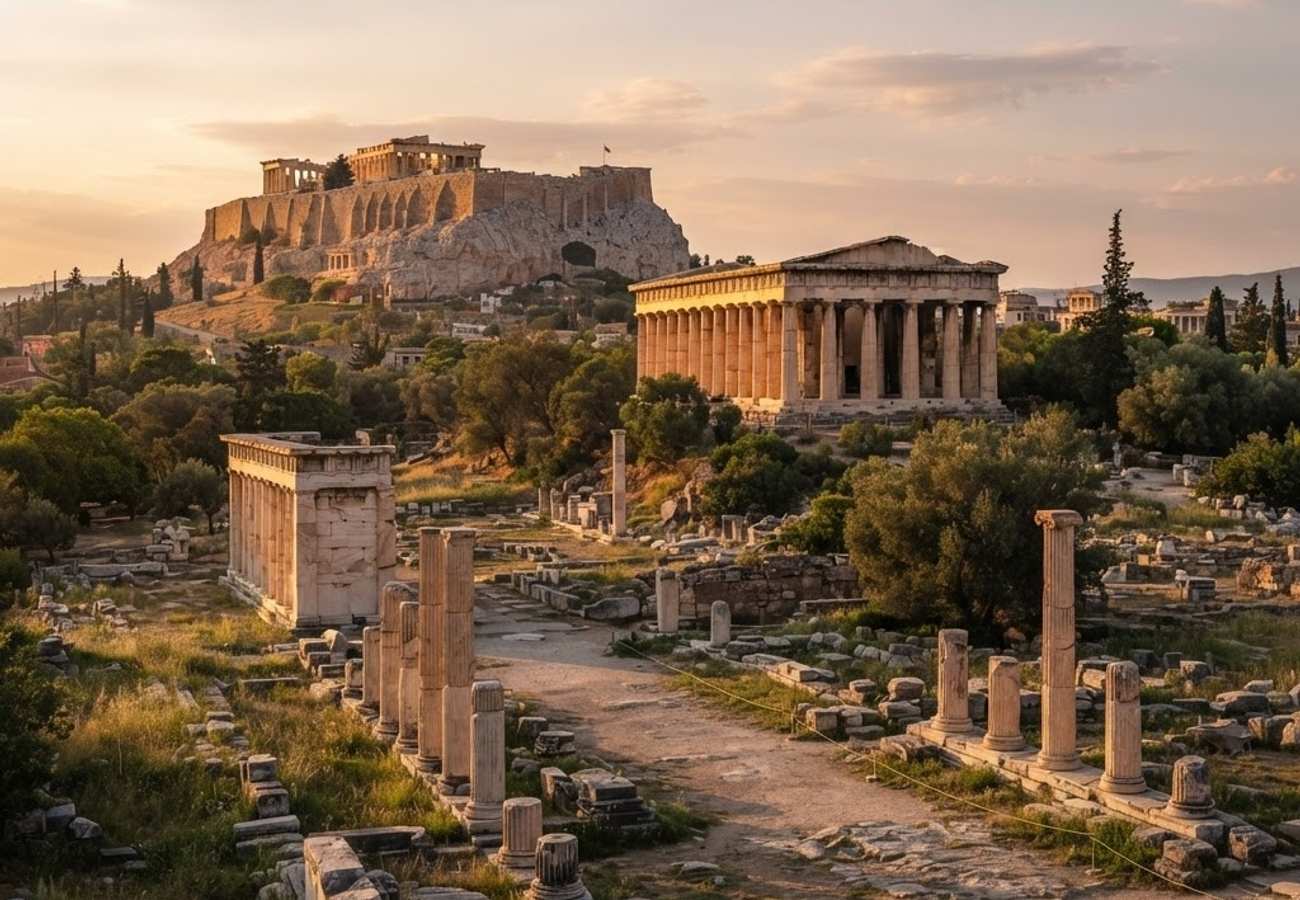
Image generated by AI
At the base of the Acropolis lies a sprawling archaeological park that served as the beating heart of classical Athens, where the foundations of Western democracy, philosophy, and urban commerce were laid over 2,500 years ago. While it may appear today as a serene collection of marble fragments and weathered columns, the Ancient Agora was once a chaotic, high-energy hub where citizens debated law, philosophers taught in the shade, and merchants traded goods from across the Mediterranean.
The Civic Engine of Athenian Democracy
The Ancient Agora functioned as the primary administrative and social nerve center of classical Athens. During the 5th century BC, as the city refined its radical democratic systems, this open square became the physical manifestation of civic engagement. Research and excavations conducted by the American School of Classical Studies have uncovered more than 30 acres of public infrastructure, including intricate inscriptions and artifacts that highlight the sheer density of the area's historical activity.
Athenian governance relied on a triad of institutions: the people's courts, the Council of Five Hundred, and the Assembly. While the Assembly typically convened on the nearby Pnyx Hill, the other two operated directly within the Agora's perimeter. The Bouleuterion, located in the southern sector, served as the meeting hall for councilors who drafted decrees and monitored city officials. Simultaneously, the dikasteria (people's courts) utilized various open-air spaces and buildings on the western and northern edges to adjudicate legal disputes.
For the contemporary traveler, the Stoa of Attalos provides the most tangible link to this political legacy. Reconstructed in the 1950s, this two-story colonnade now houses the Agora Museum. Visitors can examine the actual bronze ballots used by ancient jurors, official marble decrees, and fragments of klepsydras—water clocks used to strictly time political orations to ensure fair debate.
Architectural Design for Public Engagement
The layout of the Agora was intentionally designed to facilitate a life lived almost entirely in the public eye. The most prominent features were the stoas—long, covered walkways that offered essential protection from the harsh Attic sun and winter rains. These structures were not merely aesthetic; they were functional spaces for business, education, and political lobbying.
Along the western boundary, several critical stoas defined the landscape. The Stoa Basileios (Royal Stoa) was the seat of the archon basileus, the official overseeing religious law. Nearby, the Stoa of Zeus Eleutherios stood as a monument to freedom and the city's victory over the Persian Empire. This corridor of power allowed litigants and philosophers to move seamlessly between the shaded galleries and the open central square.
Dominating the northwest horizon is the Temple of Hephaestus. Widely regarded as the best-preserved Doric temple in all of Greece, it was constructed in the mid-5th century BC on the Kolonos Agoraios hill. Its location was strategic, overlooking the noisy workshops of potters and metal-smiths. Visiting this site in the late afternoon allows travelers to see the marble glow under the setting sun, providing a clear perspective on how compact and integrated the ancient city center truly was.
Other religious sites, such as the Temple of Apollo Patroos and shrines to Zeus Phratrios and Athena Phratria, were interspersed among the law courts and shops. This proximity underscores a fundamental aspect of ancient life: there was no separation between the sacred, the legal, and the commercial.
Commerce and the Economy of the Marketplace
In the classical era, the term "agora" carried a dual meaning, referring simultaneously to a physical location and the act of public speaking or shopping. This linguistic overlap mirrors the reality of the space, where a citizen might visit to purchase olive oil and end up embroiled in a debate regarding naval strategy.
The morning hours saw the square flood with farmers bringing fresh produce—figs, grapes, and amphorae of wine—while artisans sold textiles, sandals, and pottery. This economic activity was underpinned by the Athenian silver tetradrachm, the "owl" coin that became a standard currency across the eastern Mediterranean.
Industry data from the period suggests a skilled craftsman earned roughly one drachma per day, a sum sufficient for modest family sustenance. To ensure that poverty did not bar citizens from civic duty, jurors in the people's courts were paid a small stipend in the same coinage. The Agora Museum still displays the bronze weights and balance scales that ensured fair trade and maintained trust in these daily transactions.
Even today, the commercial spirit persists just outside the archaeological boundaries in the Monastiraki district. Modern cafes serve grilled fish, olives, and local wines—ingredients that have remained staples of the Athenian diet since the 5th century BC.
Legal Rigor and the Challenges of Early Democracy
While Athenian democracy is often romanticized, the legal proceedings within the Agora were frequently intense and high-stakes. The people's courts had the power to exile citizens or seize property based on the verdict of massive juries, often comprising hundreds of men selected by lot.
To maintain integrity and prevent bribery, the city employed a sophisticated system of bronze tickets to assign jurors to specific courts on the day of a trial. Archaeological evidence of this system remains visible through the discovery of juror identification tags and the stone bases of the water clocks used to regulate the length of legal arguments.
The political process was further refined in the Bouleuterion, where the Council of Five Hundred—composed of members from the city's ten tribes—met to set the agenda for the wider Assembly. Adjacent to this was the Tholos, a circular building that housed a rotating group of officials who lived and ate on the city's dime to ensure they were always available for emergency governance.
Why This Matters: The Experience of Urban Governance
For the modern visitor, the Ancient Agora is more than a collection of ruins; it is a lesson in the logistics of transparency. In an era of digital discourse and remote governance, the Agora represents a time when political accountability required physical presence.
From a logistical standpoint, the Agora teaches us that the environment shapes the behavior of the citizenry. The transition from the shaded, private conversations of the stoas to the exposed, public shouting matches of the square created a rhythmic flow of diplomacy and confrontation. For the traveler, walking these paths reveals that the "birth of democracy" wasn't a single event, but a daily, messy process of negotiation, commerce, and conflict.
Understanding the Agora allows a visitor to see Athens not as a museum of the dead, but as the prototype for every modern city square, shopping mall, and courthouse in the Western world.
The stones of the Agora remain a silent testament to the enduring power of the public voice.
Related Travel Guides
Disclaimer
This article is for informational and educational purposes only. It does not constitute legal, financial, or professional advice. While we strive to provide accurate and up-to-date information, travel policies, regulations, and conditions change rapidly. Always verify information with official sources before making travel decisions. Nomad Lawyer makes no representations about the accuracy, reliability, completeness, or suitability of the information provided. Readers should consult qualified professionals for advice specific to their circumstances. The views expressed in this article are those of the author and do not necessarily reflect the views of Nomad Lawyer.
Preeti Gunjan
Contributor & Community Manager
A passionate traveller and community builder. Preeti helps grow the Nomad Lawyer community, fostering engagement and bringing the reader experience to life.
Learn more about our team →