
American Airlines Call Sign Conflict Over Phoenix: How Layered Aviation Safety Prevented Collision in 2026
Two American Airlines jets sharing the same call sign, American 2482, were safely separated over Phoenix Sky Harbor International Airport thanks to redundant air traffic control and onboard TCAS systems.

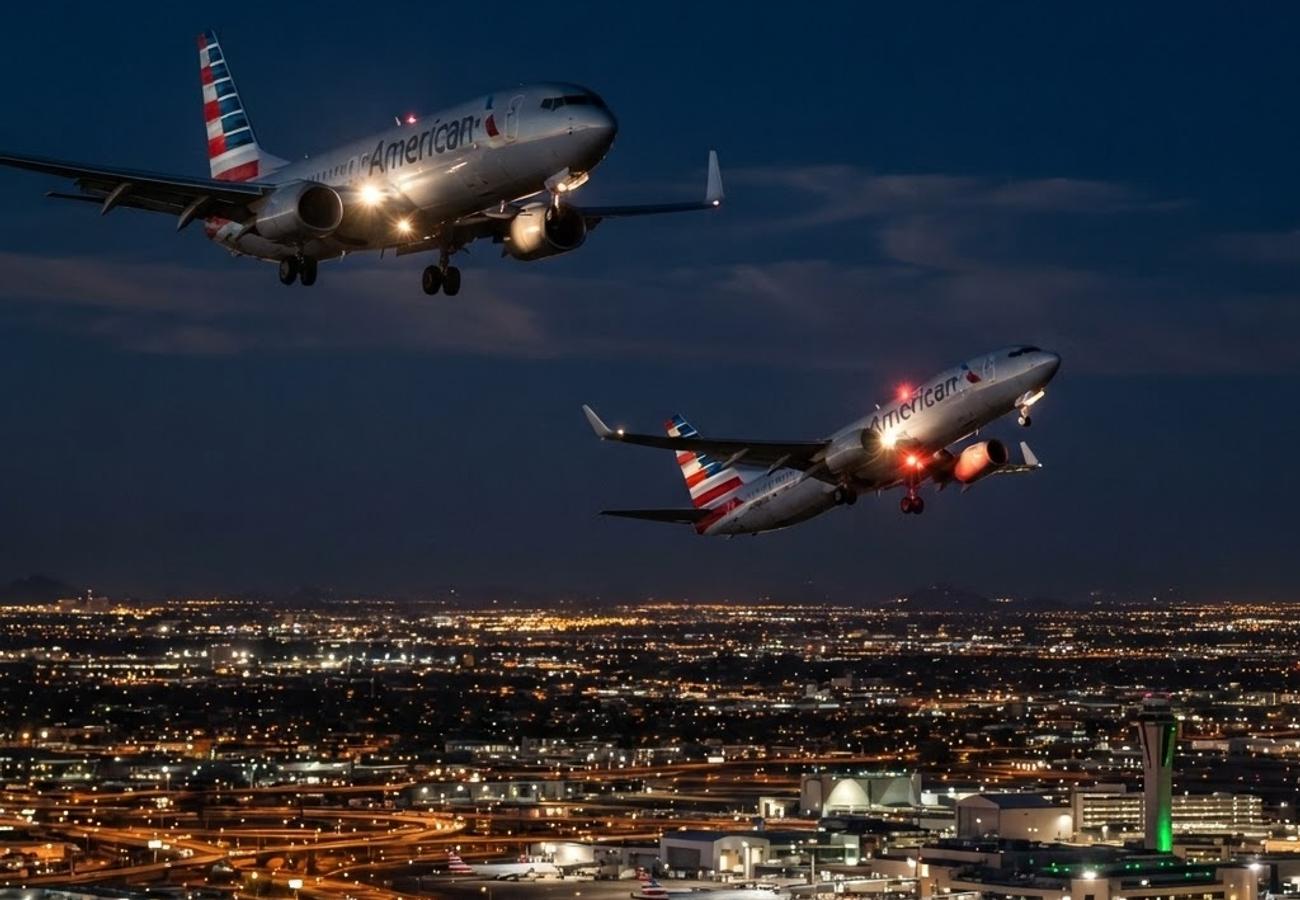
Image generated by AI
A scheduling error resulted in two American Airlines aircraft operating under the identical call sign, American 2482, in the vicinity of Phoenix Sky Harbor International Airport. Redundant safety protocols and rapid controller intervention prevented a loss of separation.
Shortly after midnight local time, two aircraft—one arriving and one departing—were both identified as American 2482. This duplication created a high-risk environment where flight crews could have potentially responded to instructions intended for the other aircraft.
A Phoenix air traffic controller identified the duplication and the converging flight paths immediately. To resolve the ambiguity, the controller transitioned to using "inbound" and "outbound" modifiers when addressing the aircraft. By issuing specific vectors and altitude assignments, the controller maintained legal separation throughout the encounter.
Our analysis of the event indicates that while the situation was an administrative failure, it did not result in a violation of established separation standards.
Critical Incident Breakdown
- Flight Identifiers: Both aircraft operated as American 2482.
- Location: Phoenix Sky Harbor International Airport airspace.
- Timing: Shortly after midnight local time.
- Primary Cause: Dispatch oversight during scheduling changes.
- Mitigation Strategy: Use of "inbound" and "outbound" descriptors by ATC.
- Safety Outcome: No loss of separation; no TCAS resolution advisories triggered.
Aviation Safety Architecture: The Defense Layers
The Phoenix incident serves as a primary example of the "defenses in depth" model used in modern aviation. When one layer fails, subsequent systems are designed to catch the error.
1. Air Traffic Control (ATC) Separation Controllers manage aircraft through vertical and lateral separation. In this instance, the arriving flight was maintained at a higher altitude than the departing flight. This vertical buffer ensured that even as their horizontal trajectories crossed, the aircraft remained safely apart.
2. TCAS (Traffic Collision Avoidance System) As a final line of defense, all commercial jets carry TCAS. This system operates independently of ground control by using transponder signals to monitor nearby aircraft. If two planes converge on a collision course, TCAS issues coordinated "Resolution Advisories" (RAs)—commanding one pilot to climb and the other to descend. In the Phoenix case, no RAs were triggered, confirming the aircraft never entered a critical conflict zone.
3. Dispatch and Scheduling Protocols Standard industry procedure requires airlines to apply modifiers or unique suffixes to call signs if scheduling disruptions (such as delays) cause two aircraft to be airborne simultaneously under the same number. This safeguard failed in the Phoenix event, reportedly because one aircraft was deployed to cover delayed passengers while the original flight was still en route.
Why This Matters: Industry Implications
For travelers and aviation professionals, this event highlights a growing tension in US airspace. As traffic volumes return to or exceed pre-pandemic levels, the margin for administrative error shrinks.
From a logistical perspective, the real impact here is the vulnerability of the "human element" in dispatch. While the technology (TCAS) and the tactical response (ATC) worked perfectly, the systemic failure occurred in the planning phase. This suggests that airline dispatch software may require more robust automated flags to prevent duplicate call signs in the same sector.
Our analysis suggests that relying on a controller's quick thinking to solve a dispatch error is a precarious strategy. While the outcome was safe, the incident underscores the necessity of automating the "call sign modifier" process to remove human error from the scheduling chain.
Forward Outlook
Regulatory agencies are expected to review the dispatch chain of this event to determine if updated guidance is required for flight-number management. As hubs like Phoenix face increased pressure, the industry will likely push for:
- Enhanced Dispatch Automation: Software that prevents the assignment of duplicate call signs within a specific geographic radius.
- ATC Staffing Improvements: Continued investment in controller staffing to ensure the mental bandwidth exists to handle such anomalies.
- Increased Audit Frequency: More rigorous checks on how airlines handle "recovery flights" for delayed passengers.
A reminder that the complexity of aviation safety is a feature, not a flaw, ensuring that one mistake does not lead to a catastrophe.
Related Travel Guides
Disclaimer
This article is for informational and educational purposes only. It does not constitute legal, financial, or professional advice. While we strive to provide accurate and up-to-date information, travel policies, regulations, and conditions change rapidly. Always verify information with official sources before making travel decisions. Nomad Lawyer makes no representations about the accuracy, reliability, completeness, or suitability of the information provided. Readers should consult qualified professionals for advice specific to their circumstances. The views expressed in this article are those of the author and do not necessarily reflect the views of Nomad Lawyer.
Raushan Kumar
Founder & Lead Developer
Full-stack developer with 11+ years of experience and a passionate traveller. Raushan built Nomad Lawyer from the ground up with a vision to create the best travel and law experience on the web.
Learn more about our team →