
Walking the Ancient Agora: A Strategic Guide from Monastiraki to Thissio and the Acropolis in 2026
Navigate the historic heart of Athens with a strategic walking route from Monastiraki through the Ancient Agora to Thissio, optimizing for heat, crowds, and the best Acropolis views.

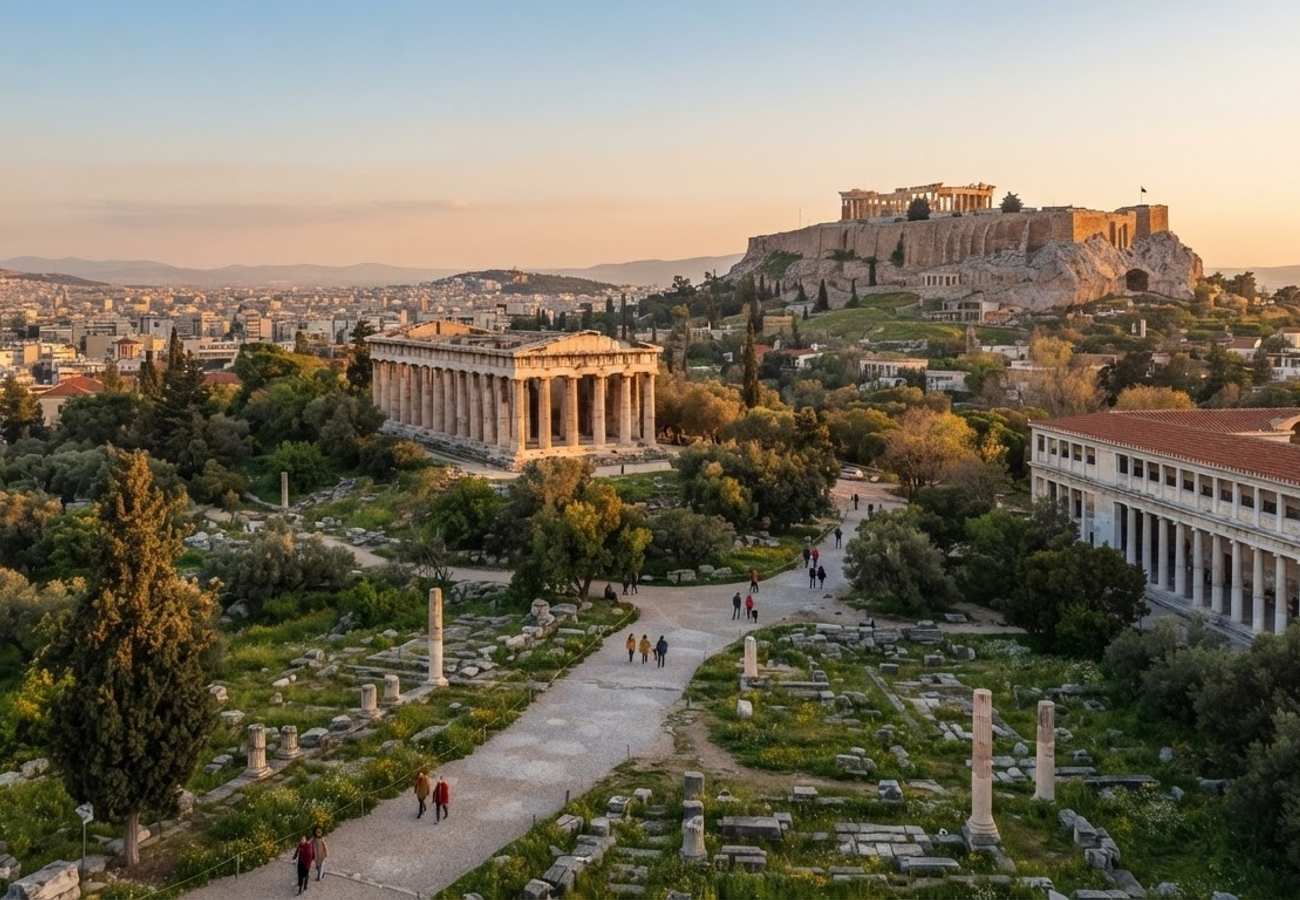
Image generated by AI
Athens' historic center is a dense layering of millennia, where the modern commute of metro riders intersects with the ruins of classical democracy. For those navigating the city in 2026, the trek from Monastiraki through the Ancient Agora to Thissio remains the most effective way to experience the civic heart of the city without the frustration of repetitive paths or midday heat exhaustion.
Strategic Planning for the Agora Circuit
The Ancient Agora is positioned strategically between the Monastiraki and Thissio metro stations, situated just northwest of the Acropolis. To maximize efficiency, visitors should adopt a linear flow: enter via the northeast gate on Adrianou Street, ascend toward the Temple of Hephaestus, and exit near Thissio. This trajectory follows the site's natural incline, ensuring that the most strenuous uphill walking is completed first.
For those planning a comprehensive visit to the city's archaeological landmarks, the combined 5-day ticket is the most economical choice. In the 2026 high season, this pass costs approximately 30 euros. This single ticket provides access to a wide array of sites, including:
| Included Site | Access Type |
|---|---|
| Acropolis | Included |
| Ancient Agora | Included |
| Roman Agora | Included |
| Hadrian’s Library | Included |
| Temple of Olympian Zeus | Included |
| Kerameikos | Included |
| Aristotle’s Lyceum | Included |
Given the physical demand of these sites, industry observers suggest splitting the itinerary: visiting the Acropolis during the early morning hours and reserving the Ancient Agora for the late afternoon. Single-entry tickets for the Agora are generally priced at slightly more than half the cost of the combined pass, making the bundle a logical choice for anyone visiting three or more locations.
Operational hours for both the Agora and the Museum of the Ancient Agora (located within the Stoa of Attalos) typically span from 08:00 to 19:30 during peak season. However, these times are subject to change based on the lunar calendar and public holidays. To avoid the most intense Mediterranean heat—particularly in July and August—arrivals before 09:00 or after 16:30 are highly recommended.
Navigating Monastiraki and the Initial Approach
Monastiraki serves as the primary gateway for most visitors, as it is accessible via metro lines 1 and 3. Upon exiting the station into Monastiraki Square, the Acropolis dominates the skyline to the south, while the lush, low-lying expanse of the Ancient Agora sits to the left. While the square is a high-energy hub of street vendors and souvenir stalls, it provides essential infrastructure, including ATMs and restrooms, within a 100-meter radius of the exit.
A useful tactic for orienting oneself is to start at a rooftop cafe overlooking the square. From this vantage point, the geographical relationship between the Acropolis, the Agora ruins, and the distant Temple of Hephaestus becomes clear. This brief pause also allows the initial morning rush at the ticket offices to subside.
From the square, the route proceeds west along Adrianou Street. This path runs parallel to the ancient Panathenaic Way, allowing visitors to view the ruins through the perimeter fencing before officially entering. After a 5-to-7-minute walk past local boutiques specializing in linen and leather, the northeast gate of the Agora appears on the left, marked by turnstiles and a ticket booth.
Exploring the Panathenaic Way
Entering through the Adrianou gate places the visitor directly onto the Panathenaic Way, the historic processional route that once linked the Dipylon Gate of the Kerameikos cemetery to the Acropolis. The modern path is a wide, gravel track that curves gently upward.
To avoid backtracking, the most efficient route is to follow this main spine toward the Temple of Hephaestus first, then loop back toward the eastern side to visit the Stoa of Attalos. As you move inward, the transition from the noisy commercial district to the park-like serenity of the Agora is immediate. To the right, the colonnades of the Stoa of Attalos provide a promising shaded refuge for later in the journey.
For those documenting the trip, the first 100 meters offer a prime photographic opportunity. By framing the low-lying ruins against the backdrop of the Acropolis, photographers can capture the scale of the civic center. During the "golden hour" of late afternoon, the long shadows cast by the remaining columns add significant depth to these compositions.
The Temple of Hephaestus and Panoramic Vistas
The Temple of Hephaestus, or the Hephaisteion, stands as one of the most impeccably preserved Doric temples in the Greek world. Located on a low hill at the northwest edge of the site, it serves as both an architectural marvel and a premier observation point.
Rather than focusing solely on the front facade, visitors should complete a full circuit of the fenced perimeter. The western and southern sides offer clean views of the fluted columns and metopes against the urban sprawl of Athens. The eastern side provides a dramatic composition, positioning the temple above the Agora ruins with the Acropolis rising in the background.
This hilltop is also a critical point for panoramic views. Looking southeast, the Parthenon and the Propylaea are clearly visible, while the Areopagus and Philopappos Hill are visible to the south. Because this area is exposed to the elements, it is the ideal time to apply sunscreen or hydrate before descending toward the shaded sections of the site.
Why This Matters: The Traveler's Perspective
For the modern visitor, the Ancient Agora is more than a collection of stones; it is a lesson in urban planning and endurance. From a logistical standpoint, the decision to start at Monastiraki and end at Thissio isn't just about convenience—it's about energy management. In the Athenian summer, the difference between a 12:00 PM visit and a 4:30 PM visit is the difference between physical exhaustion and a pleasant stroll.
Furthermore, using the combined ticket transforms the experience from a series of isolated stops into a coherent historical narrative. By linking the Agora with the Acropolis and Kerameikos, the traveler moves from the heights of religious power to the center of political discourse and finally to the city's ancestral burial grounds. This sequence provides a psychological and historical "Information Gain" that a random visit to a single site cannot offer.
A strategic approach to the Agora turns a potentially grueling walk into a seamless journey through the cradle of Western civilization.
Related Travel Guides
Disclaimer
This article is for informational and educational purposes only. It does not constitute legal, financial, or professional advice. While we strive to provide accurate and up-to-date information, travel policies, regulations, and conditions change rapidly. Always verify information with official sources before making travel decisions. Nomad Lawyer makes no representations about the accuracy, reliability, completeness, or suitability of the information provided. Readers should consult qualified professionals for advice specific to their circumstances. The views expressed in this article are those of the author and do not necessarily reflect the views of Nomad Lawyer.
Preeti Gunjan
Contributor & Community Manager
A passionate traveller and community builder. Preeti helps grow the Nomad Lawyer community, fostering engagement and bringing the reader experience to life.
Learn more about our team →