
American Airlines QR Code Customer Service Model Collapses During Massive Washington DC Travel Chaos, Grounding Thousands
Breaking airline news: Severe thunderstorms and crippling flight cancellations at Washington DCA completely overwhelmed American Airlines' digital-first QR code customer service model, triggering massive travel chaos.

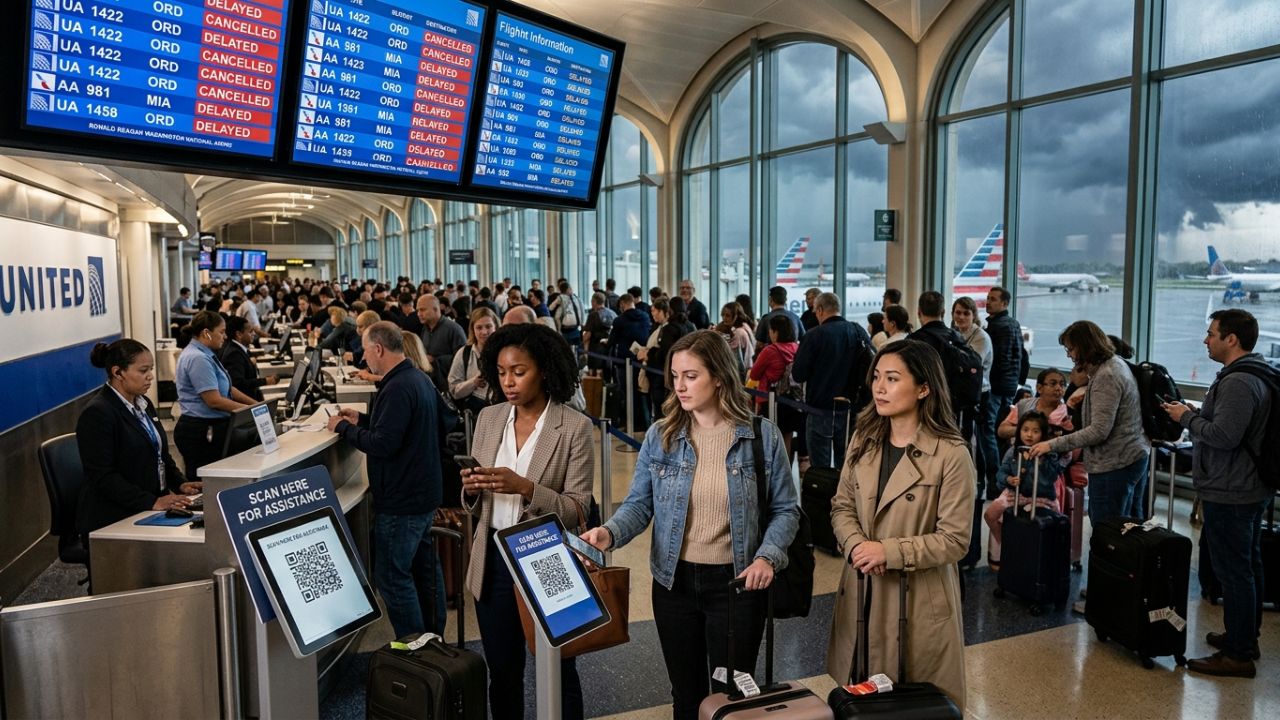
Image representing the severe operational breakdown at Ronald Reagan Washington National Airport (DCA), where massive flight cancellations overwhelmed American Airlines' highly automated, QR-code-based customer service system, generating intense travel chaos. (Image Credit: Aviation Tracking Network)
American Airlines QR Code Customer Service Model Collapses During Massive Washington DC Travel Chaos, Grounding Thousands
Severe Mid-Atlantic Storms Expose the Critical Flaws of Digital-Only Airline Support Systems
The rapid automation of the United States commercial aviation sector has just suffered a catastrophic, highly visible failure in the nation's capital. According to the latest breaking airline news and critical aviation updates, American Airlines is currently facing intense industry-wide criticism after severe Mid-Atlantic thunderstorms triggered absolute travel chaos at Ronald Reagan Washington National Airport (DCA). The severe weather event, compounded by incredibly restrictive FAA air traffic flow controls, completely exposed deep, systemic vulnerabilities in the airline's aggressively reduced in-person customer service model. By forcing thousands of panicked, stranded passengers to rely almost exclusively on automated, QR-code-based digital assistance systems during a massive wave of sudden flight cancellations, American Airlines effectively paralyzed its own operational recovery, proving that high-tech automation cannot replace human intervention during severe airport disruptions.
The crisis escalated violently as a cascading series of delays and cancellations devastated operations at DCA, which serves as a massive operational fortress hub for American Airlines on the East Coast. The sheer scale of the disruption—exacerbated by weather-related constraints spilling over from Dallas-Fort Worth—overwhelmed the airline's digital-first infrastructure. Stranded passengers were left scrambling in incredibly congested terminals, struggling to access functional rebooking tools via mobile applications while desperately seeking non-existent human assistance. This unprecedented breakdown raises profound, urgent questions regarding the long-term viability of extreme automation in commercial aviation, challenging whether current digital airline customer service structures are fundamentally incapable of managing large-scale operational disasters.
Section-Wise Breakdown: The Anatomy of an Automated Meltdown
The operational collapse at Washington DCA reveals the severe vulnerabilities of relying exclusively on digital support during a highly volatile weather crisis:
The Mid-Atlantic Storm Trigger The absolute catalyst for this nationwide disruption was a massive, fast-moving severe weather system that tore across the Mid-Atlantic region, instantly generating significant turbulence in airline scheduling matrices. Washington DC airports bore the absolute brunt of the operational strain. At Ronald Reagan Washington National Airport, the destruction to the schedule was staggering: approximately 34% of all scheduled flights were completely cancelled, while another 39% were severely delayed. This created a massive, immediate backlog of thousands of stranded passengers. The chaos violently extended to American Airlines’ regional partner, PSA Airlines, which was forced to cancel nearly a third of its entire regional operation. This specific failure instantly compounded connectivity issues, effectively severing vital feeder routes funneling passengers into major fortress hubs. The FAA was forced to deploy temporary air traffic slowdowns, generating a massive ripple effect that impacted schedules far beyond Washington DC, actively stretching into Dallas-Fort Worth and paralyzing the broader national network.
The QR Code System Collapse The central, undeniable failure highlighted by this massive disruption was American Airlines’ highly controversial shift away from fully staffed airport customer service counters. At DCA, passengers are now overwhelmingly directed toward digital QR codes, proprietary mobile applications, and automated phone-based support systems for emergency rebooking. During normal, clear-weather operations, this digital-first approach theoretically streamlines passenger flow. However, during a severe crisis, the system buckled. As thousands of desperate passengers simultaneously attempted to scan QR codes and refresh applications to rebook their cancelled flights, the automated infrastructure failed to provide the necessary triage. Staffed customer service counters at Washington National Airport are no longer consistently maintained for everyday disruption management, leaving highly stressed travelers completely dependent on self-service tools exactly when urgent, empathetic human assistance was critically required.
Airport Congestion and the Staffing Crisis As the delays relentlessly compounded, the complete lack of sufficient in-person support generated terrifying terminal congestion. Passengers experienced massive confusion over highly complex rebooking options, reporting extreme difficulty navigating the digital tools while battling spotty terminal Wi-Fi and missed connections. Desperate for answers, massive crowds formed at the few available departure gates, completely overwhelming the minimal gate agents stationed there. These isolated employees were suddenly forced to manage incredibly complex customer service disputes while simultaneously attempting to execute standard boarding procedures. This created a highly destructive feedback loop: operational efficiency plummeted as diverted staff attention directly caused further, completely avoidable delays in flight departures.
Flight Details: The Washington DCA Disruption Matrix
To provide exact, factual clarity on the immense scale of this logistical failure, aviation analysts have mapped the specific operational metrics reported during the Washington DC collapse. The following factual matrix details the precise breakdown of the disruption:
Factual Ronald Reagan Washington National (DCA) Operational Matrix
| Disruption Metric | Operational Detail / Carrier Impact |
|---|---|
| Primary Affected Airport | Ronald Reagan Washington National Airport (DCA) |
| Total DCA Flight Cancellations | Approximately 34% of scheduled flights cancelled |
| Total DCA Flight Delays | Approximately 39% of scheduled flights delayed |
| Primary Affected Airline | American Airlines |
| Regional Carrier Impact | PSA Airlines (Cancelled nearly one-third of regional operations) |
| Primary Cause of Disruption | Severe Mid-Atlantic thunderstorms & FAA flow restrictions |
| Cascading Network Impact | Systemic delays stretching into Dallas-Fort Worth |
Data accurately reflects the severe operational failures recorded at DCA. (Source: Aviation Tracking Network)
Passenger Impact: Trapped by Automation
For the traveling public, the collapse of American Airlines' customer service model at DCA was an absolute nightmare. When sudden flight cancellations strike, passengers expect immediate, clear guidance. Instead, travelers were met with generic QR codes and automated chat loops that offered zero actionable intelligence regarding their missed connections. The financial and psychological toll was immense: stranded passengers were unable to quickly secure alternative flights, leading to incredibly expensive, forced overnight stays in Washington DC. Because American Airlines' own customer service policy correctly states that they are generally not obligated to provide compensation for hotels or meals during severe weather events (as dictated by DOT guidelines), the inability to rapidly rebook via the digital tools cost travelers thousands of dollars in unrecoverable out-of-pocket expenses.
Industry Analysis: The Automation Divide
Aviation analysts closely monitoring the DCA meltdown emphasize that this crisis highlights a massive, growing philosophical divide among major US carriers. While American Airlines has aggressively leaned into automated systems, reducing the number of airport service agents per flight to lower overhead costs, their competitors have taken a different approach. During this exact same Mid-Atlantic storm system, United Airlines was heavily noted for maintaining comparatively stronger, highly visible access to live customer support agents. This hybrid service model utilized by United ensured far greater resilience during the disruption. The incident has definitively proven that while automation effectively manages routine standby lists and seating allocations, it is inherently incapable of handling the complex, highly emotional logistics of a massive, multi-hub operational breakdown.
Conclusion: The Limits of Digital-Only Aviation
The severe disruption at Ronald Reagan Washington National Airport serves as a highly visible, definitive case study exposing the extreme limits of digital-only airline service models. While severe Mid-Atlantic thunderstorms and rigid FAA air traffic controls initiated the crisis, it was American Airlines' heavy reliance on QR-code assistance and minimized ground staffing that ultimately transformed a manageable weather event into absolute travel chaos. As American Airlines and its regional partner PSA Airlines assess the damage from thousands of flight cancellations and severe airport disruptions, the industry must accept a critical operational reality: technology can significantly optimize daily efficiency, but during a massive logistical collapse, robust, in-person human assistance remains the absolute required standard for maintaining operational control and passenger trust. (Source: Aviation Tracking Network via Nomad Lawyer)
Key Takeaways
- Massive DCA Collapse: Severe weather and FAA restrictions triggered massive chaos at Ronald Reagan Washington National Airport (DCA), cancelling ~34% of flights and delaying ~39%.
- PSA Airlines Devastated: American Airlines' regional partner, PSA Airlines, was forced to cancel nearly a third of its entire regional operation.
- QR Code Failure: American Airlines' aggressively reduced in-person customer service model collapsed, leaving passengers heavily dependent on failing QR codes and mobile apps for rebooking.
- Gate Agent Overload: The lack of dedicated customer service desks forced desperate crowds to overwhelm boarding gate agents, creating a destructive feedback loop of further delays.
- The Industry Divide: Competitors like United Airlines successfully maintained access to live customer support agents during the exact same storm system, proving the value of hybrid service models.
✈️ Frequently Asked Questions (Factual Aviation & Disruption Data)
What specific airport served as the primary epicenter for this massive operational breakdown? The severe disruption and resulting travel chaos were heavily concentrated at Ronald Reagan Washington National Airport (DCA) in Washington DC.
Exactly what percentage of flights were cancelled and delayed at Washington DCA during this event? According to reported operational figures, approximately 34% of flights were cancelled at DCA, while approximately 39% of flights were severely delayed.
Which major airline and regional partner were most heavily criticized during this disruption? American Airlines faced massive criticism, while its regional partner, PSA Airlines, was forced to cancel nearly a third of its entire regional operation.
What specific technological system was blamed for failing passengers during the crisis? American Airlines' heavy reliance on a QR-code-based digital assistance system and mobile applications completely failed to handle the massive surge of panicked passengers requiring rebooking.
What were the primary environmental and regulatory causes of the initial flight delays? The initial disruption was triggered by a highly destructive combination of severe Mid-Atlantic thunderstorms, strict FAA air traffic flow restrictions, and weather-related constraints spilling over from Dallas-Fort Worth.
Did other major US airlines utilize a different customer service approach during this exact storm? Yes. While American Airlines leaned heavily on digital systems, competitors like United Airlines were specifically noted for maintaining comparatively stronger access to live, in-person customer support agents.
Under DOT and FAA guidelines, are airlines required to pay for hotels during weather disruptions? No. In cases involving severe weather, airlines are generally not obligated to provide compensation for accommodation or additional expenses, though they are strictly required to rebook passengers on the next available flight.
How did the lack of customer service desks negatively impact the actual departure of remaining flights? The lack of dedicated service desks forced massive crowds to seek assistance directly from gate agents, forcing them to manage rebooking and boarding simultaneously, which severely reduced operational efficiency and caused further flight delays.
🌍 Related Travel Guides & Flight Resources
- Navigate Airport Disruptions Like a Pro Master the art of surviving unexpected travel chaos with our expert strategies.
- Breaking Airline News & Evasion Routes Stay ahead of the delays with our real-time aviation updates and route intelligence.
- Global Flight Cancellation Defense Grid Essential legal rights and compensation tactics when your flight goes down.
⚖️ Disclaimer
The flight cancellation statistics, delay metrics, and airline operational overviews provided in this report are for informational purposes only. The specific aviation variables regarding the operational meltdown at Ronald Reagan Washington National Airport (DCA)—including the exact cancellation percentages (~34%) for American Airlines, the regional impact on PSA Airlines, and the efficiency of QR-code-based customer service systems—are subject to ongoing review by corporate airline dispatchers and the Federal Aviation Administration (FAA). All data regarding the Mid-Atlantic thunderstorms and resulting scheduling backlogs has been officially sourced from aviation tracking networks as of June 15, 2026. NomadLawyer does not guarantee the absolute accuracy or current validity of the information provided and assumes no liability for sudden schedule changes, rolling domestic delays, agonizing missed connections, or any financial consequences resulting from the use of this content. Passengers are strongly advised to utilize a combination of digital applications and live agent support when navigating severe weather disruptions.
Disclaimer
This article is for informational and educational purposes only. It does not constitute legal, financial, or professional advice. While we strive to provide accurate and up-to-date information, travel policies, regulations, and conditions change rapidly. Always verify information with official sources before making travel decisions. Nomad Lawyer makes no representations about the accuracy, reliability, completeness, or suitability of the information provided. Readers should consult qualified professionals for advice specific to their circumstances. The views expressed in this article are those of the author and do not necessarily reflect the views of Nomad Lawyer.
Kunal K Choudhary
Co-Founder & Contributor
A passionate traveller and tech enthusiast. Kunal contributes to the vision and growth of Nomad Lawyer, bringing fresh perspectives and driving the community forward.
Learn more about our team →