
Airbus A380's Unconventional Cockpit Design: Engineering Innovation Behind the World's Largest Airliner
Breaking airline news and aviation industry updates for 2026.

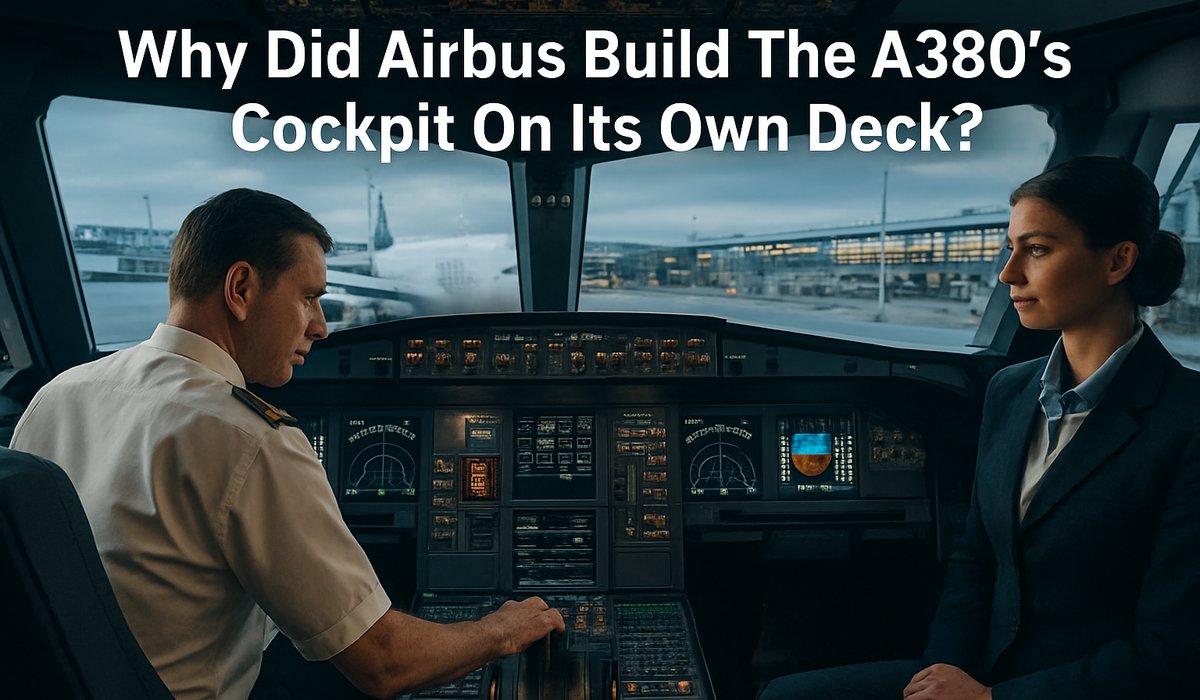
Image generated by AI
Airbus A380's Unconventional Cockpit Design: Engineering Innovation Behind the World's Largest Airliner
How spatial constraints and passenger capacity ambitions led to a revolutionary flight deck configuration
The Double-Deck Revolution
When the Airbus A380 made its commercial debut with Singapore Airlines on October 25, 2007, it fundamentally transformed global aviation. As the world's largest passenger aircraft, capable of accommodating over 850 passengers in a single fuselage, the superjumbo jet didn't just expand seating capacity—it demanded a complete reimagining of traditional aircraft architecture.
The A380's full double-deck configuration presented unprecedented engineering challenges. Rather than situating the flight deck atop the upper passenger level, as conventional aircraft design dictated, Airbus engineers opted for a distinctly unconventional solution: positioning the cockpit on its own intermediate deck, nestled between the main lower cabin and the upper passenger section.
Why a Separate Flight Deck Made Sense
This architectural decision wasn't arbitrary. Airbus engineers faced competing demands when designing the world's largest commercial airliner. The upper deck needed maximum space for premium seating, while the lower deck required optimal configuration for economy passengers. Placing the traditional overhead cockpit would have consumed valuable upper-deck real estate—a costly compromise that would have reduced revenue-generating seating.
By carving out an independent intermediate level for flight operations, designers solved a critical spatial puzzle. The cockpit occupies minimal footprint while maintaining full visibility and accessibility for pilots. This approach preserved the A380's remarkable passenger capacity while ensuring the flight deck met all operational and safety requirements.
Engineering Excellence in Aviation
The decision reflects the broader innovation that defined the A380's development. Engineers had to balance competing priorities: maximizing seating configurations, maintaining structural integrity across two passenger decks, ensuring adequate cockpit functionality, and adhering to strict aviation safety protocols.
The intermediate cockpit design also simplified maintenance access and reduced complexity in the upper-deck structural layout. Airbus's solution demonstrates how necessity drives innovation in aviation engineering—sometimes the most elegant solutions emerge when designers challenge conventional thinking.
Since its introduction, the A380 has remained a testament to what's possible when engineering ambition meets commercial need. Though production ended in 2021, the aircraft's groundbreaking design continues influencing how manufacturers approach large-capacity aircraft development.
FAQ: Understanding the A380's Unique Cockpit Design
Q: Where exactly is the A380 cockpit located compared to other large aircraft? A: The A380 features its cockpit on a separate intermediate deck positioned between the lower main cabin and upper passenger deck, rather than atop the fuselage like traditional aircraft.
Q: How does the intermediate cockpit design affect pilot visibility and operations? A: The positioning maintains full visibility and operational capability while maximizing passenger seating in premium upper-deck areas—a critical design compromise that doesn't compromise safety.
Q: What was Airbus's primary motivation for this unconventional cockpit placement? A: Space optimization. Placing the cockpit on the upper deck would have sacrificed valuable revenue-generating seating on an aircraft designed to carry 850+ passengers efficiently.
Q: Did the intermediate cockpit design influence future aircraft development? A: Yes, the A380's engineering solutions have influenced how manufacturers approach large-capacity aircraft architecture, though few have adopted identical configurations.
Q: Is the A380 still in operation despite production ending? A: Absolutely. Airlines continue operating A380s extensively on high-capacity international routes, with many aircraft expected to remain in service for decades.
Related Travel Guides
Flight Delay Compensation Guide 2026
Understanding Airline Route Changes
Airport Security Process Updated (2026)
External Resources
Disclaimer
This article is for informational and educational purposes only. It does not constitute legal, financial, or professional advice. While we strive to provide accurate and up-to-date information, travel policies, regulations, and conditions change rapidly. Always verify information with official sources before making travel decisions. Nomad Lawyer makes no representations about the accuracy, reliability, completeness, or suitability of the information provided. Readers should consult qualified professionals for advice specific to their circumstances. The views expressed in this article are those of the author and do not necessarily reflect the views of Nomad Lawyer.
Kunal K Choudhary
Co-Founder & Contributor
A passionate traveller and tech enthusiast. Kunal contributes to the vision and growth of Nomad Lawyer, bringing fresh perspectives and driving the community forward.
Learn more about our team →