
Western Sydney International Airport 24-Hour Operations to Redraw Global Flight Routes in 2026
Western Sydney International Airport will launch 24-hour, curfew-free operations in late 2026, enabling new long-haul connections and boosting cargo capacity for the Asia-Pacific region.

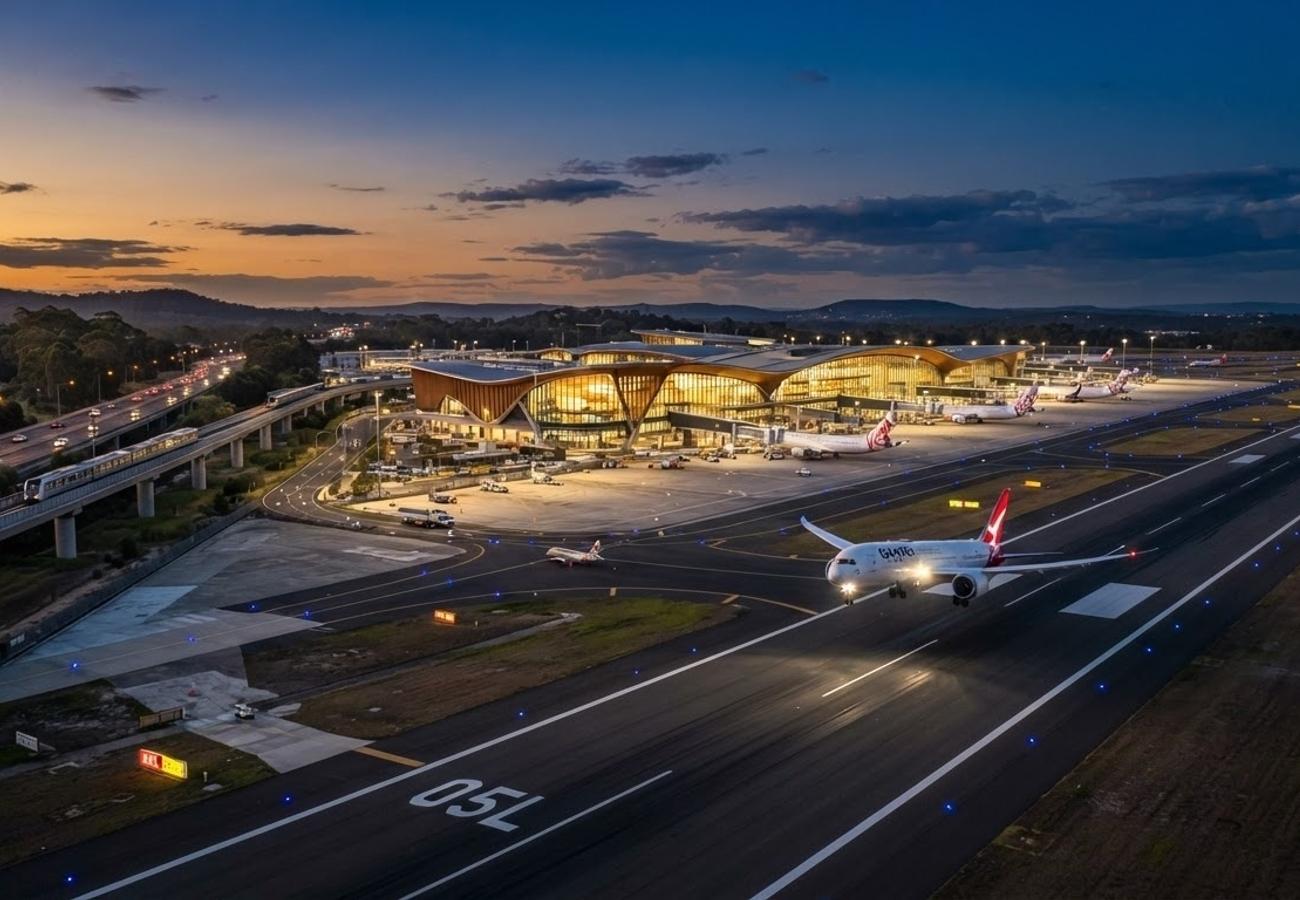
Image generated by AI
Australia’s aviation landscape is shifting westward as the Nancy-Bird Walton (Western Sydney International) Airport prepares for 24-hour, curfew-free operations starting in late 2026.
The development at Badgerys Creek, located approximately 40 kilometres west of Sydney's central business district, aims to eliminate the restrictive night-time curfews that currently limit operations at Sydney Kingsford Smith Airport. This operational flexibility is expected to fundamentally alter passenger flow and cargo logistics across the Asia-Pacific region.
Operational Timeline and Infrastructure
The airport will roll out its services in two primary phases during 2026. Cargo operations are scheduled to commence in July 2026, followed by the first passenger flights on 25 October 2026.
The facility is designed as a single-runway operation in its first phase, with a master plan that envisions expansion into a multi-runway hub as demand increases toward the 2040s. To support this volume, the government has integrated the airport with the new M12 motorway and a dedicated metro rail line currently under construction.
Strategic Shift in Long-Haul Connectivity
The absence of a curfew is the primary driver for international carriers. By utilizing round-the-clock slots, airlines can now schedule departures and arrivals that were previously impossible.
- Singapore Airlines: Confirmed daily service starting November 2026. The carrier will utilize near-midnight departures to align with its broader network in Asia and Europe.
- Middle Eastern Carriers: New capacity has been negotiated for operators from Qatar and the United Arab Emirates.
- Network Efficiency: The 24-hour model allows for later evening departures to Europe and earlier morning arrivals from North America and Asia, reducing the need for overnight hotel stays for connecting passengers.
Domestic and Regional Network Reorientation
While the global gateway is the primary focus, domestic growth will provide the initial foundation.
- Jetstar: Will operate the first commercial passenger flight on 25 October 2026, with initial routes to Melbourne, Brisbane, and the Gold Coast.
- Qantas Group: Qantas-branded services will follow the Jetstar launch to supplement the network.
- Other Early Adopters: Air New Zealand and Singapore Airlines are confirmed as early participants in the Western Sydney market.
From a logistical perspective, this shift redistributes traffic away from the congested Kingsford Smith precinct, offering regional New South Wales passengers a more direct route that avoids peak-hour city congestion.
24-Hour Cargo and the "Aerotropolis" Concept
The airport is positioned as a critical logistics hub for eastern Australia. The integrated cargo precinct, opening in late July 2026, will see Qantas Freight among its first operators.
The ability to move freight at any hour is vital for time-sensitive industries, including pharmaceuticals and fresh produce. This infrastructure supports the "aerotropolis" vision—a cluster of advanced manufacturing, agribusiness, and technology firms designed to leverage just-in-time production and high-frequency e-commerce networks.
Operational Data Summary
| Milestone | Date | Primary Focus |
|---|---|---|
| Cargo Services Launch | July 2026 | Qantas Freight & Logistics |
| First Passenger Flight | 25 October 2026 | Jetstar (Domestic) |
| Singapore Airlines Launch | November 2026 | Long-haul International |
| Full Phase 1 Operation | Late 2026 | 24-Hour Curfew-Free |
Why This Matters
For travelers and logistics managers, the real impact is the removal of the "curfew bottleneck." At Kingsford Smith, the night-time curfew forces airlines to schedule flights in tight windows, often leading to congestion and limited slot availability.
Our analysis of the route map suggests that Western Sydney International will act as a pressure valve. For the passenger, this means more competitive fares due to increased slot availability and the potential for "same-day" long-haul connections. For the industry, it represents a shift toward a decentralized aviation model in Sydney, where cargo and long-haul transit are decoupled from the inner-city constraints.
Industry Outlook
The success of the Nancy-Bird Walton airport depends on the seamless integration of the M12 motorway and metro rail. If surface transport keeps pace with flight frequency, we expect a significant migration of "banked" connection waves—where multiple flights arrive and depart in clusters—from the east to the west.
Furthermore, the curfew-free status makes this a prime testing ground for new international entrants who previously found Sydney's restrictive hours a barrier to entry. Expect increased frequency from Gulf carriers as bilateral agreements are finalized.
A new era of round-the-clock connectivity is arriving in Sydney.
Related Travel Guides
Disclaimer
This article is for informational and educational purposes only. It does not constitute legal, financial, or professional advice. While we strive to provide accurate and up-to-date information, travel policies, regulations, and conditions change rapidly. Always verify information with official sources before making travel decisions. Nomad Lawyer makes no representations about the accuracy, reliability, completeness, or suitability of the information provided. Readers should consult qualified professionals for advice specific to their circumstances. The views expressed in this article are those of the author and do not necessarily reflect the views of Nomad Lawyer.
Kunal K Choudhary
Co-Founder & Contributor
A passionate traveller and tech enthusiast. Kunal contributes to the vision and growth of Nomad Lawyer, bringing fresh perspectives and driving the community forward.
Learn more about our team →