
Aviation Updates: Virgin Atlantic Celebrates 42 Years, Deploying Starlink Wi-Fi to Shield Passengers from Long-Haul Travel Chaos
From its legendary 1984 Gatwick-Newark flight to its massive Starlink digital rollout, Virgin Atlantic marks 42 years of disrupting global legacy carrier monopolies.

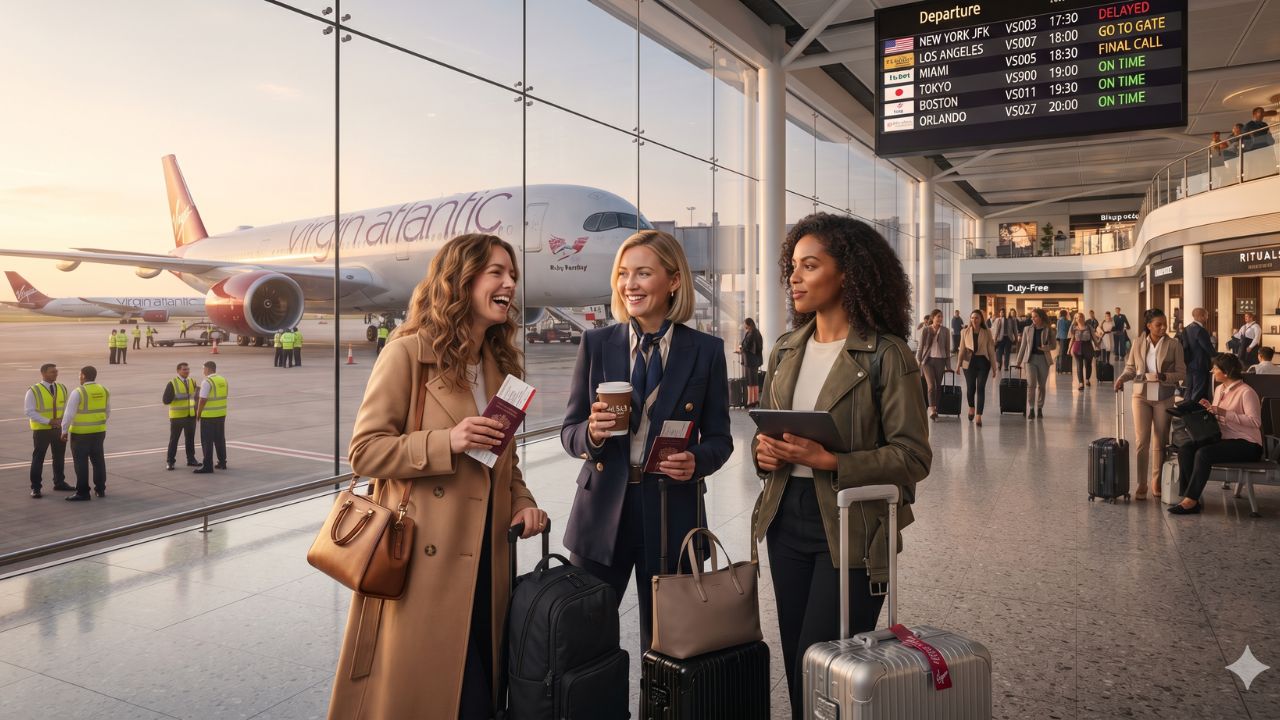
Image generated by AI
Aviation Updates: Virgin Atlantic Celebrates 42 Years, Deploying Starlink Wi-Fi to Shield Passengers from Long-Haul Travel Chaos
As legacy carriers struggle under the crushing weight of systemic operational failures, Virgin Atlantic marks 42 years of fiercely disrupting the transatlantic market, aggressively deploying Starlink connectivity to heavily insulate premium passengers from the psychological toll of international transit delays.
Image generated by AI
As urgent airline news platforms and critical aviation updates continuously document the massive waves of systemic airport disruptions suffocating major international transit hubs, Virgin Atlantic is officially marking an incredibly historic milestone. The iconic UK carrier is celebrating exactly 42 years since its legendary first commercial flight aggressively launched from Sussex, a highly disruptive moment that permanently reshaped the rigid structure of competitive long-haul aviation. Operating from its strategic base in Crawley, West Sussex, the airline officially commenced operations in 1984 with a ruthless focus on shattering established flag carrier monopolies. Over four decades, Virgin Atlantic has completely transformed from a single-route challenger into a massive global aviation brand. Today, as passengers worldwide battle the agonizing realities of massive flight cancellations and severe regional travel chaos, the airline is aggressively deploying high-speed Starlink satellite internet and cutting-edge digital streaming platforms, proving that highly focused customer innovation remains the absolute ultimate defense against the miseries of modern intercontinental transit.
Expanded Overview: Shattering the Transatlantic Monopoly
When analyzing the massive structural evolution of modern air travel, Virgin Atlantic’s violent entry into the long-haul market represents a brilliant strategic disruption.
Before 1984, transatlantic travel was entirely dominated by deeply entrenched legacy airlines operating with zero incentive to innovate or lower exorbitant fares. Virgin Atlantic entered the heavily regulated aviation industry with a singular, disruptive model explicitly aimed at challenging these established carriers directly on their most lucrative long-haul routes. The airline’s relentless focus on elevating the premium passenger experience instantly set it apart in an incredibly brutal sector. This intense dedication forced the entire industry to rapidly accelerate innovation in onboard service, global route connectivity, and premium economy concepts—features that eventually became absolute mandatory standards across the global sector.
Section-Wise Breakdown: The Sussex Foundation
The foundation of this massive global network was firmly built utilizing a highly calculated, single-aircraft launch strategy.
On 22 June 1984, the airline officially operated its very first passenger service, taking off from London Gatwick Airport and touching down in Newark in the United States. This inaugural flight marked the absolute beginning of its massive long-haul expansion strategy. The very first service utilized a leased Boeing 747-200, an aircraft previously operated by another international airline. Securing this massive airframe enabled the nascent carrier to instantly enter the transatlantic market and forcefully compete on one of the absolute busiest, most highly contested aviation corridors in the world.
Section-Wise Breakdown: The Massive Global Expansion
Following its historic Gatwick-Newark launch, the carrier aggressively exploded out of its UK hubs to capture massive global market share.
In late 1984, the airline rapidly executed an early European diversification strategy, introducing a highly strategic short-haul service between Gatwick and Maastricht in the Netherlands. By 1986, the carrier had successfully expanded its fleet and launched a massive long-haul route directly connecting Gatwick with Miami. Over the following decades, the United States became the airline’s absolute most critical long-haul battleground, with incredibly dense routes launching to New York JFK, Los Angeles, Boston, and Orlando. Refusing to remain a purely transatlantic operator, the carrier eventually executed a massive Asia-Pacific expansion, launching highly lucrative long-haul services directly into Tokyo Narita, Japan, firmly cementing its status as a truly global aviation powerhouse.
Flight Details: Virgin Atlantic Expansion & Technology Matrix
The exact operational telemetry outlining this historic 42-year trajectory, detailing the specific inaugural metrics and massive digital upgrades, has been consolidated into the mandatory matrix below.
Virgin Atlantic Expansion & Technology Matrix
| Operational Milestone | Aviation Data |
|---|---|
| Operating Carrier | Virgin Atlantic |
| Inaugural Flight Date | 22 June 1984 |
| First Long-Haul Route | London Gatwick to Newark (USA) |
| Original Aircraft Fleet | Leased Boeing 747-200 |
| Corporate Headquarters | Crawley, West Sussex (UK) |
| Inflight Connectivity | Starlink satellite internet |
| Digital Entertainment | Sport 24 (6,000 hours of live sports) |
Passenger Impact: Mitigating the Trauma of Transit
For the modern passenger attempting to navigate the highly unpredictable post-pandemic aviation landscape, Virgin Atlantic’s massive digital transformation completely redefines the inflight experience.
Long-haul travel is frequently fraught with severe transit anxiety, missed connections, and the agonizing boredom associated with massive flight delays. To violently combat this, the airline has officially introduced a massive partnership with global sports broadcaster Sport 24, enabling flawless live sports streaming directly onboard its aircraft. The advanced inflight entertainment system now offers unprecedented access to more than 6,000 hours of live sports content through Sport 24 and Sport 24 Extra channels. Passengers can flawlessly stream major global events, including the highly anticipated FIFA World Cup 2026, directly on their personal devices, heavily insulating them from the psychological exhaustion of marathon intercontinental transit.
Industry Analysis: The Starlink Digital Revolution
Aviation technology strategists explicitly note that the deployment mechanics behind this digital rollout heavily solidify the carrier's competitive dominance.
The cutting-edge streaming service seamlessly operates through aircraft heavily equipped with high-speed satellite internet powered entirely by Starlink. This flawless connectivity allows highly stable in-flight streaming completely across the airline's longest routes. Access is deeply linked directly to the airline’s free loyalty program, enabling massive integration across its entire digital ecosystem. At present, approximately one-third of the airline’s massive fleet is officially equipped with this Starlink-powered connectivity. A highly aggressive phased rollout plan is currently underway, with absolute full fleet integration expected to be completed by the end of 2027, ensuring the carrier remains years ahead of its legacy competitors.
Conclusion: 42 Years of Relentless Disruption
Ultimately, Virgin Atlantic’s massive celebration of 42 years since its landmark first flight from Sussex highlights one of the most incredible corporate evolutions in global aviation history. From a single leased Boeing 747-200 aggressively challenging a deeply entrenched monopoly to a massive global network spanning across the United States, Europe, and Asia, the carrier has constantly redefined what passengers should expect from air travel. As the airline aggressively pushes forward with its massive Starlink digital rollout by 2027, it continues to flawlessly execute its original 1984 mission: violently disrupting the status quo, heavily elevating the passenger experience, and proving that continuous, high-speed innovation is the only way to successfully navigate the chaos of modern global mobility.
Key Takeaways
- Historic Anniversary: Virgin Atlantic is officially celebrating exactly 42 years since its highly disruptive inaugural passenger flight.
- Inaugural Route: The airline's legendary first service launched on 22 June 1984, flying a leased Boeing 747-200 from London Gatwick to Newark.
- Global Expansion: Over four decades, the airline aggressively expanded from its Sussex base to dominate routes into Miami, JFK, LA, Orlando, and Tokyo Narita.
- Digital Transformation: The carrier has partnered with Sport 24 to offer passengers over 6,000 hours of live sports streaming, including the FIFA World Cup 2026.
- Starlink Rollout: High-speed Starlink satellite internet currently powers one-third of the fleet, with massive 100% integration targeted for the end of 2027.
FAQ: Virgin Atlantic 42nd Anniversary
When did Virgin Atlantic operate its very first commercial flight? The highly disruptive UK carrier operated its absolute first passenger service on 22 June 1984.
What was the original route flown by Virgin Atlantic in 1984? The inaugural long-haul flight launched from London Gatwick Airport and touched down in Newark in the United States.
When will the airline complete its Starlink internet fleet integration? Virgin Atlantic is actively executing an aggressive phased rollout, with full Starlink satellite internet integration expected across the entire fleet by the end of 2027.
Related Travel Guides
LATAM Airlines SAF Charter Flights Travel Chaos 2026
VietJet Restores Kolkata Bangkok Flights Travel Chaos 2026
UK Transatlantic Passenger Rights Flight Delay Compensation Guide 2026
Disclaimer: This article is strictly for informational purposes. The aviation historical data, specific inaugural flight metrics (22 June 1984, Gatwick-Newark), aircraft specifications (Boeing 747-200), and projected digital integration timelines (Starlink full fleet rollout by 2027) are based on official corporate archives and current technology disclosures provided by Virgin Atlantic available at the time of publication. International airline network planning, specific digital streaming availability (Sport 24), and satellite Wi-Fi deployment schedules are highly dynamic and subject to continuous modification based on complex global supply chain constraints and software certification processes. Passengers must explicitly verify exact inflight connectivity features, specific digital entertainment availability, and routing timetables directly with Virgin Atlantic prior to booking long-haul international travel.
Disclaimer
This article is for informational and educational purposes only. It does not constitute legal, financial, or professional advice. While we strive to provide accurate and up-to-date information, travel policies, regulations, and conditions change rapidly. Always verify information with official sources before making travel decisions. Nomad Lawyer makes no representations about the accuracy, reliability, completeness, or suitability of the information provided. Readers should consult qualified professionals for advice specific to their circumstances. The views expressed in this article are those of the author and do not necessarily reflect the views of Nomad Lawyer.
Preeti Gunjan
Contributor & Community Manager
A passionate traveller and community builder. Preeti helps grow the Nomad Lawyer community, fostering engagement and bringing the reader experience to life.
Learn more about our team →