
USS America aircraft carrier sunk: Navy deliberately decommissions Cold War supercarrier
The U.S. Navy intentionally sank the USS America (CVA-66) supercarrier in 2026 after 47 years of Cold War service. This historic decommissioning marks the end of an era in naval warfare and raises questions about carrier retirement practices.

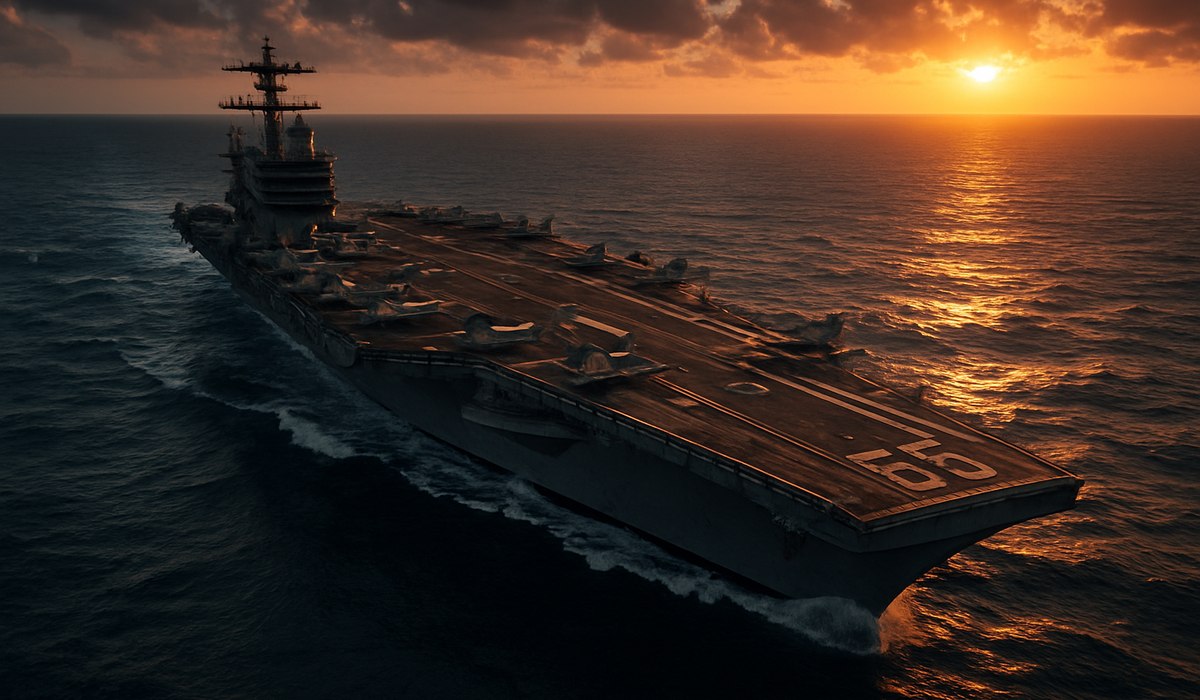
Image generated by AI
The U.S. Navy Deliberately Sank Its Own USS America Aircraft Carrier After Nearly Five Decades
In a striking conclusion to nearly half a century of service, the U.S. Navy intentionally sank the USS America (CVA-66) supercarrier in 2026, marking a significant milestone in Cold War naval history. The third vessel to bear the American name, this Kitty Hawk-class supercarrier was laid down on New Year's Day 1961, launched in 1964, and commissioned at Norfolk Naval Shipyard in January 1965. After 47 years of active service spanning multiple geopolitical crises and military operations, the Navy determined that deliberately sinking the historic vessel was the most strategic decommissioning method. This decision reveals important details about how the U.S. Navy manages aging supercarrier retirement and Cold War-era naval assets.
The USS America's Operational Legacy: From Mediterranean Deployments to Cold War Tensions
The USS America aircraft carrier sunk in 2026 had served through some of the most volatile decades in modern history. The supercarrier began its operational life in late 1965 with a Mediterranean deployment, where it participated in the Franco-American exercise "Fairgame IV." By April 1967, the vessel demonstrated its diplomatic importance when a military coup in Greece prompted the USS America to lead a carrier task force eastward, positioning itself to evacuate American citizens if necessary.
Just weeks later, tensions in the Middle East escalated dramatically as the Six-Day War approached. Nearly 30 international journalists boarded the USS America to document events, attracting the attention of Soviet naval forces. According to official Navy records, a Soviet destroyer repeatedly maneuvered through the carrier's formation, prompting Vice Admiral William I. Martin, Commander of the 6th Fleet, to formally protest these aggressive tactics.
When the Six-Day War erupted on June 6, 1967, the USS America's crew found themselves at the center of international controversy. During the conflict, the USS Liberty was attacked, and aircraft launched from the supercarrier responded to assist the damaged vessel. The Navy's medical team aboard the USS America worked around the clock treating wounded sailors and removing shrapnel. Throughout the crisis, the carrier maintained strict neutrality, as confirmed by the journalists aboard—directly contradicting Arab claims that American forces provided air cover for Israeli operations.
Key Moments: The USS America's Vietnam Service and Combat Operations
The USS America supercarrier transitioned to Pacific operations in April 1968, beginning the first of three deployments to Vietnam. Operating from "Yankee Station," the carrier's aircraft conducted 112 days of combat operations, striking roads, waterways, fuel storage areas, and bridges in sustained efforts to disrupt North Vietnamese logistics and supply lines. The carrier achieved its first MiG kill on July 10, 1968, establishing itself as a formidable combat platform.
Return deployments in 1970 and subsequent years continued the USS America's Vietnam operations until large-scale American involvement ended in 1973. The supercarrier subsequently spent much of the 1970s conducting peacetime operations and training missions. In 1986, following terrorist attacks in Europe that killed two American servicemen, the USS America was repositioned for Operation "Eldorado Canyon," launching strike aircraft in retaliatory operations against Libya. The vessel continued active service through the 1990 invasion of Kuwait, demonstrating its ongoing strategic value throughout the Cold War era and into the post-Cold War period.
Why the Navy Chose to Sink Its Own USS America Supercarrier
The decision to deliberately sink the USS America aircraft carrier rather than preserve or scrap it reflects evolving naval strategy and fiscal considerations. By 2026, the vessel had become obsolete compared to modern Nimitz-class and Gerald R. Ford-class supercarriers incorporating advanced systems and propulsion technologies. The Navy determined that maintaining the aging supercarrier was economically unsustainable, and traditional scrapping methods posed environmental and logistical challenges.
Controlled sinking allows the Navy to conduct final operational assessments, test damage mitigation procedures, and gather valuable data about supercarrier vulnerability and resilience. Additionally, intentional sinking eliminates the extended and expensive process of ship breaking, where hazardous materials and radioactive components require specialized handling. The USS America's deliberate decommissioning also serves as a practical exercise for naval personnel involved in vessel management and emergency response protocols.
Environmental considerations favored controlled sinking in designated deep-water locations over traditional scrapping, which generates significant hazardous waste. The Navy carefully selected sinking coordinates to avoid commercial shipping lanes and ensure proper environmental containment. This approach represents a shift in decommissioning strategy that future generations of aging supercarriers may follow as Cold War-era vessels reach obsolescence.
The Strategic Implications of Decommissioning America's Carriers
The sinking of the USS America aircraft carrier has broader implications for U.S. naval strategy and carrier fleet composition. The Navy maintains approximately 11 operational supercarriers at any given time, with additional vessels in construction or undergoing major refurbishment. Removing an aging Kitty Hawk-class supercarrier allows the service to redirect maintenance resources and personnel toward newer platforms featuring advanced electromagnetic catapult systems, enhanced radar capabilities, and integrated cyber-defense measures.
Modern supercarriers like the USS Gerald R. Ford (CVN-78) incorporate 40 years of technological advancement beyond the USS America's original 1960s design. The deliberate decommissioning underscores how Cold War-era naval platforms, while historically significant, no longer meet contemporary operational requirements in contested maritime environments. As China and Russia continue modernizing their naval forces, the U.S. Navy prioritizes newer, technologically superior platforms capable of maintaining American sea-control dominance.
The USS America's decommissioning also reflects changing geopolitical realities. The Cold War threats that defined the vessel's operational life—Soviet naval expansion and direct superpower naval confrontation—have evolved into more complex maritime competition scenarios. Modern adversaries employ advanced anti-ship missiles, submarine forces, and cyber capabilities that require different carrier design philosophies than Cold War-era supercarriers possessed.
Key Data Table: USS America Supercarrier Historical Overview
| Specification | Details |
|---|---|
| Hull Classification | CVA-66 (Attack Carrier); reclassified CV-66 (Multi-Purpose Carrier) |
| Class | Kitty Hawk-class supercarrier |
| Laid Down | January 1, 1961 (Newport News Shipbuilding) |
| Launched | February 23, 1964 |
| Commissioned | January 23, 1965 |
| Decommissioned | December 30, 1996 |
| Final Disposition | Intentionally sunk in 2026 |
| Years of Service | 47 years (1965-2026 including reserve periods) |
| Displacement | Approximately 60,000 tons |
| Length | 1,088 feet |
| Aircraft Capacity | 70+ aircraft at peak operations |
| Notable Deployments | Mediterranean (1965-1967); Vietnam (1968-1973); Middle East (1967-1991) |
| Combat Operations | Six-Day War response (1967); Vietnam operations; Operation Eldorado Canyon (1986); Operation Desert Storm support (1990-1991) |
| Crew Complement | Approximately 4,500 sailors (ship's company plus air wing) |
What This Means for Travelers
While the USS America's sinking primarily affects naval operations and military history enthusiasts, the decommissioning has secondary implications for travelers interested in military heritage and Cold War history:
- Naval Museum Access: Historians and Cold War researchers who wished to
Preeti Gunjan
Contributor & Community Manager
A passionate traveller and community builder. Preeti helps grow the Nomad Lawyer community, fostering engagement and bringing the reader experience to life.
Learn more about our team →