
Aviation Updates: Massive Nationwide US Travel Chaos Triggers 669 Flight Cancellations and 6,476 Delays as Thunderstorms Paralyze Major Networks
As incredibly severe thunderstorms violently suffocate US airspace, travelers are plunged into terrifying travel chaos following 669 cancellations and 6,476 delays paralyzing Delta, American, and Southwest networks.

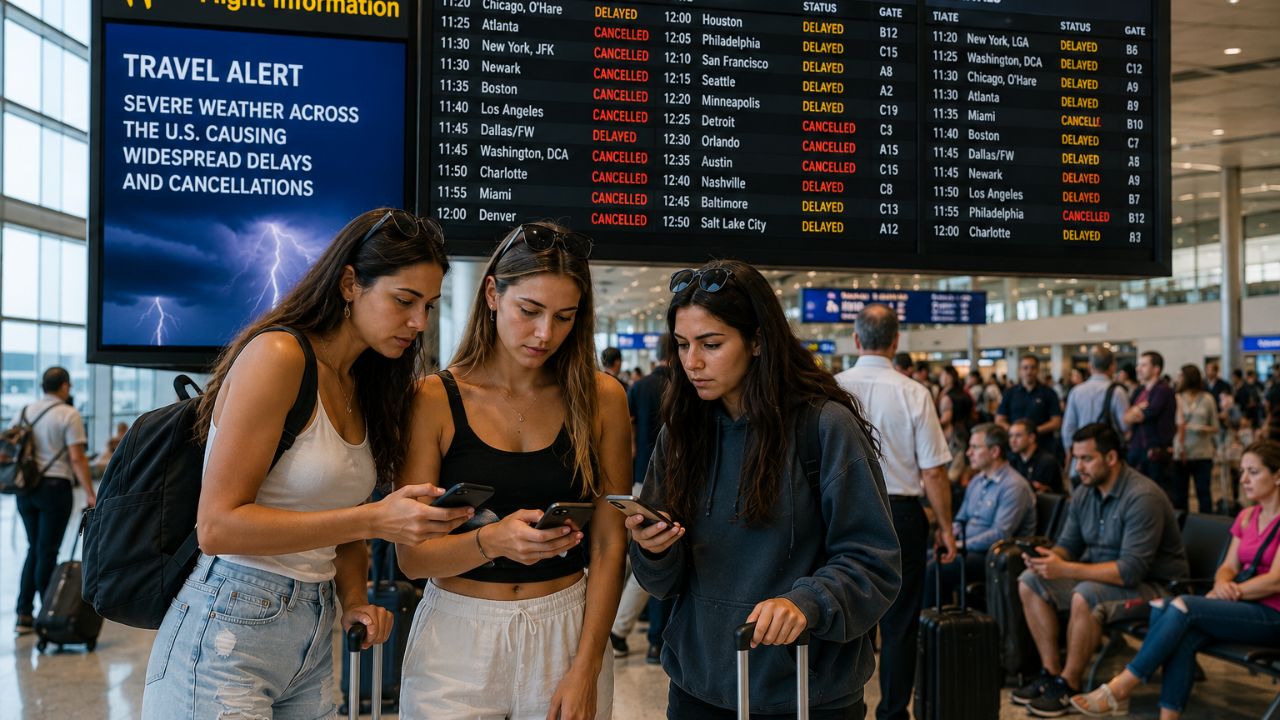
Image generated by AI
Aviation Updates: Massive Nationwide US Travel Chaos Triggers 669 Flight Cancellations and 6,476 Delays as Thunderstorms Paralyze Major Networks
As incredibly severe terminal gridlock and massive regional weather systems completely suffocate the primary aviation gateways of the United States, hundreds of thousands of deeply exhausted passengers are actively battling terrifying travel chaos following a catastrophic, system-wide meltdown that triggered 669 flight cancellations and 6,476 delays across major hubs from New York to Los Angeles.
While incredibly exhausted domestic and international passengers desperately navigate an incredibly brutal peak travel season defined by rolling flight cancellations and severe, localized airport disruptions, a massive, highly destructive wave of severe thunderstorms is actively paralyzing the absolute highest levels of the American commercial aviation network. According to the absolute latest breaking airline news and official operational metrics sourced directly from FlightAware, an absolute tidal wave of high-density airspace pressure is currently generating historic bottlenecks across the national system. Desperate to ensure that severe, unverified atmospheric limitations do not completely destroy the safety parameters of heavily congested airspace corridors, the Federal Aviation Administration has aggressively implemented massive ground stops and severe departure restrictions. At the time of reporting, real-time aviation trackers confirm that this massive weather event has completely shattered the operational schedules of Delta Air Lines, JetBlue, American Airlines, Southwest, and their regional feeder partners, plunging the Northeast, Midwest, South, and West Coast into an apocalyptic state of rolling delays.
This highly critical capacity collapse explicitly exposes the domestic aviation network not just as a vital transit feed, but as a heavily congested, deeply fragile capacity zone prone to sudden, catastrophic failure during convective weather events. By violently overwhelming ground handling crews, air traffic control sectors, and massive wide-body aircraft rotation schedules at critical hubs like Dallas-Fort Worth and LaGuardia, this systemic demand is directly driving massive travel chaos. Because traditional massive transit nodes frequently suffer from severe tarmac congestion leading to massive, unannounced communication breakdowns, this current ground stop protocol serves as an absolute warning. It completely bypasses the terrifying logistical nightmares of airborne holding patterns, representing a highly structural safety intervention that forces major carriers into a brutal, high-stakes battle of immediate schedule adjustment. The resulting gridlock strands millions of passengers in overcrowded terminals, explicitly demonstrating how rapidly local storm systems can completely destroy the national flight matrix.
Aviation Updates: The Nationwide System Collapse
This massive, highly structural shift in regional network stability perfectly illustrates the intense, incredibly fragile nature of modern domestic mobility.
According to highly detailed, official aviation updates, this strategic ground management is explicitly triggered by widespread thunderstorms forcing cascading operational strain. Across the national system, airlines and airports are experiencing a devastating 6,476 total delays and 669 total cancellations. The disruption is heavily concentrated across the Northeast corridor, where multiple massive airports are simultaneously affected by extreme weather. Air traffic controllers are actively implementing severe flow restrictions to maintain safety, which completely paralyzes the departure and arrival sequences. This massive consistency in airport disruptions prevents any unified transit recovery, instead generating a highly volatile, highly delayed environment where low visibility conditions—particularly reported at West Coast hubs like San Francisco—further compound the terrifying logistical nightmare for exhausted families and corporate commuters.
Section-Wise Breakdown: Navigating the Paralyzed Hubs
The sudden, massive evolution of these critical transit failures actively impacts several incredibly distinct, highly sensitive operational dynamics spanning multiple major aviation sectors.
The Northeast Corridor Gridlock
At the absolute core of this massive operational pivot is the severe congestion strangling the East Coast. The most severe operational pressure is concentrated across the Northeast corridor, heavily impacting the New York airspace. LaGuardia Airport (LGA) suffered a devastating 179 cancellations and 380 delays, while JFK reported 85 cancellations and 328 delays. Newark (EWR) absorbed 459 delays alongside 28 cancellations. Moving south, the Washington DC sector collapsed under heavy travel restrictions, with Washington National (DCA) registering 94 cancellations and 251 delays, supported by massive disruptions at Washington Dulles (IAD) and Baltimore (BWI). Boston Logan (BOS) and Philadelphia (PHL) also faced massive ground stops, creating layered congestion across one of the busiest airspace corridors in the world.
The Southern and Central Hub Collapse
While the Northeast absorbed the initial shockwaves, the Southern and Central massive connecting hubs completely failed to maintain network integrity. Dallas–Fort Worth International Airport (DFW) stands out as the most heavily delay-affected hub nationwide, absorbing a massive 743 delays and 66 cancellations. Atlanta (ATL) suffered 410 delays, while Charlotte (CLT) absorbed 311 delays. The cascading travel chaos also violently impacted Nashville (BNA), Austin (AUS), and Houston (IAH). The failure of these massive central gateways means that connecting passengers are aggressively stranded with virtually no options for immediate rebooking.
The West Coast and Midwest Spillage
The operational collapse refused to remain localized, rippling violently into the West and Midwest. Chicago O’Hare (ORD) reported 394 delays and 15 cancellations, while Denver (DEN) suffered 427 delays. The West Coast, battling its own localized low-ceiling conditions, saw San Francisco (SFO) report 339 delays and Los Angeles (LAX) report 240 delays. Seattle (SEA) and Minneapolis (MSP) also faced massive operational slowdowns, confirming that the entire national network is operating in a state of fragile, highly volatile recovery.
Flight Details and Verified Disruption Impact Matrices
To fully understand the exact structural parameters of this massive performance collapse and how airlines are desperately attempting to navigate complex airspace constraints, the following matrices explicitly detail the massive failures directly recorded by FlightAware.
Confirmed Major Hub Disruption Matrix
| Airport Hub | Total Cancellations | Total Delays |
|---|---|---|
| LaGuardia (LGA) | 179 | 380 |
| John F. Kennedy (JFK) | 85 | 328 |
| Newark Liberty (EWR) | 28 | 459 |
| Washington National (DCA) | 94 | 251 |
| Dallas–Fort Worth (DFW) | 66 | 743 |
| Atlanta (ATL) | 15 | 410 |
| Chicago O'Hare (ORD) | 15 | 394 |
| Denver (DEN) | 13 | 427 |
| San Francisco (SFO) | 7 | 339 |
Confirmed Airline Disruption Matrix
| Airline Carrier | Total Cancellations | Total Delays | Operational Impact |
|---|---|---|---|
| American Airlines | 93 | 994 | Highest combined disruption intensity |
| Southwest Airlines | 40 | 1,480 | Highest delay volume nationwide |
| Delta Air Lines | 10 | 561 | Severe connecting hub gridlock |
| United Airlines | 13 | 554 | Severe Midwest/Coastal delays |
| JetBlue | 62 | 262 | Severe Northeast corridor impact |
| Republic Airways | 119 | 278 | Severe regional feeder collapse |
| Endeavor Air | 98 | 222 | Severe regional feeder collapse |
| PSA Airlines | 80 | 177 | Severe regional feeder collapse |
Data explicitly reflects the massive, highly structural operational disruption currently paralyzing the US aviation network due to intense convective weather systems.
Passenger Impact: The Financial and Emotional Toll
For the highly demanding passengers actively engaged in this massive domestic mobility crisis, traditional, highly anticipated peak travel is currently viewed as a completely terrifying trap.
The immediate consequence of this massive weather event is measured in the hundreds of thousands of passengers violently displaced inside crowded terminals. Passengers facing these massive airport disruptions are explicitly advised to expect extended connection delays, especially through DFW, ATL, JFK, and ORD. Families are sleeping on terminal floors, losing massive amounts of non-refundable hotel deposits, and suffering intense anxiety as they endure rolling delays. The failure of regional carriers—like Republic and Endeavor—means smaller communities are completely cut off from the national network. Travelers must proactively monitor real-time updates via airline applications, allow massive additional airport processing times, and immediately attempt to rebook through alternate airports if they hope to escape the travel chaos.
Industry Analysis: The Economics of Systemic Network Fragility
Aviation structural analysts strictly point out that this massive, multi-national operational failure perfectly illustrates the extreme, highly vital importance of heavily optimized, resilient air traffic control flow management.
Aviation data explicitly indicates that massive carrier networks are absolutely desperate to secure rapid schedule recoveries following ground stops. The primary cause of this widespread flight cancellations event is the implementation of FAA safety spacing during thunderstorms. However, the disproportionate pressure placed on regional feeder carriers violently exposes how rapidly the hub-and-spoke model collapses. When regional airlines like PSA and SkyWest absorb massive cancellations, the primary hubs lose their outbound feed, triggering a complete logistical meltdown that can take airlines up to 72 hours to fully normalize.
Conclusion: A Highly Fragile Recovery Outlook
The massively evolving infrastructure dynamics directly defining the integration of severe weather into the US aviation network violently reflect a much broader, highly critical structural transformation currently dominating how American commercial aviation is physically managed in 2026.
Rather than violently forcing massive domestic traffic through deeply congested, delay-prone airspace during thunderstorms, the FAA prioritizes massive ground stops. As airlines aggressively prioritize rolling adjustments to recover their schedules, travelers actively navigating the incredibly busy sector must absolutely remain highly vigilant. To actively survive potential travel chaos this week, passengers must aggressively monitor all breaking aviation updates, contact airlines immediately during ground stop windows for re-accommodation, and perfectly understand that escaping modern airport disruptions fundamentally requires accepting that the entire national network is currently operating in a deeply fragile state of recovery.
Key Takeaways
- Massive System Failure: Widespread thunderstorms triggered 669 cancellations and 6,476 delays across the United States.
- Airlines Paralyzed: Southwest Airlines suffered a massive 1,480 delays, while American Airlines faced 93 cancellations and 994 delays.
- Regional Carriers Collapsed: Republic Airways and Endeavor Air were devastated by the gridlock, canceling 119 and 98 flights respectively.
- Epicenter of Chaos: The Northeast corridor (LGA, JFK, EWR) and major southern hubs (DFW, ATL) are the primary chokepoints of this disruption.
- Passenger Survival Strategy: Travelers are aggressively urged to strictly utilize airline applications for rapid rebooking, expect cascading connection delays, and prepare for massive travel chaos across all major hubs.
Related Travel Guides
Massive UAE Visa Bombshell: Strict New 30-Day Escape Window Announced
Travel Chaos Cripples Spain as Iberia and Ryanair Suffer 1,079 Delays
Disclaimer
This article is for informational and educational purposes only. It does not constitute legal, financial, or professional advice. While we strive to provide accurate and up-to-date information, travel policies, regulations, and conditions change rapidly. Always verify information with official sources before making travel decisions. Nomad Lawyer makes no representations about the accuracy, reliability, completeness, or suitability of the information provided. Readers should consult qualified professionals for advice specific to their circumstances. The views expressed in this article are those of the author and do not necessarily reflect the views of Nomad Lawyer.
Preeti Gunjan
Contributor & Community Manager
A passionate traveller and community builder. Preeti helps grow the Nomad Lawyer community, fostering engagement and bringing the reader experience to life.
Learn more about our team →