
Massive Travel Chaos Engulfs the US as Severe Storms Force 1,180 Flight Cancellations and 7,279 Delays, Stranding Passengers in Texas, Atlanta, and Los Angeles: Airline News
A devastating wave of travel chaos cripples the US aviation network, as severe storms and FAA ground stops trigger 1,180 flight cancellations and strand thousands nationwide.

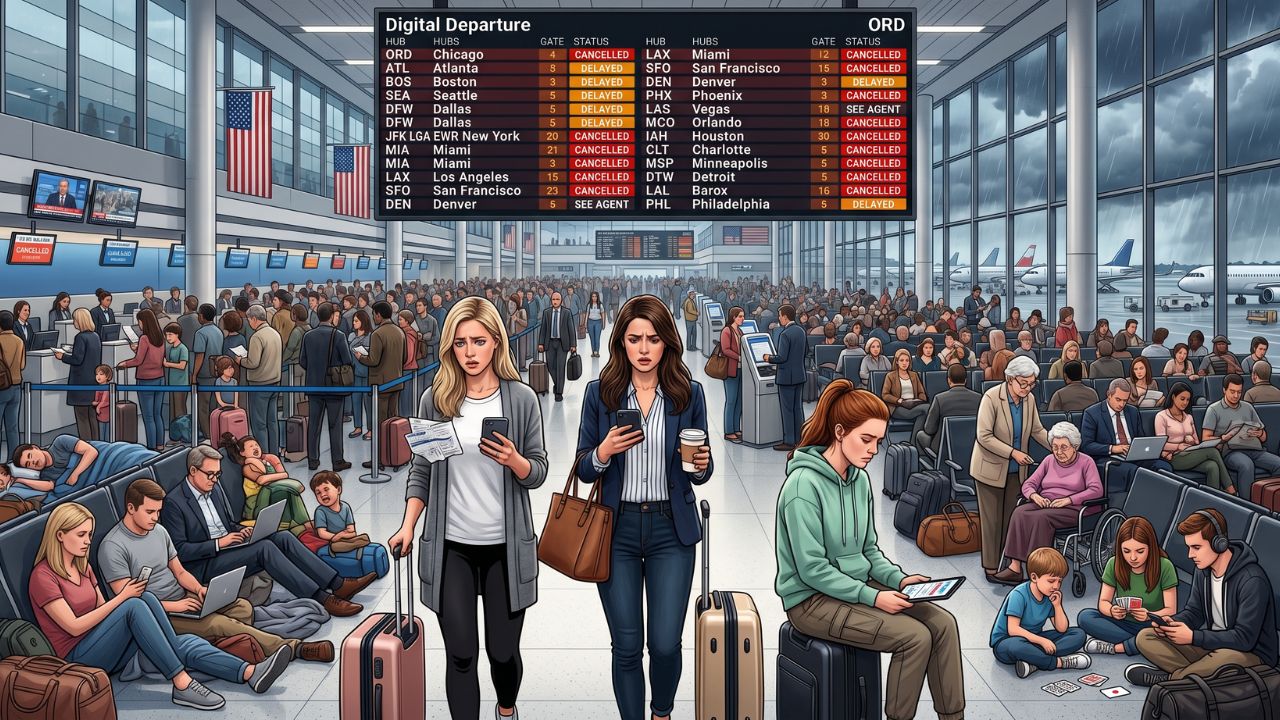
Image generated by AI
In a devastating breakdown of domestic aviation logistics, severe travel chaos has violently paralyzed operations across the entire United States, stranding thousands of passengers as severe weather rips through the continent. Reported on June 20, 2026, as exhausted travelers frantically monitor the latest airline news for any sign of recovery, the US network absorbed an overwhelming wave of operational bottlenecks. Recording a staggering 1,180 outright flight cancellations and an unbelievable 7,279 compounding delays, this massive wave of airport disruptions ruthlessly strangled vital connecting domestic routes. Grounding massive legacy fleets operated by Delta, American, Southwest, and United, alongside critical regional connectors like SkyWest and Envoy Air, the disruption epicenter violently struck Dallas-Fort Worth before rippling outward to Atlanta, Los Angeles, Las Vegas, Philadelphia, and Charlotte. Driven by brutal thunderstorms, heavy rain, freezing rain, and massive FAA ground stops, this nationwide operational collapse represents today's most crucial headline in breaking aviation updates and passenger survival strategy.
By introducing direct passenger coordination and dynamic scheduling backups, the regional aviation hubs target growing passenger demand across vital commerce sectors. The choice to coordinate flight departures in phases helps to manage gate capacity, supporting the country's broader regional transportation network.
Context: The Collapse of the US Domestic Grid
For the highly interconnected North American aviation grid, the massive disruption exposes the terrifying fragility of the national airspace when assaulted by severe, multi-state weather systems.
When 7,279 flights are delayed and 1,180 flights are canceled across core national gateways, the structural resilience of the travel sector is pushed past its absolute breaking point. The massive storm system—bringing a lethal combination of thunderstorms, freezing rain, and heavy snow—moved aggressively from the Southwest and central United States directly toward the Mid-Atlantic and Northeast. Because FAA traffic management initiatives and mandatory ground stops were activated at major hubs like Hartsfield-Jackson Atlanta and Dallas-Fort Worth, the cascading effect was instantaneous. Legacy carriers were forced to abandon their schedules, leaving tens of thousands of passengers trapped inside terminals across Denver, Boston, Austin, and San Antonio. The sheer density of this weather event proved that no airline—from ultra-low-cost carriers like Allegiant to mainline giants like American Airlines—could escape the widespread logistical destruction.
To view live flight schedules, verify the active departure status of your specific US itinerary, or to track potential route restorations prior to heading to the airport, travelers must consult official aviation directories. For direct updates regarding how these massive operational failures might impact your current flight cancellations out of Dallas or Atlanta, travelers should aggressively utilize the official digital portals of their respective airlines. To explore live flight tracking and monitor the exact severity of the cascading bottlenecks paralyzing the broader North American airspace, passengers can consult the official FlightAware tracking service.
Section-Wise Breakdown: Dissecting the Network Collapse
The Texas Epicenter: DFW, Dallas Love, and Austin
Texas absorbed the absolute heaviest damage during this nationwide collapse. Dallas-Fort Worth International Airport (DFW) emerged as the primary disruption center, recording a massive 871 delays and 612 cancellations as violent storms and FAA ground stops shut down the tarmac. Nearby, Dallas Love Field saw 65 cancellations and 224 delays, largely crippling Southwest Airlines' regional grid. Further south, Austin-Bergstrom International Airport registered 254 delays and 42 cancellations, while San Antonio International Airport reported 101 delays and 17 cancellations, effectively paralyzing the entire Texas triangle.
The Eastern Hubs: Atlanta, Charlotte, and Philadelphia
The storm system brutally attacked the East Coast scheduling anchors. Operations at Hartsfield-Jackson Atlanta International Airport were severely impacted by 552 delays and 120 cancellations, destroying Delta Air Lines' core network flow. Charlotte Douglas International Airport reported 441 delays and 181 cancellations, devastating American Airlines and its regional affiliates. Further north, Philadelphia International Airport was crippled by 199 delays and 30 cancellations, while Boston Logan recorded 235 delays and 32 cancellations.
The Western Gateways: Denver, Las Vegas, and Los Angeles
The Western US could not escape the cascading delays. Denver International Airport suffered 428 delays and 26 cancellations, severely pressuring United and Southwest. Harry Reid International Airport in Las Vegas experienced 301 delays and 20 cancellations. On the coast, Los Angeles International Airport registered 246 delayed flights and 16 cancellations, trapping passengers attempting to connect through to the Pacific Rim.
Technical Roster: Official Airport & Airline Disruption Matrices
To ensure absolute factual accuracy regarding the exact volume of grounded flights and the specific operational damage inflicted across the primary hubs and carriers, the following matrices detail the strictly verified flight data:
Official US Airport Disruption Matrix (June 20, 2026)
| US Airport Hub | Verified Delays | Verified Cancellations |
|---|---|---|
| Dallas-Fort Worth (DFW) | 871 Flights | 612 Flights |
| Atlanta (ATL) | 552 Flights | 120 Flights |
| Charlotte (CLT) | 441 Flights | 181 Flights |
| Denver (DEN) | 428 Flights | 26 Flights |
| Las Vegas (LAS) | 301 Flights | 20 Flights |
| Austin-Bergstrom (AUS) | 254 Flights | 42 Flights |
| Los Angeles (LAX) | 246 Flights | 16 Flights |
| Nashville (BNA) | 236 Flights | 24 Flights |
| Boston Logan (BOS) | 235 Flights | 32 Flights |
| Dallas Love Field (DAL) | 224 Flights | 65 Flights |
| Philadelphia (PHL) | 199 Flights | 30 Flights |
| San Antonio (SAT) | 101 Flights | 17 Flights |
Official US Airline Impact Matrix (June 20, 2026)
| Airline / Operator | Verified Delays | Verified Cancellations |
|---|---|---|
| Southwest Airlines | 1,598 Flights | 101 Flights |
| American Airlines | 1,025 Flights | 402 Flights |
| Delta Air Lines | 702 Flights | 120 Flights |
| United Airlines | 557 Flights | 12 Flights |
| SkyWest Airlines | 408 Flights | 64 Flights |
| Envoy Air | 284 Flights | 150 Flights |
| Frontier Airlines | 221 Flights | 23 Flights |
| PSA Airlines | 210 Flights | 126 Flights |
| Allegiant Air | 196 Flights | 7 Flights |
| Piedmont Airlines | 103 Flights | 73 Flights |
| Sun Country Airlines | 7 Flights | 1 Flight |
| VivaAerobus | Data Withheld | 1 Flight (at DFW) |
Data accurately reflects the verified disruption metrics tracking the total 7,279 delays and 1,180 cancellations paralyzing operations across the United States.
Passenger Impact: Stranded in the Terminals
For the thousands of tourists physically trapped inside terminals from Los Angeles to Boston, the immediate impact of this 8,459-flight disruption wave is severe logistical exhaustion and destroyed itineraries.
Because tighter regional schedules connecting through massive hubs like DFW and ATL rely entirely on punctual arrivals, the FAA ground stops instantly stranded passengers overnight. Travelers faced extended waiting times, agonizing missed connections, and completely revised departure schedules. The 1,180 outright cancellations forced passengers into a brutal, nationwide competition for rebooking onto alternate mainline flights, drastically increasing pressure on standby capacity and driving up immediate hotel costs in major hub cities.
Industry Analysis: The Statistical Probability of Failure
Aviation analysts monitoring the operational collapse across the United States note that cumulative data of this nature provides critical benchmarks for evaluating network reliability during severe weather.
Analysts emphasize that managing over 7,200 concurrent delays requires massive ground infrastructure. The sheer volume of disruptions experienced by massive operators like Southwest (1,598 delays) and American (402 cancellations) proves that aircraft rotation broke down entirely. When thunderstorms, freezing rain, and FAA traffic management initiatives collide simultaneously, the national grid cannot recover quickly. Aviation operators utilize these specific daily operational figures to map out long-term infrastructure requirements, warning that as severe weather events increase, the statistical probability of these massive transit disruptions within the domestic corridor will only continue to rise.
Actionable Advice for Surviving the US Gridlock
If you are currently trapped inside a US airport during this massive operational breakdown, you must execute this strategic survival checklist immediately:
- Exploit Digital Rebooking: If your flight out of DFW or ATL is disrupted, do not wait for the physical service desk. Immediately monitor official digital display boards and use your airline's mobile app to rebook. Ground staff are completely overwhelmed; your app is the fastest route to securing a seat on the next available service.
- Audit Alternative Ground Transport: If your outbound flight is officially delayed by more than eight hours on the East Coast (e.g., PHL to BOS), immediately evaluate alternative transport like Amtrak or luxury bus services, bypassing the aviation gridlock entirely.
- Understand Your Consumer Rights: Review your airline’s policies regarding refunds and travel credits immediately. Because this disruption is officially weather-related and triggered by FAA ground stops, airlines are generally not legally required to provide complimentary hotel accommodations. Keep essential items and medications strictly in your carry-on baggage.
FAQ: US Nationwide Flight Disruptions
How many flights were delayed or canceled across the United States?
Global tracking systems officially recorded exactly 7,279 flight delays and 1,180 flight cancellations across the US network on June 20, 2026.
Which US airport suffered the worst flight cancellations?
Dallas-Fort Worth International Airport (DFW) suffered the highest disruption rate, recording a massive 871 delays and 612 cancellations.
Which airline suffered the most delays and cancellations?
Southwest Airlines recorded the most delays (1,598), while American Airlines suffered the highest number of outright cancellations (402).
The Reality of Nationwide Hub Gridlock
The catastrophic breakdown across the US aviation network proves definitively that highly interconnected domestic hubs possess a terrifying operational fragility when assaulted by severe weather. By effectively recording 7,279 delayed flights and 1,180 cancellations, the cascading failure quickly stranded travelers attempting to cross the continent. Yet, as exhausted tourists frantically attempt to secure rebookings via airline apps or search for hotel rooms in Atlanta and Dallas, they must accept a critical new reality: systemic weather congestion cannot be fixed quickly. Surviving this level of interconnected travel chaos now demands extreme psychological adaptability, a complete refusal to panic in long customer service lines, and the tactical discipline to instantly utilize digital rebooking tools the exact second an FAA ground stop is announced.
Key Takeaways
- Massive Network Collapse: The US domestic network suffered severe travel chaos, recording exactly 7,279 delays and 1,180 flight cancellations.
- Texas Epicenter: Dallas-Fort Worth (DFW) was completely crippled, suffering 871 delays and 612 cancellations.
- American and Southwest Grounded: Southwest absorbed 1,598 delays, while American Airlines was forced to cancel 402 flights.
- Severe Weather Trigger: The disruptions were driven by a massive system of thunderstorms, heavy rain, freezing rain, and FAA ground stops.
- Survival Strategy: Passengers are strongly urged to instantly rebook via airline apps and maintain extreme flexibility, as weather-related delays do not guarantee airline-provided hotel accommodations.
Related Travel Guides
Massive Travel Chaos Paralyzes Chicago O'Hare with 1,425 Disruptions
Disclaimer
This article is for informational and educational purposes only. It does not constitute legal, financial, or professional advice. While we strive to provide accurate and up-to-date information, travel policies, regulations, and conditions change rapidly. Always verify information with official sources before making travel decisions. Nomad Lawyer makes no representations about the accuracy, reliability, completeness, or suitability of the information provided. Readers should consult qualified professionals for advice specific to their circumstances. The views expressed in this article are those of the author and do not necessarily reflect the views of Nomad Lawyer.
Kunal K Choudhary
Co-Founder & Contributor
A passionate traveller and tech enthusiast. Kunal contributes to the vision and growth of Nomad Lawyer, bringing fresh perspectives and driving the community forward.
Learn more about our team →