
United States Joins Canada, United Kingdom, Germany and Australia for Travel Innovation Spotlight as World's First Virtual Train Lets Elderly Explore 10 Countries Without Leaving Seats in 2026
The world's first virtual train uses immersive digital reality to help elderly travelers explore 10 international countries without leaving their seats, spotlighting a growing global movement in accessible travel innovation.

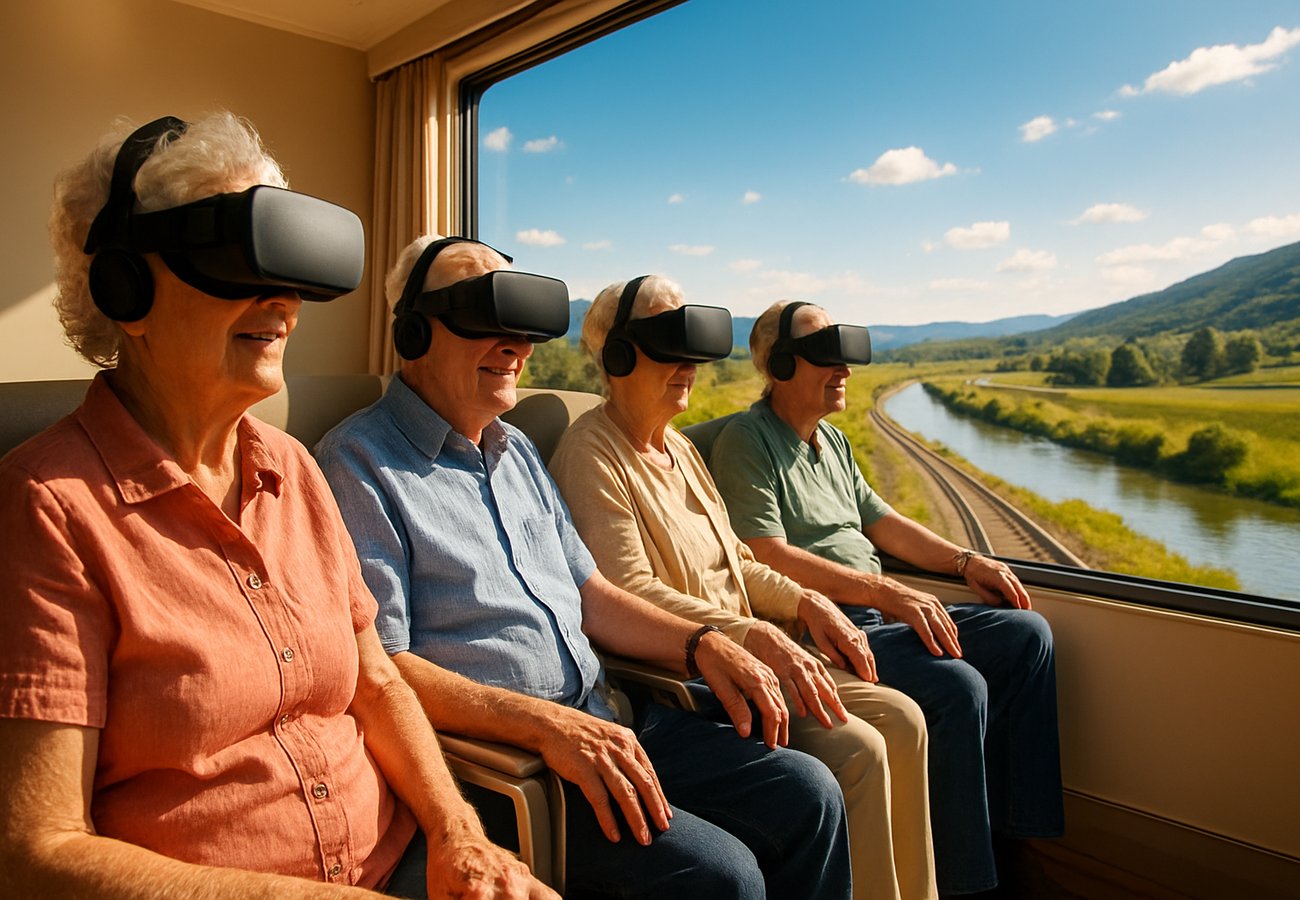
Image generated by AI
United States Joins Canada, United Kingdom, Germany and Australia for Travel Innovation Spotlight as World’s First Virtual Train Lets Elderly Explore 10 Countries Without Leaving Seats in 2026
Combining Sensory Projection, Immersive Storytelling, and Themed Dining, the Virtual Train Experience is Revolutionizing Accessible Travel and Memory Care on a Global Scale
An extraordinary breakthrough in accessible travel and experiential healthcare is rapidly capturing international attention. In 2026, the introduction of the world’s first highly immersive "Virtual Train" has proven that the joy of exploration does not have to be limited by physical mobility. Designed explicitly for elderly individuals and residents of assisted living facilities, this groundbreaking digital environment perfectly recreates the multi-sensory experience of international rail travel, allowing seniors to journey through up to 10 different countries without ever leaving their seats.
Quick Summary
- The Innovation: The world’s first fully immersive Virtual Train, designed to simulate international rail travel for elderly and mobility-restricted populations.
- The Experience: It combines visual projections of high-definition landscapes, realistic sound environments, guided narration, and culturally themed meals to recreate physical travel.
- Global Spotlight: Care providers and tourism innovators in the United States, Canada, the United Kingdom, Germany, and Australia are actively monitoring and exploring this technology.
- The Core Benefit: The simulated travel provides critical cognitive stimulation, combats isolation and dementia, and allows individuals to experience the thrill of exploration despite medical limitations.
How the Virtual Train Brings the World to the Passenger
Rather than relying purely on solitary virtual reality (VR) headsets, the Virtual Train is fundamentally designed as a shared communal experience. Rooms are structurally converted into incredibly realistic train carriages, complete with physical vintage-style seating, detailed cabin aesthetics, and massive high-definition window screens.
As the "train" departs, these digital windows display gorgeous, sweeping 4K footage of rolling landscapes across 10 distinct countries. To fully sell the simulation, the environmental design incorporates the rhythmic auditory clacking of train wheels, gentle physical vibrations, and even curated dining experiences. If the virtual route transitions through the Italian Alps, the passengers are served authentic espresso and biscotti while guided narration explains the passing regional history.
A Global Perspective on Accessible Innovation
The initiative is drawing heavy praise and analytical review from global superpowers prioritizing the intersection of travel technology and healthcare:
- United States Perspective: U.S. travel analysts view the virtual train as a massive leap forward for accessible VR tourism. Healthcare experts in the U.S. are increasingly relying on immersive digital experiences to support emotional well-being within massive senior communities, highlighting how tech can bridge the gap for those who previously loved to travel but no longer can.
- Canada Perspective: Canadian advocates are heavily focused on the quality-of-life improvements. By simulating the grand social adventure of a cross-country train, the technology directly combats the isolation and severe depression that can occasionally plague aging populations in care environments.
- United Kingdom Perspective: In the UK, the focus is deeply clinical. The National Health Service (NHS) and affiliated care homes have routinely tested simulated environments to provide emotional stimulation and drastically reduce anxiety for patients navigating dementia. The virtual train perfectly amplifies these therapies by combining memory triggers and storytelling.
- Germany Perspective: German research into cognitive health strongly supports this model. German scientists view the simulated international journeys not simply as entertainment, but as an actively therapeutic tool designed to foster profound memory engagement and spark neurological connections.
- Australia Perspective: Australian aged-care providers are treating the Virtual Train as a foundational pillar of future "experiential care models," prioritizing daily life enhancement through sensory-rich, multi-layered social interactions that transcend the four walls of a medical facility.
The Future of Hybrid Travel Mechanics
What began as a highly specialized intervention for elderly care is poised to disrupt the mainstream travel industry.
Tourism experts predict that as this immersive technology matures logically, "Hybrid Travel" will become widely commercially available. Mainstream consumers may soon utilize these hyper-realistic virtual environments to meticulously "test-drive" premium global destinations prior to booking physical tickets, or to explore notoriously inaccessible environments—like deep-sea coral reefs or Himalayan bases—without the inherent physical danger or environmental impact.
Ultimately, the 2026 debut of the Virtual Train proves that the core magic of travel—the feeling of communal discovery and the beauty of witnessing a vast world—can be successfully translated through technology, ensuring that exploration remains a lifelong privilege, regardless of physical limitations.
FAQ: The World's First Virtual Train Experience
Q: What is the Virtual Train? A: It is a deeply immersive, multi-sensory physical room designed specifically to simulate the environment of an international rail carriage. It utilizes 4K window projections, soundscapes, and themed dining to recreate the feeling of traveling.
Q: Who is this technology designed for? A: The experience was explicitly created for elderly individuals and individuals with severe mobility or health restrictions who are no longer capable of enduring physical overseas travel.
Q: How many countries can the train visit? A: The current simulated programming allows passengers to experience beautiful, high-definition routes across 10 different international countries.
Q: Is it just for entertainment? A: Absolutely not. International doctors and researchers (notably in the UK and Germany) consider this highly therapeutic. The sensory stimulation actively combats dementia anxiety, triggers memory engagement, and massively reduces feelings of social isolation.
Disclaimer
This article is for informational and educational purposes only. It does not constitute legal, financial, or professional advice. While we strive to provide accurate and up-to-date information, travel policies, regulations, and conditions change rapidly. Always verify information with official sources before making travel decisions. Nomad Lawyer makes no representations about the accuracy, reliability, completeness, or suitability of the information provided. Readers should consult qualified professionals for advice specific to their circumstances. The views expressed in this article are those of the author and do not necessarily reflect the views of Nomad Lawyer.
Raushan Kumar
Founder & Lead Developer
Full-stack developer with 11+ years of experience and a passionate traveller. Raushan built Nomad Lawyer from the ground up with a vision to create the best travel and law experience on the web.
Learn more about our team →