
US Aviation Crisis Escalates: 356 Flight Delays and 18 Cancellations Strand Passengers at Los Angeles, San Francisco, Chicago O'Hare, JFK, Atlanta, and 20+ Major Hubs as Regional Carriers and Airline Networks Face Cascading Operational Pressure
Major disruption across US aviation system on April 23, 2026: 356 delayed flights and 18 cancellations at LAX, SFO, ORD, JFK, ATL, and regional airports. SkyWest, Delta, United, and JetBlue impacted. FAA-monitored congestion affects tourism and business connectivity nationwide.

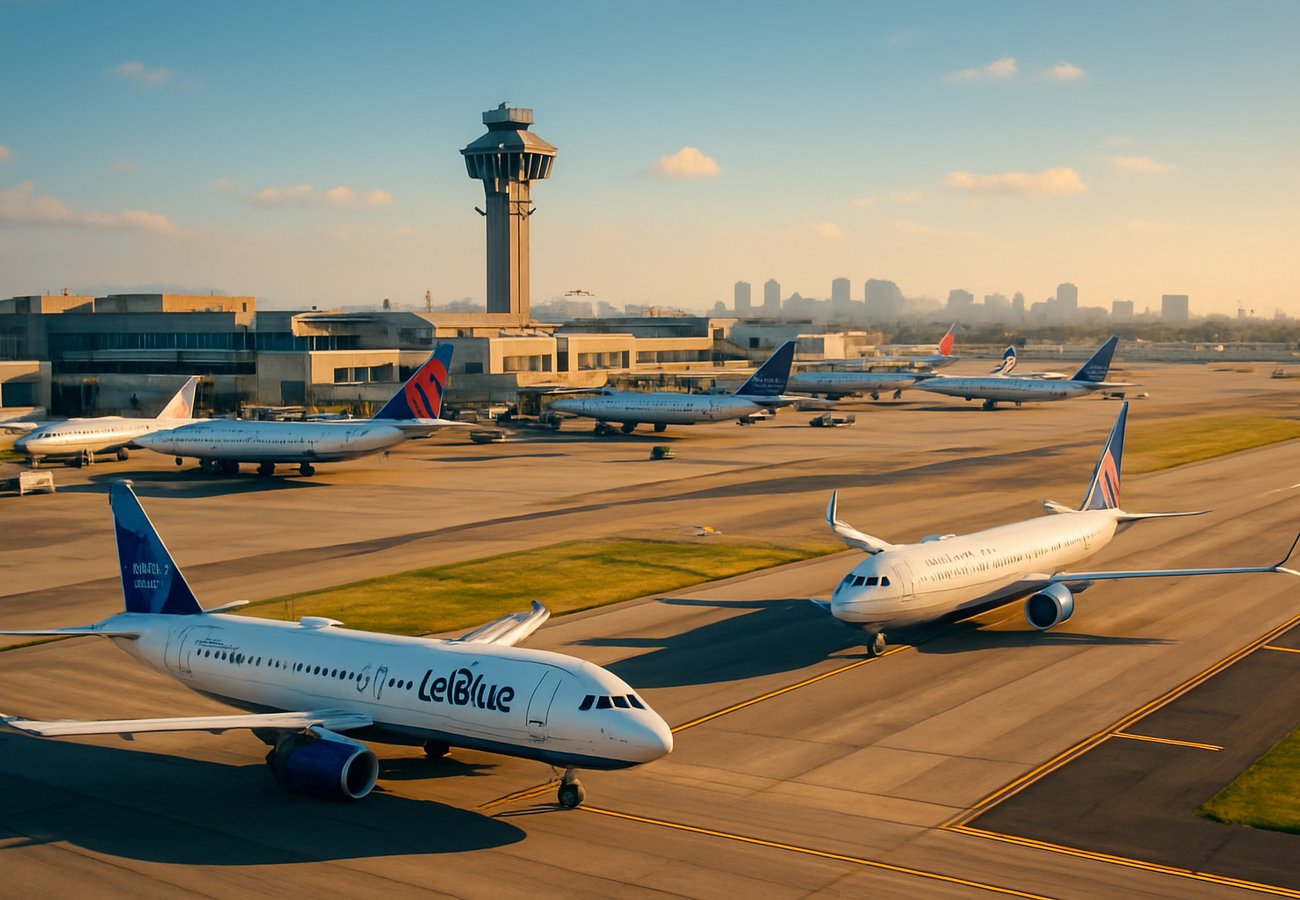
Image generated by AI
Quick Summary
- 356 flight delays and 18 cancellations reported across US aviation system on April 23, 2026
- Major hubs affected: LAX, SFO, ORD, JFK, ATL, DFW, MCO, MIA, and 15+ additional airports
- Regional carrier SkyWest records highest delay impact; Delta, United Airlines, JetBlue significantly affected
- Root causes: Air traffic congestion, operational constraints, staffing limitations, hub bottlenecks
- Tourism and business travel disrupted; cascading network effects amplify nationwide impact
United States Aviation System Under Strain: 356-Flight Delay Crisis and 18 Cancellations Paralyze Major Hubs from Pacific to Atlantic
WASHINGTON — The United States aviation system experienced one of its most significant operational disruptions of 2026 on April 23, with 356 flight delays and 18 cancellations cascading across the nation's busiest airports and regional networks. The widespread disruption, concentrated at major hub airports including Los Angeles International (LAX), San Francisco International (SFO), Chicago O'Hare (ORD), New York JFK, and Hartsfield-Jackson Atlanta International (ATL), created a ripple effect of schedule disruptions affecting business travelers, leisure passengers, and international connectivity.
The scope of disruption—affecting 22 of the nation's top 30 airports—signals systemic vulnerabilities in US aviation capacity and operational resilience. Federal Aviation Administration (FAA) monitoring systems indicate that the disruptions stem from a combination of air traffic congestion, regional carrier bottlenecks, and operational constraints that have accumulated as post-pandemic travel demand continues to exceed infrastructure capacity at peak-demand airports.
The incident represents a critical test of US aviation system robustness and highlights growing pressure on aviation infrastructure as passenger volumes stabilize at historically high levels. Tourism stakeholders, corporate travel managers, and government agencies are closely monitoring the situation as airlines and airport operators work to restore normal operations.
Scope of Disruption: National Network Impact Assessment
Delay Distribution Across US Aviation System
The 356 delayed flights distributed unevenly across 22 major airports, with Chicago O'Hare (ORD) recording the highest delay volume at 37 delays, followed by Hartsfield-Jackson Atlanta (ATL) with 30 delays and Los Angeles International (LAX) with 31 delays. The concentration of delays at these three mega-hubs—which collectively handle over 280 million passengers annually—demonstrates how bottlenecks at high-traffic facilities quickly cascade through interconnected airline networks.
Delay concentration by region:
- West Coast: LAX (31), SFO (19), SAN (9), OAK (4), SJC (6), SEA (18), LAS (10) = 97 delays
- Northeast/Mid-Atlantic: JFK (23), EWR (13), BOS (14), PHL (9), IAD (8), ORD (37) = 104 delays
- Southeast: ATL (30), MCO (19), MIA (12), FLL (8), CLT (4) = 73 delays
- Central/Mountain: DFW (15), IAH (11), DTW (6), MSP (6), PHX (8), ANC (16) = 62 delays
- Remaining: Various regional airports = 20 delays
This geographic distribution reveals that no region of the continental US escaped disruption, indicating a nationwide rather than localized operational challenge.
Cancellation Pattern Analysis
Eighteen cancellations, while substantially lower than delay volume, still represent significant passenger impact. Unlike delays (which typically last 1-4 hours), cancellations force passenger rebooking, frequently requiring overnight accommodations and extending journey times by 24+ hours.
Cancellation distribution:
| Airport | Code | Cancellations | Total Disruptions | Disruption Rate |
|---|---|---|---|---|
| Detroit Metro Wayne County | DTW | 5 | 11 | 45% |
| JFK | JFK | 2 | 25 | 8% |
| DFW | DFW | 2 | 17 | 12% |
| LAX | LAX | 1 | 32 | 3% |
| MCO | MCO | 1 | 20 | 5% |
| MIA | MIA | 1 | 13 | 8% |
| IAD | IAD | 1 | 9 | 11% |
| SEA | SEA | 1 | 19 | 5% |
| ATL | ATL | 1 | 31 | 3% |
| PHX | PHX | 1 | 9 | 11% |
Detroit Metropolitan Wayne County Airport (DTW) emerged as the most disrupted facility by cancellation rate, with 5 cancellations among 11 total disruptions (45% cancellation rate). This suggests operational constraints specific to Detroit operations—possibly aircraft maintenance issues, crew unavailability, or maintenance hangar capacity limitations.
Root Cause Analysis: Operational Bottlenecks and System Stress
Regional Carrier Cascading: SkyWest as Network Linchpin
SkyWest Airlines, which operates as feeder service for larger carriers (Delta, United, American), recorded the highest delay impact across its network. As a regional carrier flying regional turboprop and smaller narrow-body aircraft, SkyWest connects smaller cities (Boise, Des Moines, Reno, Sacramento) to major hub airports where passengers connect to long-haul flights.
When regional flights arrive late, they create cascading effects:
- Hub congestion: Connecting passengers miss onward flights, requiring rebooking and gate occupancy extension
- Aircraft utilization: Aircraft scheduled for multiple daily rotations encounter time compression, compounding delays
- Crew scheduling: Flight crews approaching duty time limits must be replaced, requiring deadheading (non-revenue crew positioning)
- Maintenance pressure: Delayed aircraft miss scheduled maintenance windows, creating maintenance backlog
SkyWest's dominance across ORD, OAK, MSP, and DTW—accounting for significant delay volume at each airport—indicates that regional carrier operational challenges are primary drivers of the nationwide disruption.
Hub-Based Bottlenecks at Tier-1 Airports
Delta Air Lines, with major hub operations at Hartsfield-Jackson Atlanta (ATL), experienced heavy hub-based delays (30 delays). Atlanta, as the world's busiest airport by passenger volume (110+ million annually), operates with minimal scheduling slack. When any component of operations—air traffic control, ground handling, aircraft maintenance—experiences disruption, cascading effects are immediate and severe.
Similarly, United Airlines' high-density operations at Chicago O'Hare (ORD) and Newark Liberty (EWR) created significant delay propagation. Chicago O'Hare's constrained runway capacity (2 parallel runways + 1 crosswind runway) limits flexibility during high-demand periods, and when departure queues build, arrival slots are consumed, creating feedback loops of delay.
Air Traffic Control and Staffing Constraints
FAA air traffic control facilities have reported sustained staffing pressures, particularly at high-traffic facilities (New York TRACON, Chicago Center, Los Angeles Approach). When controller staffing falls below operational targets, maximum acceptable delay thresholds are reduced, causing proactive ground delays to prevent airspace saturation.
Some delays on April 23 were "ground stops" or "timed restrictions"—deliberate delays imposed before aircraft depart to prevent arrival congestion. While this prevents worse delays at destination airports, it still counts toward published delay statistics and affects passengers.
Weather and Operational Timing
While no major weather systems impacted the continental US on April 23, scattered convective activity in Florida and southeast Georgia may have created capacity reductions at MCO and ATL. Additionally, military training activity in airspace near Nellis (near LAS) and other military installations can reduce available civilian airspace capacity during peak periods.
Airline-Specific Impact Analysis
Domestic Carriers
SkyWest Airlines: Highest delay count due to network-wide feeder operations. Regional turboprops operate on tighter schedules with less scheduling slack than large commercial aircraft.
Delta Air Lines: High delay level reflects massive hub operations at Atlanta (30 delays) and secondary pressures at other hubs. Delta's interconnected network amplifies individual delays.
United Airlines: Significant delays at Newark (EWR), San Francisco (SFO), and Houston (IAH) reflect hub congestion and regional operations stress.
JetBlue Airways: Moderate-high delays concentrated at Boston Logan (BOS, 14 delays), Orlando (MCO, 19 delays), and Fort Lauderdale (FLL, 8 delays), indicating East Coast and leisure-route impact.
Southwest Airlines: Moderate delays spread across leisure-destination airports (San Diego, Las Vegas, Orlando), suggesting leisure-travel demand concentration.
International Carriers: Operational Stability Contrast
In stark contrast to domestic carriers, major international operators—Lufthansa, British Airways, Air France, Emirates, Qatar Airways, Turkish Airlines, and Asian carriers (Cathay Pacific, Korean Air, Singapore Airlines)—maintained substantially better operational performance with minimal or zero cancellations and only minor delays.
This disparity reflects:
- Schedule buffers: International long-haul flights include 30-60 minute schedule padding to absorb minor disruptions
- Fewer connections: Direct long-haul routing avoids hub bottlenecks that cascade through connecting networks
- Operational discipline: International carriers implement strict schedule adherence protocols to maintain international flight time windows
- Network resilience: International carriers operate more geographically dispersed networks with less hub concentration
The stability of international operations despite domestic chaos suggests that the crisis is fundamentally a domestic network problem, not a systemic US aviation infrastructure problem.
Tourism and Economic Impact
Tourism Sector Disruption
The US travel and tourism industry, valued at approximately $2.3 trillion in annual economic activity, is particularly vulnerable to aviation disruptions. April 23 disruptions directly impacted:
- Leisure travelers: Families, retirees, international tourists on pre-booked itineraries missing hotel check-ins, tour operator schedules, and cultural/recreational reservations
- Business travel: Corporate meetings, trade conferences, business development trips delayed or cancelled
- International tourism: Inbound international travelers experiencing poor first impressions of US aviation reliability; potential deterrent to future bookings
Each delayed passenger typically represents $50-200 in economic losses (hotel rebooking costs, meal expenses, activity cancellations), multiplying across 356 delays to suggest $17.8-71.2 million in immediate tourism-sector economic loss from April 23 disruptions alone.
Business Continuity Impact
Corporate travel managers report increasing pressure to adopt alternative transportation (automobile, rail) or virtual meeting technology when mission-critical meetings face aviation uncertainty. Over time, such substitution effects reduce aviation demand but also represent economic leakage from the travel and tourism ecosystem.
 US aviation system operations centers coordinate response to nationwide flight delays and cancellations
Passenger Experience and Rights
Passenger Compensation Framework
Under US Department of Transportation regulations, passengers on delayed flights are entitled to:
3-hour delays (domestic):
- Meals and refreshments (if available)
- Communication access (phone, email)
- Hotel accommodations (if overnight delay)
- Ground transportation
Cancelled flights (airline-caused):
- Full refund or rebooking on next available flight
- Same compensation as above for delays caused by airline operational failures
FAA/weather delays (extraordinary circumstances):
- Limited compensation (meals, hotels, communication)
- No monetary compensation available
The distinction between airline-caused and weather-related delays is critical but often disputed, with passengers and airlines frequently disagreeing on causation classification.
Passenger Communication Challenges
Major airlines activated customer service hotlines and deployed additional ground staff to affected airports. However, the scale of disruption (356 simultaneous delays) exceeded customer service capacity at peak periods, creating extended phone wait times (30-90+ minutes) and limited real-time rebooking assistance.
Real-time flight information systems (FlightAware, airline apps) provided data transparency, but interpretation challenges created confusion regarding whether delays were temporary or permanent cancellations, and which compensation categories applied.
System Vulnerability Assessment: What April 23 Reveals
Capacity Ceiling at Mega-Hubs
The concentrated delay pattern at LAX, ORD, and ATL—coupled with their disproportionate impact on nationwide operations—indicates that these three airports are operating at or near capacity ceilings. With limited available scheduling slack, minor disruptions quickly cascade into major systemwide delays.
Current terminal capacity, runway capacity, and air traffic control facility staffing at these airports cannot accommodate simultaneous disruption plus normal operational variance. Expansion solutions (new terminals, additional runways, controller hiring) require years to implement and billions in capital investment.
Regional Carrier Dependency and Vulnerability
The FAA's "Essential Air Service" program and regional partnerships create a system where small carriers (SkyWest, Republic, Endeavor) operate the majority of connecting flights at major hubs. When any single regional carrier experiences disruption, cascading effects affect entire hub networks.
Consolidation of regional operations around fewer, larger carriers could potentially increase resilience, but would sacrifice route coverage to smaller communities.
Network Interconnection vs. Resilience Trade-off
The highly interconnected US aviation network maximizes efficiency during normal operations but creates vulnerability to cascade failures. A single regional flight delay at a spoke airport can disrupt 10+ connecting flights at the hub, affecting hundreds of passengers.
More dispersed network architectures (with multiple redundant routing options) would reduce cascade severity but increase per-passenger costs through longer routing and reduced frequency.
Outlook: Infrastructure Modernization and Operational Adaptation
Immediate Actions (24-48 hours)
Airlines are implementing:
- Proactive schedule reductions to prevent cascade delays
- Crew repositioning and contingency reserve deployment
- Customer communication escalation and rebooking flexibility
- Maintenance prioritization to maximize available aircraft
FAA is coordinating:
- Air traffic control optimization to maximize throughput at congested facilities
- Ground delay programs to manage flow to capacity-constrained airports
- Inter-facility coordination to distribute traffic load
Medium-term (Days-Weeks)
Expect increased schedule redundancy at mega-hubs—airlines building buffer time into schedules to absorb minor disruptions before cascading into major delays.
Long-term Structural Solutions
NextGen Air Traffic Control: Modernized system management could increase effective capacity 15-20% without new infrastructure Airport Terminal Expansion: LAX, ORD, ATL expansion projects ongoing but requiring years to complete Controller Hiring: FAA recruiting academy graduates and retirees to fill staffing gaps Airline Network Optimization: Carriers evaluating hub consolidation and frequency reallocation
Frequently Asked Questions
Q: What caused the April 23, 2026 disruption? A: Root causes included regional carrier cascading delays (SkyWest), hub bottlenecks (ATL, ORD, LAX, EWR), air traffic control staffing constraints, and accumulated maintenance delays. No single failure but systemic stress.
Q: Which airports were most affected? A: Chicago O'Hare (37 delays), Hartsfield-Jackson Atlanta (30 delays), and Los Angeles International (31 delays) recorded highest delay volumes. Detroit (5 cancellations) experienced highest cancellation rate.
Q: What compensation am I entitled to for delays/cancellations? A: Airline-caused delays (3+ hours domestic) entitle passengers to meals, hotels, communication, and ground transport. Cancellations provide full refund or rebooking. Weather/FAA delays have limited compensation.
Q: Will disruptions continue? A: Risk remains elevated during peak travel periods until airports/airlines implement structural capacity improvements (NextGen ATC, terminal expansion, controller hiring).
Q: How can I minimize disruption risk? A: Book early morning flights, avoid peak travel periods, choose direct routing when possible, maintain schedule buffers for connections (minimum 90 minutes domestic), and monitor real-time flight status.
Q: How does this compare to other recent disruptions? A: April 23 disruption (356 delays) ranks among top 5 single-day disruptions in 2026, but remains below catastrophic disruption thresholds (1,000+ delays system-wide).
Disclaimer
This article is for informational and educational purposes only. It does not constitute legal, financial, or professional advice. While we strive to provide accurate and up-to-date information, travel policies, regulations, and conditions change rapidly. Always verify information with official sources before making travel decisions. Nomad Lawyer makes no representations about the accuracy, reliability, completeness, or suitability of the information provided. Readers should consult qualified professionals for advice specific to their circumstances. The views expressed in this article are those of the author and do not necessarily reflect the views of Nomad Lawyer.
Kunal K Choudhary
Co-Founder & Contributor
A passionate traveller and tech enthusiast. Kunal contributes to the vision and growth of Nomad Lawyer, bringing fresh perspectives and driving the community forward.
Learn more about our team →